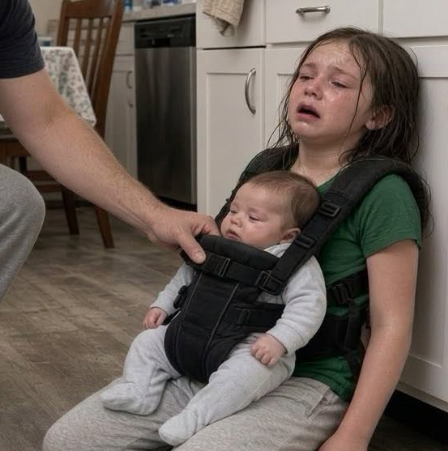
My 9-year-old daughter called from home and whispered: “Dad, I can’t hold the baby anymore.” I raced back and found her exhausted on the kitchen floor with my 8-month-old son strapped to her chest—but the second phone hidden in a bedroom drawer revealed why she had really been left there. I was standing beside a fenced dog-training field outside Edmond, Oklahoma, when my phone rang. A young German Shepherd was clearing a ramp across the field, dirt kicking from its paws under the late-afternoon sun. After nearly 15 years training dogs, I was used to noise, pressure, and making fast decisions. Then I heard Tessa’s voice. “Dad?”
I turned away from the field immediately. Something about that one word was wrong. “Tessa? What’s going on?” For a few seconds, all I heard was her uneven breathing. Then a weak baby cry came through behind her. Miles. My 8-month-old son. “Tessa, talk to me. Where are you?” “Kitchen.” Her voice cracked. “I can’t hold him anymore.” “You’re doing okay.
Sit on the floor if you’re not already there. Don’t try to carry him anywhere. I’m coming home.” She went quiet again. Then she whispered, “She told me she’d only be gone for 17 minutes.” I stopped walking. Their mother was supposed to be home with them. “When did she leave?” Tessa hesitated long enough for my stomach to tighten. “Before lunch.” I don’t remember much about the drive back except gripping the wheel and keeping Tessa on speaker whenever the signal held. I told her to stay seated, keep Miles supported, and tell me if either of them felt worse. When I reached the house, I pushed through the door calling their names. Tessa was exactly where she’d said she was. She sat against the kitchen cabinets with her legs stretched awkwardly in front of her. Miles was secured to her chest in the baby carrier, squirming and crying, while Tessa’s hands trembled from exhaustion. She looked up at me and tried to apologize. That hurt worse than anything. “You don’t apologize,” I said as I knelt beside her. “You called me. You did exactly what you were supposed to do.” I unfastened Miles, lifted him against my shoulder, and helped Tessa sit more comfortably. She drank some water while I checked that both kids were alert and settling down. Only then did I ask the question I had been holding back. “Why didn’t you call me sooner?” Tessa stared at the floor. “Mom said not to. She said you’d get mad because she just needed to do something really quick.” “Did she say where she was going?” Tessa shook her head. Then she looked toward the hallway. “But there’s another phone.” I thought I’d misunderstood her. “Another phone?” She nodded. “It keeps buzzing sometimes when you’re not home. She told me I’m never supposed to touch it.” Tessa led me toward the bedroom while I carried Miles. She stopped beside the dresser and pointed at the top drawer. I opened it. Under a folded T-shirt was a phone I had never seen before. The screen lit up before I even touched it. A message preview appeared from a contact saved only as R. “You said Grant wouldn’t find out. Leave the kids with Tessa and come now.” Below it was an earlier notification stamped 1:17 p.m. Whatever had happened that afternoon hadn’t been an emergency. It hadn’t been an unexpected delay. Someone had expected her to leave our 9-year-old daughter alone with an 8-month-old baby—and had expected me never to know. Tessa reached into the drawer, picked up the buzzing phone with both hands, and placed it in mine. ────────────────────── Type PHONE and I’ll continue. (I know you’re curious about the next part, so please be patient and read on in the comments below.)