My children forgot my sixty-ninth birthday.
Not overlooked it. Not mixed up the date. Not “meant to call later” and got caught in traffic, work, or some emergency life throws at people when they are trying their best.
They forgot me.
I learned the difference that day while sitting alone in my small kitchen with a chocolate cake sweating under a plastic cover and four clean plates laid out on the table, as if love could be summoned by preparation.
I had baked that cake myself because Richard loved chocolate when he was little. He used to lick the spoon and grin at me with frosting on his chin, and I would pretend to scold him while secretly thanking God that my boy still had something to smile about after his father died.
I bought apple juice because Jessica used to call it “fancy juice” when she was six. I put a bowl of mixed nuts on the table because she always picked out the cashews first. I set out paper napkins with tiny yellow flowers on them because they were on sale, and because I wanted the table to look cheerful.
Then I fixed my hair.
That was the part that hurt the most later.
I stood in front of the bathroom mirror, combing my thin silver hair, dabbing a little powder on my cheeks, and fastening the old gold necklace my husband, William, had given me when we were still young enough to believe there would always be more time.
I looked at myself and whispered, “You look nice, Eleanor.”
Then I waited.
At ten in the morning, I told myself they were probably getting ready.
At noon, I told myself they were busy people with busy lives.
Advertisements
At two, I told myself maybe traffic was bad.
By four, I had checked my phone so many times that my hand cramped. I even called my phone from the landline to make sure it still rang. It did. The problem was not the phone.
By sunset, the frosting on the cake had dried at the edges, the ice in the pitcher had melted, and the chair across from me remained empty.
That night, I slid down the kitchen cabinets and sat on the floor in my birthday dress, crying with my knees pulled to my chest like a child. I had not cried that way since the police officer came to my door more than forty years earlier and told me William was gone.
My name is Eleanor Whitaker. I am seventy-one years old now, but for most of my life, I did not think of myself as old. I thought of myself as a mother. That was my name, my job, my purpose, and, for a long time, my only reason to keep going.
I was twenty-one when Richard was born. I was still young, still soft in the face, still foolish enough to believe that love and hard work could protect a family from anything. William and I lived in a little rented house with yellow curtains, a squeaky screen door, and more dreams than money. Two years later, Jessica arrived, small and pink and loud, and William said our house was finally full.
Then one rainy November evening, everything changed.
William was driving home from work when a semi-truck jackknifed on the highway. They told me it happened fast. People say that when they do not know what else to say. As if fast makes death kinder. As if a sudden loss does not leave behind years of slow pain.
Richard was eight. Jessica was six.
They were too young to understand insurance forms, funeral costs, unpaid rent, grocery lists, or the terrible silence that fills a bedroom after a husband’s side of the bed goes cold forever.
So I understood for all of us.
I worked because grief does not pay electric bills. I worked because children cannot eat sorrow. In the mornings, I cleaned office buildings before sunrise, pushing a cart down long hallways while executives slept in warm beds. In the afternoons, I sewed at a garment factory until my shoulders burned and my fingers went numb. At night, after Richard and Jessica were asleep, I baked bread, pies, muffins, and cookies to sell at the farmers market on weekends.
I was so tired some nights that I would stand in the kitchen and forget why I had opened a cabinet. I burned my wrists on baking pans. I cut my fingers on sewing needles. Cleaning chemicals cracked my hands until they bled in winter.
But my children had shoes.
They had coats.
They had lunch money.
They had birthday presents wrapped in paper from the dollar store and Christmas stockings filled with candy I bought one bag at a time over several months so they would not notice how little we had.
I missed meals so they could eat seconds. I sold my wedding china when Richard needed money for college applications. I turned down good men who looked at me with kindness because I did not want my children to feel replaced. I told myself there would be time for me later.
Later, I thought, they will remember.
Later, they will understand.
Later, they will say, “Mom, we know what you gave up.”
But later came, and understanding did not come with it.
Richard grew into a polished man with cold eyes. He was smart, ambitious, and always hungry for something bigger than the room he was standing in. I helped him through business school, paid what I could, and borrowed what I should not have borrowed. When he graduated, I sat in the crowd wearing a blue dress with a mended hem, clapping so hard my palms stung.
He barely looked at me afterward.
By the time he married Ashley, a woman from a wealthy family who spoke in a voice smooth enough to hide every insult, Richard had learned how to be embarrassed by me without saying it plainly.
At their wedding, I was seated near the kitchen doors.
Not near the front. Not with family. Not where photographs were being taken. I sat beside a cousin of Ashley’s mother and a retired neighbor nobody seemed to know. Every few minutes, the kitchen doors swung open behind me, blowing hot air against my neck.
I looked across the room and saw Richard at the head table, laughing with his bride. For one second, his eyes met mine.
He looked away.
Jessica’s rejection was quieter, but it cut deeper.
She had been my little shadow once. She used to crawl into bed with me during thunderstorms and ask me to braid her hair in the morning. I stitched every school costume she ever wore. I made her prom dress by hand because we could not afford one from the mall, and she cried when she saw herself in the mirror.
But somewhere between college, fashion magazines, and expensive friends, Jessica began to see me as something old and inconvenient.
One evening she invited me to a work event. I was so proud I could hardly breathe. I wore my best olive-green dress from a thrift shop, the one I had saved for church and weddings. When I arrived, Jessica kissed the air near my cheek, looked me up and down, and whispered, “Mom, please don’t talk too much tonight. These are important people.”
Important people.
I stayed quiet all night.
I smiled when introduced. I nodded when others spoke. I held a glass of water like it was champagne and tried not to look at my hands because they told the truth about me.
When I got home, I hung that olive-green dress in the back of my closet and never wore it again.
Years passed. Richard bought a mansion in the suburbs with white columns, a pool, and a lawn so perfect it looked combed. Jessica moved into a downtown penthouse with cream furniture, glass tables, and a view of the skyline. I stayed in the little two-bedroom house where I had raised them, with peeling paint on the back steps, a stubborn rosebush by the porch, and a kitchen full of ghosts.
I did not envy their money.
I envied the people they had time for.
Friends. Clients. Co-workers. Neighbors. Anyone but me.
My children sent Christmas texts with no warmth. They came by only when it was convenient or when they needed something. Richard borrowed five hundred dollars once and never paid it back. Jessica asked for a thousand dollars for a “medical emergency,” then posted pictures from Cancun that same week.
I noticed. Mothers notice. We just do not always speak.
After my sixty-ninth birthday, something inside me changed. I did not stop loving them. I wish love worked that way. I wish it could be folded up and packed away like old baby clothes.
But I stopped begging for crumbs.
I stopped asking when they were free. I stopped inviting them over and pretending I believed their excuses. I stopped setting extra plates.
For two years, my life became quiet. Painfully quiet, but honest.
Then the rumors began.
At first, I heard it from a cousin I had not spoken to since Richard’s wedding. She called one afternoon and asked, in a voice too sweet to trust, how I was feeling.
“Fine,” I said.
“You taking care of yourself?”
“I do my best.”
“Well,” she said, dragging the word out, “you know, with everything going on, people worry.”
“What everything?”
There was a pause. “Oh, Eleanor. Don’t act like you don’t know.”
That was my first hint.
Over the next few weeks, relatives who had forgotten I was alive suddenly remembered my phone number. A nephew asked if I needed help around the house. A niece wanted to take me to lunch. Someone mentioned, too casually, that people were saying William had left money behind.
A lot of money.
Ten million dollars, they whispered.
I laughed when I heard it because it was absurd. William had been dead over forty years. If there had been millions waiting for me, surely someone would have told the widow scrubbing office toilets at dawn. Surely I would not have patched my children’s coats, skipped meals, and counted pennies at the grocery store while a fortune sat hidden somewhere in my name.
But gossip has a way of waking people who slept through your pain.
One morning, my phone buzzed.
It was Richard.
“Mom, family lunch tomorrow at noon. Important conversation. Don’t miss it.”
I stared at those words for a long time.
Not, “How are you?”
Not, “I miss you.”
Not, “I’m sorry we haven’t been around.”
Just an order.
Family lunch. Important conversation. Don’t miss it.
I knew then what had brought my son back to my door. Not love. Not guilt. Not the memory of his mother crying alone with a birthday cake.
Money.
That night, I could not sleep. I lay in bed staring at the ceiling, where a thin crack ran above me like a line drawn through my life. Part of me wanted to go to Richard’s mansion and shout until every chandelier shook. Part of me wanted to stay home and protect what was left of my dignity.
And one small, foolish part of me still hoped.
Maybe, I thought, maybe they finally realized.
Maybe they want to make things right.
A mother’s heart can be a humiliating thing.
At nine the next morning, my doorbell rang.
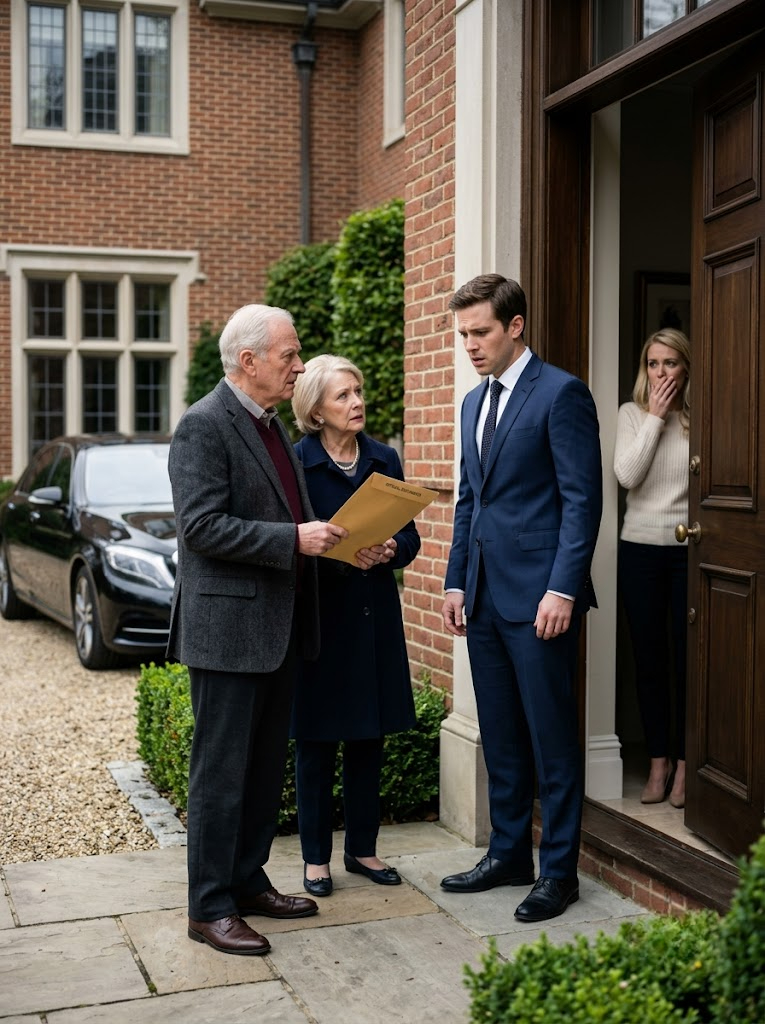
When I opened it, an older man stood on my porch in a gray suit so neatly pressed that I suddenly became aware of the peeling paint behind him. He was tall, white-haired, and carried a leather briefcase in one hand. His face was lined, but his eyes were clear and kind.
“Mrs. Eleanor Whitaker?” he asked.
“Yes.”
“My name is Arthur Bennett. I was your husband’s attorney and one of his closest friends.”
My breath caught.
William had never spoken much about lawyers. We had not been the kind of people who had “attorneys.” We were the kind of people who paid bills in envelopes and worried when the refrigerator made a strange sound.
Arthur removed his hat. “I am sorry to arrive without warning, but I need to speak with you about something that has waited far too long.”
I let him in.
My hands trembled as I poured coffee. Arthur sat at my kitchen table, the same table where my birthday cake had sat untouched two years earlier, and opened his briefcase. From it, he removed a thick manila folder, worn at the corners and sealed with careful labels.
What he told me over the next two hours changed the shape of my entire life.
William, it turned out, had made investments before he died. Not flashy ones. Not reckless ones. Small, careful investments through a man he trusted, managed quietly and legally, intended for my protection. The original amount had been significant, but over forty years, with growth, reinvestment, and careful stewardship, it had become far more.
“Not ten million,” Arthur said gently. “Fifteen.”
I could not speak.
The number meant nothing at first. It was too large to fit inside my life. Fifteen million dollars did not belong in a kitchen with chipped mugs and a stove that needed a new knob. Fifteen million dollars did not make sense to a woman who had once watered down soup so there would be enough for two growing children.
“There is more,” Arthur said.
He slid a document toward me.
William had written a will with a condition. If, for one full year, Richard and Jessica showed genuine care for me without knowing about the inheritance, they would be entitled to a share after my passing. Genuine care meant calls, visits, help, attention, and emotional concern. Not perfection. Just love shown in action.
If they failed, the money remained entirely under my control.
Arthur’s voice softened. “The test year ended six months ago.”
I already knew the answer, but I asked anyway.
“And?”
His eyes filled with sadness. “They failed, Eleanor.”
The words did not surprise me. Still, they hurt.
Arthur showed me records. Notes. Dates. Phone logs. Visits so brief they looked like deliveries. Long stretches of silence. My sixty-ninth birthday, recorded as the beginning of the test year because William had once told Arthur, “If my children ever forget their mother’s birthday, that will tell you something.”
Then Arthur took out a small metal box.
Inside was a USB drive.
“William recorded messages,” he said. “For you. And for them, if necessary.”
I watched one on Arthur’s small laptop at my kitchen table. There was my husband, young and alive, sitting in front of an old camera. His hair was dark. His hands were folded. His eyes looked straight into mine across more than forty years.
“Eleanor,” he said, “if you are watching this, then I could not stay as long as I promised. I am sorry, my love.”
I covered my mouth, but the sob came anyway.
He told me he loved me. He told me I was stronger than I knew. He told me he had worried, even then, that Richard and Jessica might grow into people who took from me without seeing me. He said he hoped he was wrong. He said nothing would make him happier than being wrong.
“But if I was right,” William said, his voice steady, “then do not let guilt steal what love tried to protect.”
By the time the video ended, I was no longer the same woman who had opened the door that morning.
I wiped my face, looked at Arthur, and said, “I have lunch at my son’s house at noon.”
“I know,” he said.
“I’m going.”
Arthur closed the folder. “Then I am going with you.”
At eleven-thirty, I put on my beige dress, the good one I saved for funerals, church services, and rare occasions when I wanted to look like I still belonged somewhere. I brushed my hair carefully. I fastened William’s necklace around my throat. For the first time in years, I looked in the mirror and did not see a forgotten woman.
I saw a witness.
Arthur drove me to Richard’s mansion in a black car that moved so quietly it seemed to glide. As we passed through the electric gate, I saw trimmed trees, stone planters, shining windows, and three luxury cars parked in the circular driveway.
“My son lives like this,” I whispered.
Arthur glanced at me. “And still came to you for five hundred dollars.”
I almost laughed. Almost.
Richard opened the door wearing an expensive suit and a smile that stopped the moment he saw Arthur beside me.
“Mom,” he said. “Glad you made it.”
His eyes moved to Arthur. “Who’s this?”
“This is Arthur Bennett,” I said. “Your father’s lawyer.”
Richard’s face changed for half a second. A flicker of fear. Then he recovered and stepped aside.
“Of course. Come in.”
The house looked like a place built to impress strangers. Marble floors. Cream furniture. A chandelier glittering above us. The kind of room where no one relaxed because everything looked too expensive to touch.
Ashley sat on the sofa, perfectly dressed, her red nails curled around a wineglass even though it was noon. She did not stand.
“Eleanor,” she said. “We thought you were coming alone.”
“You thought wrong,” I replied.
Her eyes narrowed.
Jessica appeared from the hallway in an ivory dress and heels that clicked against the floor. She kissed my cheek without warmth.
“Mom,” she said. “You look good.”
There it was again. That polite little insult disguised as a compliment.
We sat at the dining table. Lunch had been arranged beautifully—salads, roasted vegetables, fish, wine, and crystal glasses. Every detail said wealth. Every face said strategy.
Richard cleared his throat.
“Well, Mom, you must be wondering why we asked you here.”
“I have an idea,” I said.
Ashley smiled as if she were speaking to a child. “Eleanor, we’ve been very concerned about you lately.”
“Have you?”
“Yes,” Jessica said quickly. “About your health. About you living alone in that little house.”
“That little house raised you,” I said.
Jessica looked down.
Richard leaned forward, fingers clasped. “Mom, certain information has come to our attention. Rumors, really. About Dad. About money he may have left behind.”
There it was. No warm-up. No apology. No memory. Straight to the money.
“What kind of money?” I asked.
Ashley’s smile tightened. “Let’s not play games. People are saying there may be ten million dollars.”
Arthur spoke for the first time. “Interesting. Who told you that amount?”
The table went quiet.
Richard shifted in his chair. “It’s just what we heard.”
Ashley leaned forward. “The point is, Eleanor, if there is money, you need help. At your age, managing a fortune would be overwhelming.”
“At my age,” I repeated.
Jessica reached for my hand. I let her take it for one second, then withdrew.
“Mom, we only want to protect you,” she said. “Richard has business experience. I know people in finance. We could manage it together as a family.”
“As a family,” I said. “That’s a word you all suddenly remember.”
Richard sighed, irritated already. “Mom, don’t make this emotional.”
I looked at him for a long moment. “You asked your mother to lunch after two years of silence because you heard there might be money. How could it be anything but emotional?”
Ashley set down her glass too hard. “We’re trying to be practical. You’ve never handled serious money. You lived modestly your whole life.”
“I lived carefully,” I said. “There is a difference.”
Richard’s voice hardened. “Mom, let’s be realistic. If you try to manage something this large alone, people will take advantage of you.”
Arthur opened his folder. “Mrs. Whitaker raised two children alone, worked three jobs, kept a household afloat without debt, and survived widowhood with no help from the people at this table. I would be careful about assuming she lacks financial discipline.”
Richard glared at him. “And what exactly is your interest in all this?”
“I am the executor of your father’s will.”
Jessica froze. Ashley’s mouth tightened. Richard went pale enough that I saw the boy he used to be for one brief second.
Arthur placed copies of documents on the table. “Your father was not the simple man you imagined. He made investments. They grew. He also placed conditions on the inheritance.”
“What conditions?” Richard asked.
Arthur looked at both my children. “A test of love.”
Ashley laughed. “That’s ridiculous.”
“No,” Arthur said. “It was legal, specific, and documented. For one full year, without knowing about the money, you were expected to show genuine care for your mother. Calls. Visits. Concern. Not perfection. Basic decency.”
The silence in that dining room was the loudest sound I had ever heard.
Arthur continued. “The trial year began on your mother’s sixty-ninth birthday.”
Jessica’s eyes moved to me. She remembered. Or maybe she remembered that she had forgotten.
“During that year,” Arthur said, “Richard visited three times. Two visits lasted under twenty minutes. Jessica visited twice. One visit was to borrow money. Neither of you called consistently. Neither of you provided meaningful support. Neither of you noticed she spent her birthday alone.”
Richard slammed his palm on the table. “This is manipulation.”
“No,” I said quietly. “It is a mirror.”
Jessica’s eyes filled with tears. “Mom, we made mistakes.”
“Yes.”
“But you can’t punish us forever.”
“I am not punishing you,” I said. “Your father set the terms. You failed them.”
Ashley leaned forward, all sweetness gone. “We’ll contest it.”
Arthur smiled then, but there was no warmth in it. “You can try. But before you do, I suggest you consider what else we know.”
Richard’s face tightened.
Arthur removed another folder from his briefcase. “Richard, four months ago you visited a notary named Stephen Miller and paid him in cash to prepare a false document suggesting your father intended to leave assets directly to you.”
Richard’s lips parted, but no words came out.
Ashley stood. “That is a lie.”
Arthur laid photographs on the table. Richard entering an office. Richard leaving. Dates printed clearly.
“The notary is already under investigation,” Arthur said. “He is prepared to testify.”
Jessica whispered, “Richard?”
Arthur turned to her. “And Jessica, you hired a private investigator to search your mother’s financial records without her consent. We have the invoice, the emails, and the report.”
Jessica began crying for real then. Not elegant tears. Frightened ones.
“I only wanted to make sure she was safe,” she said.
“No,” I said. “You wanted to know what I was worth.”
No one answered.
Arthur was not finished. “There was also an attempt to access one of William Whitaker’s inactive accounts using forged documents bearing Eleanor’s signature.”
My hands went cold.
I looked at Richard. “You forged my name?”
He stared at the table.
“Richard,” I said, my voice breaking despite everything, “you tried to steal from me?”
“I thought the account was abandoned,” he muttered.
“I am not abandoned property.”
That sentence came out of me like thunder.
Everyone went still.
I stood then. My legs shook, but my voice did not.
“I was your mother when you had nothing. I was your mother when you needed shoes, food, rides, homework help, clean clothes, college money, wedding support, sympathy, and forgiveness. I was your mother when you were sick, scared, selfish, and ungrateful. I was your mother when you forgot me. But I am not an old purse you found in a drawer.”
Jessica covered her face.
Richard whispered, “Mom, please.”
“No,” I said. “Do not call me that only because you are afraid.”
Arthur took out one final document. “Eleanor has revised her estate plan. The full amount remains under her control during her lifetime. Afterward, it will go to charitable organizations of her choosing.”
Richard looked up sharply. “All of it?”
“All of it,” I said.
“One third to help single mothers. One third to support elderly people abandoned by their families. One third to scholarships for children who lost a parent.”
Ashley snapped. “You’re insane.”
“No,” Arthur said. “She has medical and psychological evaluations confirming sound judgment. She anticipated that accusation.”
I looked at Ashley. “Because I know the language of people who think money makes them smarter than everyone else.”
Arthur placed a small laptop on the table and inserted William’s USB drive.
When my husband’s face appeared on the screen, both my children froze.
Richard’s mouth trembled. Jessica made a sound like a wounded child.
“If you are watching this,” William said in the video, “then my Eleanor has had to face something I prayed would never happen.”
No one moved.
“Richard. Jessica. I loved you from the day you were born. But love did not blind me. I saw how you treated your mother when you thought no one was looking. I saw selfishness taking root. I hoped life would soften you. I hoped gratitude would find you. If it did, then this message will never be needed. But if you are here now, fighting for money instead of loving the woman who gave everything for you, then you do not deserve what I built to protect her.”
Jessica sobbed openly.
William’s voice softened. “Your mother is the best person I ever knew. If you forgot that, the loss is yours.”
The video ended.
The room remained silent.
Richard wiped his face with both hands. “Dad hated us.”
“No,” I said. “He knew you. That is different.”
Arthur closed the laptop. “Here are your choices. You can sign a legal waiver giving up any present or future claim to Eleanor’s estate and agree never to contact her for financial reasons again. Or I will deliver evidence of fraud, forgery, and attempted theft to the prosecutor’s office.”
Ashley hissed, “You can’t do that.”
“I can,” Arthur said. “And I will.”
Richard looked at me then, truly looked at me, perhaps for the first time in twenty years.
“Are you really going to destroy your children?” he asked.
The question might have broken me once.
Not anymore.
“I am not destroying you,” I said. “I am letting you meet the consequences you created.”
Jessica slid from her chair and knelt beside me, grabbing my hand. “Mom, I’m sorry. I’ll change. I’ll visit every day. I’ll call every morning. Please don’t leave me with nothing.”
I looked down at my daughter, at the woman who once asked me not to speak in front of important people.
“There it is,” I said sadly. “Even now, you are not afraid of losing me. You are afraid of losing money.”
She let go of my hand as if it had burned her.
Arthur pushed the documents across the table. Richard signed first, his hand shaking. Jessica signed next, tears falling onto the marble table. Ashley stood behind them, furious but powerless.
I watched them sign away what they had never earned.
Then I picked up my purse.
At the door, I turned back one last time.
“I want you to remember something. I loved you more than my own comfort, more than my youth, more than every dream I buried so you could have yours. You did not lose me because of money. You lost me because you taught me, year after year, that I was only useful when I was giving.”
Richard opened his mouth, but I raised my hand.
“No more excuses.”
I walked out of that mansion beside Arthur.
When we reached the car, I broke down.
Not because I regretted it.
Because standing up for yourself after a lifetime of swallowing pain can feel like grief and freedom at the same time.
Arthur waited until I could breathe again.
“Are you all right?” he asked.
I looked back at the mansion, where my children stood in the doorway like strangers.
“For the first time in a long time,” I said, “I think I am.”
In the months that followed, my life changed so completely that some mornings I woke up and forgot to be sad.
Arthur helped me put everything in order. I hired an accountant and a financial adviser. I learned about investments, not because I needed to prove anything to my children, but because I wanted to understand the gift William had left me.
I sold my little house.
That was harder than I expected.
Before I left, I stood in the empty kitchen and placed my hand on the table one last time. I thought of Richard doing homework there, Jessica eating cereal in pajamas, William kissing my neck while I washed dishes, and myself crying on the floor beside that forgotten birthday cake.
“Thank you,” I whispered to the house. “You held me when no one else did.”
Then I locked the door and walked away.
I bought a bright apartment downtown with two bedrooms, wide windows, a small balcony, and a kitchen with new cabinets that opened without sticking. I took painting classes. I traveled for the first time in my life. I saw Paris, Rome, and the ocean from a hotel balcony where nobody needed me to cook, clean, sew, sacrifice, or apologize for existing.
But the greatest change came from the foundation.
I named it the William Whitaker Home for Dignity.
It began as an idea and became a building filled with light. With Arthur’s help and the guidance of a brilliant social worker named Margaret, we created a place for elderly people who had been neglected, manipulated, or abandoned by their families. Not a cold institution. A home.
Private rooms. A garden. A library. Art classes. Legal help. Counseling. Shared meals. Birthday parties where no one sat alone waiting for children who did not come.
The first resident was a woman named Ruth whose sons sold her house and tried to place her in the cheapest facility they could find. The second was a retired mechanic named George whose daughter had taken his savings. Then came Helen, Martin, Delores, Samuel, and so many others whose stories sounded different but carried the same wound.
They had given everything and been treated like leftovers.
At the opening ceremony, I wore a violet dress and William’s necklace. Reporters came. Donors came. Neighbors came. Thirty residents sat in the front row, some holding tissues before I even began speaking.
Arthur stood near the stage, smiling like an old friend who had kept a promise.
And in the back row, almost hidden behind a column, I saw Jessica.
She looked thinner. Smaller somehow. No perfect makeup. No expensive armor. Just my daughter, watching me with wet eyes.
I stepped to the microphone.
“A few years ago,” I began, “I spent my birthday alone in my kitchen. I believed that because my children had forgotten me, maybe I had become forgettable.”
The crowd grew still.
“But I was wrong. A person’s value does not disappear because others fail to honor it. A mother is not worthless because her children become ungrateful. An older person is not invisible because the world looks past them.”
My voice strengthened.
“This home was born from pain, but it will not be ruled by pain. It will be ruled by dignity. By community. By the belief that it is never too late to begin again.”
People applauded. Some stood. Some cried openly.
When the ceremony ended, Jessica approached me slowly.
“Mom,” she said.
I did not correct her, though part of me wanted to.
“You were wonderful,” she whispered. “I’m proud of you.”
“Thank you.”
She swallowed hard. “I didn’t come for money. I know I don’t deserve anything. I just wanted to say I’m sorry. Not because I got caught. Not because I lost something. Because I saw you up there, and I realized you looked happier helping strangers than you ever looked being our mother. And that is because of what we took from you.”
For the first time in years, Jessica said something that sounded like truth.
I looked at her for a long while.
“Regret is a beginning,” I said. “It is not repayment.”
She nodded, tears falling. “I know.”
“Call me in two weeks,” I said. “We can have coffee. No promises beyond that.”
Her face crumpled with gratitude. “Thank you.”
Richard never called.
I heard his marriage fell apart. I heard his business reputation suffered. I heard he blamed me, Arthur, his father, the media, the lawyers, and everyone except the man in the mirror.
That hurt, but it did not surprise me.
Some people need pain to grow. Others use it as proof that the world is unfair to them.
Jessica did call. Every two weeks at first, then every week. Our conversations were awkward and careful, like walking through a house after a fire, afraid the floor might collapse. I did not give her money. I did not let her rush forgiveness. But over time, she began volunteering at the foundation. She listened to residents. She served meals. She sat with women who reminded her of me.
One afternoon, I found her painting Ruth’s nails in the common room while Ruth told her a story about surviving the Depression.
Jessica looked up at me, and for once, there was no embarrassment in her eyes.
Only humility.
Maybe that was healing. Maybe it was just the first stitch. Either way, I accepted it for what it was.
On my seventy-third birthday, the residents and staff threw me a surprise party.
There were balloons, music, a cake with thick chocolate frosting, and more hugs than I could count. Ruth made me a card. George cried during the birthday song and pretended it was allergies. Margaret gave a speech that made everyone laugh. Arthur kissed my cheek and told me William would have been proud.
Jessica came too. She brought flowers, not expensive ones, just yellow roses from a grocery store.
“They reminded me of your old napkins,” she said softly.
I knew what she meant.
For a second, the kitchen floor came back to me. The untouched cake. The silence. The phone that never rang.
Then I looked around the room at the people singing to me, people who knew what loneliness felt like and had chosen love anyway.
I blew out the candles.
And I realized I had not lost my family.
I had built a truer one.
Later that night, alone in my apartment, I stepped onto the balcony and looked up at the stars. The city lights shimmered below. My life, which had once felt so small, had become wide and bright in ways I never imagined.
I touched William’s necklace.
“We did it,” I whispered. “You protected me. And I finally protected myself.”
For most of my life, I believed being a good mother meant giving until there was nothing left. I believed love meant silence, forgiveness, and waiting at tables where nobody came.
I know better now.
Love without respect becomes a cage. Sacrifice without boundaries becomes a slow disappearance. And family is not proven by blood, names, or old photographs. Family is proven by who shows up when there is nothing to gain.
I am seventy-three years old, and I am not finished.
Not even close.
My children forgot my sixty-ninth birthday. They remembered me only when they smelled money. But by then, I had remembered something more important.
I remembered myself.
And that changed everything.