My biological mom died after giving birth to my youngest brother.
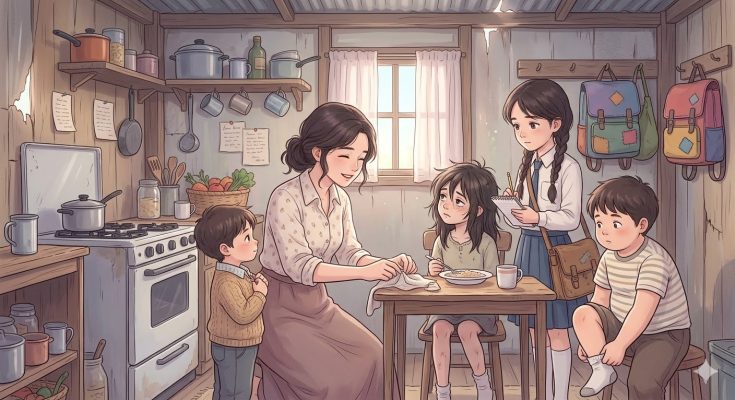
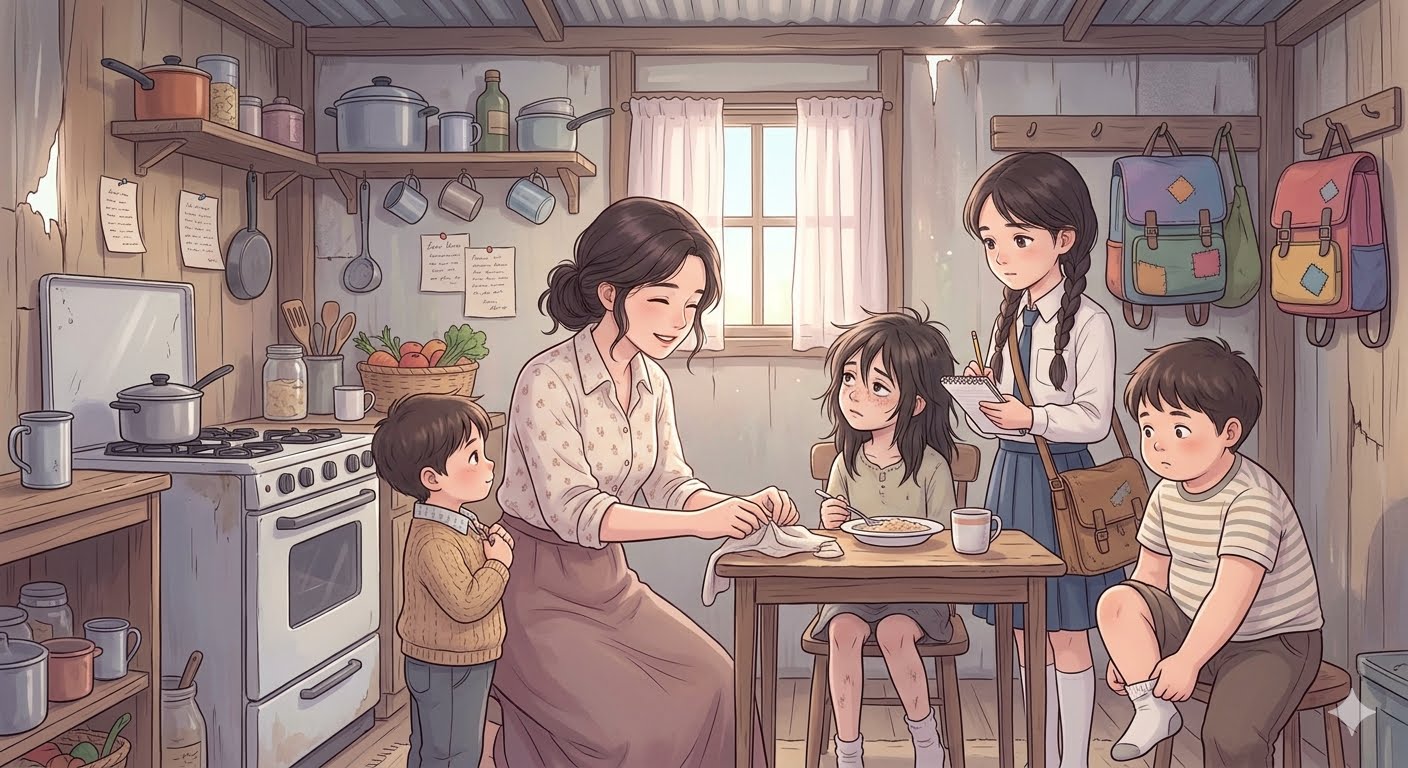
My older sister, Lucy, was barely ten years old. I, the second daughter, was eight and a skinny, sickly child, the kind who got tired doing nothing. Next came Tony, five years old, round as a potato with his eyes always wandering, searching the whole house for Mom. The youngest, Matthew, still didn’t understand anything.
Two years later, my dad remarried a woman from a respected family, a very beautiful woman who was barely twenty-seven years old.
We called her “Mom.”
My dad went out to work from morning until night and left all the care of the house and us to her. Mom did a hundred things a day without resting. We ate well, we were clean, the house was tidy, and the food always arrived hot at the table.
Three years after we started living with Mom, my dad got seriously ill and died.
When he was about to pass away, he could no longer speak. He just looked at Mom and cried.
Mom was too young. Too pretty. And she wasn’t our blood mother.
Barely ten days had passed since we buried my dad when people started arriving to collect debts, wanting to take the house, the furniture, the little we had. Mom’s family insisted she return to them and remarry.
Then, one day, Mom sold the house, paid off all the debts, and, in silence, took the four of us by the hand and left with us.
It was 1978.
We went to live crammed into the house of a distant cousin of Mom’s, whom we called Aunt Teresa. She worked cleaning fish and selling it at the market. She was a widow and poor. Her house, on the outskirts of Galveston, Texas, was little more than a tin and wood shack, and yet she took Mom and the four kids in.
Aunt Teresa gave three fat hens to an acquaintance to get Mom a job as a cleaning assistant at the general hospital.
Every day, Mom got up at three-thirty in the morning. She went to the hospital to boil water, serving it to the sick patients who woke up early to wash their faces, prepare milk, or make tea. With those coins, she bought notebooks and pencils so we could keep studying.
At six, she would run back to the house to give us breakfast and send us to school. At seven, she would return to the hospital to mop stairs, wash floors, clean bathrooms, change patients’ sheets, gather trash, and take it to be burned.
After five in the afternoon, she would still take in laundry for patients with more money.
She would get home around eight at night, exhausted.
On rainy days, she sometimes came back a little earlier. She would bring us a roasted ear of corn for each of us, or a small bag of roasted peanuts, warm and crunchy. We would lie down next to her on an old mat, listening to her tell stories from the past.
Matthew, the youngest, was afraid of the cold and would hug Mom tight.
“You’re so warm, Mom,” he would tell her.
Tony would act like a little kid and ask her to scratch his back. Sometimes Mom taught us songs, rhymes, and verses, and we would end up singing all together like a slightly out-of-tune, but happy, little choir.
Every year, on the anniversary of my biological mother’s death, Mom would prepare a simple but nice meal. She would light some candles, put out flowers, and call the four of us in front of the altar.
“She is your blood mother,” she would tell us. “She brought you into the world and took care of you as long as she could. Even though she is no longer here, she still protects you from heaven.”
On the anniversary of my dad’s death, she did the same.
As a child, and still now, I have always believed that my parents watched over us from above.
One morning, they brought Mom back to the house.
She had burned her leg with boiling water because a patient tripped and crashed into her. The burn was large. Since Mom ate little and was weak, the wound took a long time to close. It swelled, it hurt, it didn’t let her sleep. She lost so much weight she looked like a heron.
My sister Lucy cried and begged her to let her go work at the hospital in her place.
Mom refused.
Then, gritting her teeth, she went back to work with her injured leg.
Over time, that burn turned into a thick, wrinkled scar that crossed from her ankle to the top of her left foot. Mom never walked the same again.
Sometime later, Aunt Teresa was able to buy a small house near the market and sold her old house cheaply to Mom.
That same year, my sister Lucy passed the exam to enter the Teachers College in Houston. Seeing Mom so tired, she wanted to drop out and start working.
Mom didn’t allow it.
We had never seen her so firm.
She lit a candle in front of my dad’s photo and said, as if talking to him but so Lucy would hear:
“Your oldest daughter wants to quit school. When I die and meet you, how will I be able to look you in the face?”
Lucy cried, asked for forgiveness, and agreed to study.
Two years later, I also entered the university. Mom packed my suitcase and went with me to the bus terminal. When I opened the suitcase, my heart broke. Besides my clothes, Mom had packed a needle and thread, ointment, stamps, bandages, antiseptic, cold medicine.
It seemed like Mom could pack all her love inside every little thing.
The years passed. My sister and I finished our degrees and went looking for work. By then, Tony had entered Law School, and a year later Matthew started Medical School.
How can you measure all the exhaustion Mom endured in those years?
Her back began to hunch, her hair started to fill with gray, her hands became rough and hard.
Over the years, Mom married off her three oldest children. Matthew continued living with her because he hadn’t yet started his own family.
Today he is a surgeon at the same hospital where Mom worked cleaning floors.
He once confessed to me that, when he is on night duty and hears someone say “hot water,” his chest tightens, because for a second he thinks he hears Mom’s voice.
On our days off, my siblings and I would take our children to see her to cheer her up. The kids clung to her like little chicks. One would pluck her gray hairs, another would squeeze her hands, another would rub her feet.
Once, my daughter Chloe touched the scar on Mom’s leg and asked her:
“Grandma, I burned my hand a little bit and it hurt horribly. Did it hurt you a lot when you got burned like that?”
Mom smiled.
“It happened so long ago that I’ve even forgotten.”
One rainy afternoon I went to visit her. I lay down next to her and told her things about my husband, my children, about life. Outside it rained hard, as if the sky were emptying itself. I told her I was cold and Mom pulled the blanket to cover me.
I covered her too, like when I was a little girl and we slept together.
My feet were freezing, and I sought the warmth of hers. Then my foot brushed against that scar on her ankle, that scar so familiar, so hers, so much a part of our history.
And without knowing why, I started to cry.
I thought about my life, my husband, my children, my house full of noise and warmth. I thought about Mom.
She was only a wife for three years.
During all the years that came after, maybe she also desired a happiness of her own. Maybe she also felt lonely, tired, in need of someone to hold her at the end of the day.
But she chose to stay.
She chose to raise us.
She chose to spend her youth, her beauty, her health, and her dreams on four children who had not been born from her womb.
Mom…
How hard your choice was.
How many times you told my children stories of princesses, princes, and good fairies.
Someday, when they grow up, I will tell them the story of our true fairy.
A fairy with white hair, rough hands, and a slightly crooked walk because of a long scar on her left foot.
The story Mom wrote for us didn’t have castles or crowns.
She wrote it with exhaustion, with pain, with tears, with sweat, with sleepless nights.
And with her whole life…
Part 2:
That rainy afternoon I didn’t tell Mom everything I was thinking. I couldn’t. My throat was tight and my foot was still brushing against that hard scar that had changed the way she walked. She watched me cry and, as always, didn’t ask too many questions. She just stroked my hair, slowly, like when I was a little girl and got fevers at night. “There, there, mija,” she told me.
“Don’t cry over old things.” But I knew they weren’t old things. They were living things. They were there, on her ankle, in her twisted hands, in her hunched back, in her way of getting up even when she had no strength left. I stayed with her until it stopped raining. Before I left, she asked me to open the wardrobe and take out a thicker blanket.
When I moved some boxes, an old cookie tin fell, all rusted, tied with a red ribbon. Mom sat up suddenly, as if she had seen something that shouldn’t come out.
“Leave it there,” she said, but her voice sounded different. It wasn’t anger. It was fear. I picked up the tin and felt it was too heavy to just hold buttons or thread. “What is this, Mom?” She looked down. “Old papers. Nothing useful to you.” I didn’t insist at that moment, because we never learned to force a truth out of her. But that night, back at my house, I couldn’t sleep.
The next day I called Lucy, Tony, and Matthew. I told them about the tin. Matthew was silent for a long time and then said something that left us still: “I saw her cry with that tin once. I thought they were memories of Dad.” That same week the four of us went back to Mom’s house.
We didn’t arrive making a fuss or asking hard questions. We arrived with sweet bread, coffee, and the grandkids, like any Sunday. Mom saw us together and understood before we spoke. She sighed, asked the kids to go out to the patio, and sent Matthew for the tin.
Inside were letters. A lot of them. Some yellowed, others folded with such care it seemed they still held the warmth of a hand.
They were from a man named Julian Roberts, a rural teacher Mom met when she worked at the hospital. The first letters were respectful, full of simple words. He told her about a school in a small town, about a small room overlooking the river, about a quiet life where she could rest.
Then the letters changed. He no longer asked for love. He asked for permission to help her, to accompany her, to marry her and accept the four children as his own. Lucy started crying before finishing the second letter. Tony covered his mouth. Matthew stared at the floor, as if someone had placed on him all the years Mom carried without anyone knowing.
Mom didn’t cry. She just sat there with her hands on her knees. “He was a good man,” she said at last. “Very good.” We stayed quiet. She kept talking, slowly, looking at a corner of the table.
She told us that Julian proposed to her when Matthew was seven years old. That he didn’t care about the poverty, the gossip, or that she had already been someone else’s wife. He wanted to start a family with her.
He wanted to take us too. But Mom said no. Not because she didn’t love him. She did. You could hear it in her voice, even though she tried to hide it. She said she was afraid that one day we would feel she had replaced our father, or that someone would treat us as a burden in a stranger’s house. She said we had already lost too much.
“And what did you lose, Mom?” Lucy asked, her voice breaking.
Mom smiled a little, as if the question embarrassed her.
“Nothing you had to pay for.”
Then Matthew stood up and went out to the patio. We found him by the laundry sink, crying like we hadn’t seen him cry even when he graduated from medical school.
“I studied Medicine for her,” he said. “And I didn’t even know that while I was growing up, she was giving up on having someone to hold her.” No one knew what to say. There were no complaints that afternoon, but something settled differently inside us.
Because until then, we had thanked Mom for raising us, for giving us an education, for taking care of the house. But we hadn’t understood the quietest part: that she had also buried her own youth without asking our permission or making us feel guilty.
Before we left, Mom picked up the last letter. It was the only one that hadn’t been opened. It was dated more than thirty years ago. She held it for a long time between her fingers and then gave it to me. “Read it when I’m gone,” she told me.
I felt cold. “Don’t say that.” She stroked my hand with her hard fingers. “All mothers leave someday, mija. The important thing is that they don’t go before knowing how much they were loved.”
I put the letter in my purse, but I couldn’t stop thinking about it. That night, when I got home, I put it on my nightstand without opening it. And for the first time in my life, I was afraid to know the whole story of the woman who had given us everything.
What happened next…?
Part 3:
Mom died two years later, on a quiet early morning, with Matthew sitting by her side and a blanket over her feet. It wasn’t a movie death. There were no long speeches or perfect goodbyes.
The night before she had asked for vanilla porridge, had scolded one of the grandkids for running inside the house, and then fell asleep listening to the rain. At four in the morning, Matthew noticed her breathing was different. He held her hand, spoke to her softly, and called Lucy, Tony, and me.
When we arrived, Mom was still warm. Her face was serene, more rested than it had been in years. I approached her left foot and touched, for the last time, that thick scar that had gone unnoticed so many times in the midst of life.
After the burial, the house was full of people, coffee, prayers, and borrowed chairs. Neighbors arrived with rice, beans, bread, candles.
Some old patients from the hospital sent flowers. A retired nurse told us that Mom, when she cleaned the hallways, always saved half her food for some sick person who had no visitors.
An orderly said that she was the one who taught him to read medication instructions when he barely knew how to put letters together.
We listened in silence, discovering that Mom’s life had been even bigger outside our house than we had imagined. That night, when everyone left, Lucy put the cookie tin on the table. I took the last letter from Julian out of my purse.
I opened it carefully. The paper was fragile. The handwriting was firm, nice, a teacher’s handwriting. Julian asked for nothing. He didn’t insist on marrying. He didn’t complain.
He just said goodbye. He told her he had understood her decision, that he respected the love she felt for us, and that, although it hurt him, he didn’t want to become another burden on her life. At the end he wrote: “If your children ever read this, I want them to know something.
Their mother didn’t stay with them because she had no other path. She stayed because she chose them. And choosing also hurts. Take good care of her, even if it’s late, because women like that don’t make noise when they break.” No one spoke for several minutes.
Tony, who always made jokes so he wouldn’t cry, covered his face with both hands. Matthew went out to the patio. Lucy stared at Mom’s empty chair.
I don’t know if we took care of Mom the way she deserved. That question will stay with me all my life. We took her to the doctor, we bought her medicines, we filled her house with grandkids, yes.
But many times we took for granted that she would be there, sitting in her armchair, with her shawl, ready to welcome us with coffee.
Sometimes a mother’s love becomes so constant that one commits the injustice of seeing it as part of the furniture. Only when it’s missing does the entire house lose its shape.
A month after her death, Matthew suggested something. He wanted to put a small plaque in the hospital, near the stairs Mom mopped for so many years.
Not an elegant plaque, not something big. Just a line with her name. At first the administration hesitated. Then several doctors, nurses, and employees signed a petition.
The day they put it up, we all went. It read: “In memory of Helen Morales, who cleaned these hallways with tired hands and held with them the future of four children.”
Matthew cried reading it. So did I. Because finally her name remained in a place where she had left part of her body and her life.
Over time, we started telling the whole story to our children. Not the pretty version of “the good grandmother,” but the real one: the young woman who could have left, who could have married again, who could have chosen a lighter life, but decided to raise four children who were not born from her womb.
We told them about the scar, about the roasted corn on rainy days, about the suitcase full of ointment and bandages, about Julian’s letters, about the dawns at the hospital.
My daughter Chloe cried when she heard the last letter. Then she said something I never forgot: “Then Grandma really was a fairy, but the kind that get tired.”
Yes. Mom was a fairy who got tired. A fairy who didn’t have a wand, but a bucket, soap, needles, bandages, hot tortillas, and rough hands.
A fairy who didn’t save us from poverty with magic, but with work. Who didn’t give us castles, but gave us schooling.
Who didn’t give us a last name, but gave us roots. Who didn’t ask us to call her a hero, because she had enough just getting through the day alive.
Today, when it rains, I still think of her. Sometimes I prepare roasted peanuts for my grandkids and I tell them there was a woman who walked a little crooked because a burn left a long scar on her left foot.
I tell them that mark wasn’t ugly. It was a signature. The signature of everything she endured so that we could walk straight through life.
And when someone asks me if a mother has to share your blood, I think of Mom, of her tin of letters, of her old blanket, of her cold feet next to mine, and I answer without hesitation: no. A mother is the person who, being able to leave, stays; and by staying, teaches you that true love doesn’t always shine, but it holds you up.