The Vacation That Was Never Meant for Her
“At your age, Mom, traveling is too much for you. You should just go home.”
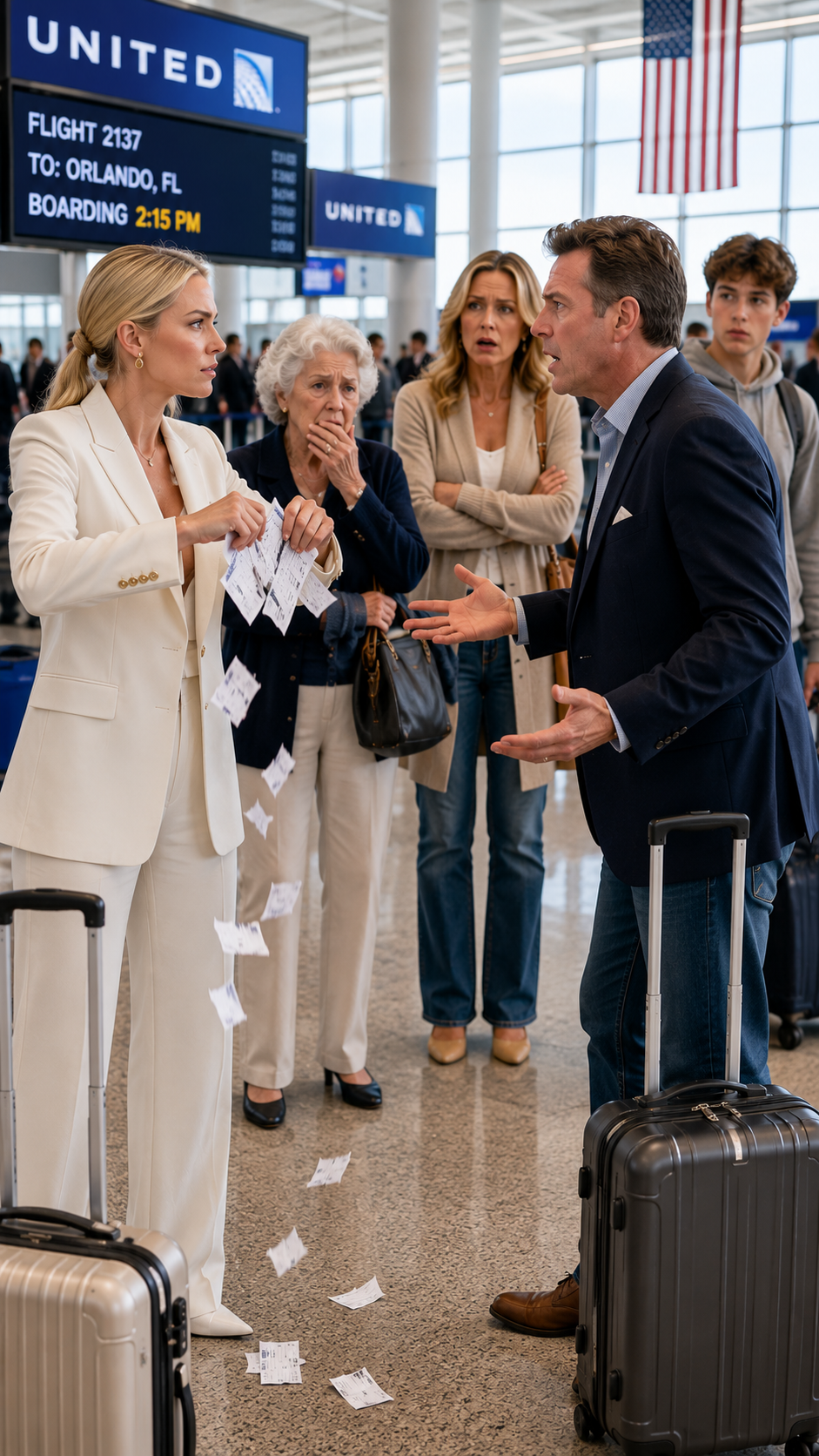
That was what my father said to my grandmother in the middle of Hartsfield-Jackson Atlanta International Airport, standing between a row of rolling suitcases and a family that suddenly forgot how to speak.
My grandmother, Dorothy Whitcomb, was seventy-six years old.
She was wearing her soft blue cardigan, the one she saved for special days, and holding an old brown suitcase that had belonged to my grandfather before he passed away. She had been excited for weeks. It was supposed to be her first real vacation in nearly twenty years.
She had paid for all of us to fly to Florida.
My father, Graham Whitcomb, had told her it would be a family trip. He said she deserved sunshine, ocean air, and a few peaceful days with the people she loved most.
But when we reached the airline counter, the agent looked at her screen, frowned, and said, “I’m sorry, ma’am. I don’t see a ticket under the name Dorothy Whitcomb.”
Grandma blinked softly.
“That can’t be right,” she said. “My son printed my itinerary for me.”
She pulled a folded paper from her purse and handed it over with both hands, like it was something valuable.
The agent looked at it, then looked at my father.
“This isn’t a confirmed reservation,” she said carefully. “It looks like a sample itinerary.”
My father sighed like Grandma had embarrassed him.
“Mom, we don’t have time for this,” he said. “The flight boards soon. I’ll call you a car. You can go back to the house.”
My stepmother, Marissa, adjusted her designer sunglasses on top of her head. My aunt Celeste stared at the floor. My cousins suddenly became very interested in their phones.
Nobody said a word.
So I did.
My name is Audrey Whitcomb. I am thirty-two years old, and I work as a CPA specializing in financial audits. I spend my days finding numbers that do not belong where people claim they belong.
But I never thought the ugliest case I would ever uncover would begin with my own grandmother standing alone at an airport counter.
The Ticket I Tore in Half
Grandma did not cry.
That was the part that hurt the most.
She simply held her purse close to her chest and nodded, as if she was trying not to make trouble for anyone.
“Maybe there was a mistake,” she whispered.
I looked at my father.
“Dad, she paid for this trip.”
He did not even turn fully toward me.
“Audrey, stay out of it,” he said. “This is between me and my mother.”
“No,” I said. “It became my business the second you tried to leave her standing here like she was luggage you no longer wanted.”
Marissa gave a small laugh.
“Don’t be dramatic. Your grandmother gets confused sometimes.”
Grandma lowered her eyes.
That did it.
I pulled out my own boarding pass, tore it cleanly in half, and let the pieces fall into the trash beside me.
My father’s face changed.
“What are you doing?”
I reached for Grandma’s suitcase.
“I’m going home with her.”
“Audrey,” he warned, lowering his voice, “you’re going to regret making a scene.”
I looked him straight in the eye.
“Not as much as you’ll regret whatever I find when I start asking questions.”
For the first time that morning, my father looked nervous.
Not guilty.
Not sorry.
Nervous.
The House That Told the Truth
We drove back to Grandma’s small house outside Franklin, Tennessee, in near silence.
She kept looking out the window, her hands folded in her lap.
“Your father has been under pressure,” she said softly. “Maybe he really did make a mistake.”
I wanted to believe that for her sake.
But I couldn’t.
When we got to the house, I noticed things I had missed before.
The porch light was broken. The kitchen cabinets were nearly empty. The heat was turned down so low the rooms felt cold. In the refrigerator, there was half a carton of milk, a jar of pickles, and two containers of medication.
My father had just bought a new black SUV.
Marissa had posted photos from a luxury spa three weeks earlier.
My cousins had flown first class before.
And my grandmother was stretching a pot of soup across three days.
That evening, her neighbor, Mrs. Landry, knocked on the door with a casserole dish in her hands.
She gave me a careful look.
“I’m glad you’re here, Audrey,” she said quietly. “Your father comes by twice a month, but he never stays. He only takes the mail from the bank and leaves.”
My stomach tightened.
After Grandma went to bed, I sat at her kitchen table and opened the drawer where she kept her old paperwork.
There were bank letters, missing statements, tax notices, insurance documents, and a thick folder from a local attorney’s office.
Inside was a document titled:
Durable Power of Attorney.
The authorized agent was my father.
Graham Whitcomb had full permission to manage Dorothy Whitcomb’s bank accounts, property decisions, retirement income, medical payments, and major financial transactions.
Grandma had signed it two years earlier after a minor hospital stay, believing it was only to help him pay bills if she ever needed him.
But that document had given him access to everything.
The Numbers That Did Not Lie
The next morning, I took Grandma to her bank.
The branch manager knew her name. That alone told me she had been there before asking questions she never fully understood.
I requested full account statements for the last four years.
The manager looked uncomfortable, but Grandma gave permission.
Page by page, the truth appeared.
My grandmother had once had more than $310,000 between her retirement savings, Social Security deposits, the sale of a small lake lot my grandfather had left her, and money she had saved from years of working as a school cafeteria manager.
Now less than half remained.
There were cash withdrawals.
Transfers to my father.
Payments toward Marissa’s credit cards.
A luxury SUV down payment.
Vacation charges.
Home renovation expenses that had never touched Grandma’s house.
And then I saw it.
A $35,000 withdrawal labeled:
Family Vacation Package.
Grandma stared at the paper for a long time.
Then she said something I will never forget.
……………………………………………………………………………………………..
PART 2
A 76-Year-Old Grandmother Paid $35,000 for the Family Vacation — Then Her Son Told Her, “You’re Better Off Staying Home” at the Airport, Unaware His CPA Granddaughter Was Already Gathering Evidence to Expose the Truth and Protect Her
“I don’t want to punish my son, Audrey. I just want him to stop treating me like I’m already gone.”
Before I could answer, my phone buzzed.
It was a photo in the family group chat.
My father, Marissa, Celeste, and my cousins were smiling on the plane with plastic cups in their hands.
Under it, my father had written:
Finally, a vacation without extra baggage.
Grandma saw the message before I could hide it.
Her face did not change.
But something in her eyes finally went quiet.
The Attorney Who Did Not Raise His Voice
Three days later, I sat in the office of Malcolm Pierce, an elder law attorney in Nashville.
He was calm, direct, and serious in the way only people with real power can afford to be.
He reviewed the bank statements, the power of attorney, the property records, and the fake itinerary.
Then he removed his glasses and looked at Grandma.
“Mrs. Whitcomb, this is not a family misunderstanding,” he said. “This appears to be financial exploitation of an elderly parent.”
Grandma folded her hands tightly.
“Can it be stopped?”
“Yes,” he said. “We can petition to suspend his authority immediately. We can protect your accounts, review property activity, and notify the court that your consent may have been misused.”
Grandma closed her eyes.
For a moment, she looked like a woman carrying the weight of every meal she had cooked, every bill she had paid, every excuse she had made for the son who had slowly turned her love into access.
Then she opened her eyes.
“Do it.”
Within a week, the court granted an emergency order. My father’s access to Grandma’s accounts was frozen while the matter was reviewed.
The call came at 2:41 in the morning.
I answered from Grandma’s kitchen.
My father’s voice exploded through the phone.
“What did you do, Audrey?”
I stayed calm.
“Good morning to you too.”
“My card was declined at the hotel. Marissa is furious. Celeste can’t pay for her room either. Do you understand what you’ve caused?”
I looked at Grandma sitting across the table in her robe, listening silently.
“I don’t know, Dad,” I said. “Maybe there was a mistake. You can call a car and go home, like you told Grandma.”
Then I hung up.
The Kitchen Table Became a Courtroom
They came back to Tennessee two days later.
No beach photos.
No smiling airport selfies.
No proud family posts.
My father arrived at Grandma’s house with Marissa behind him, her face tight with anger. Aunt Celeste came carrying a store-bought pie, as if dessert could soften what documents had already exposed.
The kitchen table was covered with folders.
Malcolm Pierce sat beside Grandma.
I stood behind her chair.
My father slammed his hand on the table.
“This is disrespectful. I am her son. I was taking care of things.”
Grandma looked at him with a calmness that made the room colder.
“No, Graham,” she said. “You were taking things.”
Malcolm opened the first folder.
He read through transfers: $18,000, $42,000, $70,000. Payments to Marissa’s cards. A down payment on the SUV. Checks written for house repairs Grandma never received. A supposed medical expense that never went to any clinic.
Then he turned to my aunt.
“Celeste, you received $54,000 from your mother’s account marked as an emergency family loan. Can you explain the emergency?”
Aunt Celeste went pale.
“Graham told me it was an advance from Mom’s estate.”
My father turned on her.
“Be quiet.”
But it was too late.
Everything started cracking open.
Malcolm placed printed text messages on the table.
One message from my father to Celeste read:
Let her think she’s going. Once we’re at the airport, she won’t be able to do anything.
Another said:
That money does more good for us now than sitting around for an old woman who barely uses it.
Grandma pressed one hand against her chest.
For the first time, I saw her face break.
But she still did not cry.
She stood slowly.
“You called me an old woman,” she said. “But this old woman can still read. And she can still tell the difference between a son and someone who used her.”
The Plan Behind the Vacation
Marissa began to cry, but not like someone who felt sorry.
She cried like someone watching comfort slip away.
My father tried to step closer.
“Mom, I was going to fix it. I was trying to keep everything in the family.”
Grandma looked at him.
“I am family. Or did that only matter when you needed my signature?”
The silence was heavy.
Then Malcolm opened the final folder.
He hesitated before speaking.
“Mrs. Whitcomb, there is something else.”
My hands went cold.
“Your son had started paperwork to sell this house.”
Grandma froze.
“My house?”
Malcolm nodded.
“The proposed buyer was a business contact of your son’s. The price was far below market value. There was also a prepared application for a private assisted living facility outside Knoxville. It was unsigned, but most of the paperwork was already completed.”
My father looked down.
That was when I understood.
The trip was not just a vacation.
It was a distraction.
While the family was in Florida posting photos, someone was planning to move my grandmother out of the only home she had left.
…………………………………………………………………………………………………………………..
PART 3
A 76-Year-Old Grandmother Paid $35,000 for the Family Vacation — Then Her Son Told Her, “You’re Better Off Staying Home” at the Airport, Unaware His CPA Granddaughter Was Already Gathering Evidence to Expose the Truth and Protect Her
Grandma turned to her son.
Her voice was almost too soft to hear.
“Where were you going to send me, Graham?”
He swallowed.
“It was a nice place, Mom. You wouldn’t have been alone.”
Grandma let out a sad, quiet laugh.
“How strange,” she said. “When you needed my money, I was capable enough to sign papers. But when I wanted to keep my own home, suddenly I was too old to understand.”
What He Lost
The legal process took months.
The power of attorney was permanently revoked. Grandma’s accounts were protected with dual authorization. The attempted house sale was canceled. My father was ordered to repay a large portion of the money through court-supervised payments and asset liquidation.
He lost the SUV.
He lost a rental property he had quietly purchased using Grandma’s funds.
Marissa filed for divorce once she realized the vacations, cards, and easy money were gone.
Aunt Celeste sold land to repay what she had accepted.
The family group chat went silent.
No one posted about loyalty anymore.
My father called many times.
At first, he shouted.
Then he cried.
Then he tried the sentence he thought would work forever.
“Audrey, I’m your father. You can’t turn my mother against me.”
One afternoon, Grandma asked for the phone.
She held it in both hands.
“Nobody turned me against you, Graham,” she said. “You walked there by yourself.”
Then she ended the call.
Later, protective restrictions were put in place so he could not come to the house, pressure her, or handle any of her affairs again.
What She Got Back
Little by little, Grandma’s house came back to life.
We fixed the porch light. Changed the locks. Painted the kitchen. Repaired the roof. Filled the refrigerator with real groceries. Paid the utility bills on time.
The house began to smell like coffee, cinnamon toast, and warm soup again.
Grandma started going back to church.
She wore lipstick again.
She sat on the porch with Mrs. Landry in the evenings, waving at neighbors like she was slowly remembering that she still belonged to the world.
One Saturday, she asked me to drive her to a salon.
“I want to look like a woman who survived her own son,” she said.
And she did.
She looked beautiful.
Not untouched by pain.
But not defeated by it either.
The Real Trip
Six months after the airport, I placed a navy-blue suitcase on Grandma’s bed.
She narrowed her eyes at me.
“Audrey, what did you do?”
I opened the suitcase.
Inside were two real plane tickets.
Not samples.
Not screenshots.
Not promises.
Two confirmed tickets to Charleston, South Carolina, where she had always wanted to see the ocean again because Grandpa had once taken her there when they were newly married.
Her hand trembled as she picked up the ticket.
She read her name three times.
Dorothy Elaine Whitcomb.
Confirmed.
“Am I really going?” she whispered.
I smiled.
“This time, nobody gets to leave you behind.”
At the airport, she walked slowly but with her head high.
When we passed the ticket counter, she stopped.
“This is where he left me,” she said.
I took her hand.
“No,” I told her. “This is where you started coming back.”
In Charleston, she cried when she saw the ocean.
Not from sadness.
It was the kind of crying that happens when a person finally puts down a burden they carried too long.
She bought a white sun hat, ate shrimp and grits by the water, and sent Mrs. Landry a photo with one simple message:
“I made it.”
When we came home, she framed that picture and placed it on the mantel.
Under it, she wrote in careful handwriting:
Dignity is not inherited. It is protected.
My father lost money, comfort, reputation, and control.
But my grandmother got back something far greater.
She got back her voice.
And I learned that loving your family does not mean staying silent while someone is being slowly erased.
Sometimes love means tearing your own ticket in half.
Sometimes love means asking hard questions.
Sometimes love means closing the door, even when the person on the other side shares your blood.
Because family is not the person who uses you when you grow old.
Family is the person who refuses to let you stand alone at the counter.
Sometimes the person who smiles in family photos is the same person quietly taking advantage behind closed doors, and that is why love should never require blindness, silence, or the sacrifice of someone’s dignity.
An elderly parent is not a bank account, not a burden, and not a forgotten chapter in someone else’s life; they are a human being who once gave their strength so others could stand.
Real family does not measure an aging parent by how useful they are, how much money they still have, or how easily they can be controlled, but by the years of love they gave without asking for applause.
There are moments when staying quiet feels easier because speaking up may divide the family, but sometimes silence is the very thing that allows the wrong person to keep hurting the one who trusted them most.
Audrey did not destroy her family by exposing the truth; the truth only revealed what had already been broken by greed, selfishness, and the belief that a mother’s love could be used without consequence.
Dorothy’s greatest victory was not getting her money back, keeping her house, or taking the trip she deserved; it was standing in her own kitchen and finally saying, with a steady voice, that she was still alive and still mattered.
Forgiveness should never be demanded from the person who was hurt just because the person who caused the hurt shares the same last name, because family ties do not erase responsibility.
When someone has spent a lifetime giving, protecting, feeding, forgiving, and sacrificing, the least their family can do is protect them when they are too tired to fight alone.
The strongest love in this story was not loud or dramatic; it was a granddaughter quietly tearing up her ticket, picking up an old suitcase, and choosing dignity over a vacation.
In the end, the people who truly belong in your life are not always the ones connected by blood, but the ones who stay beside you when everyone else decides you are no longer convenient.
