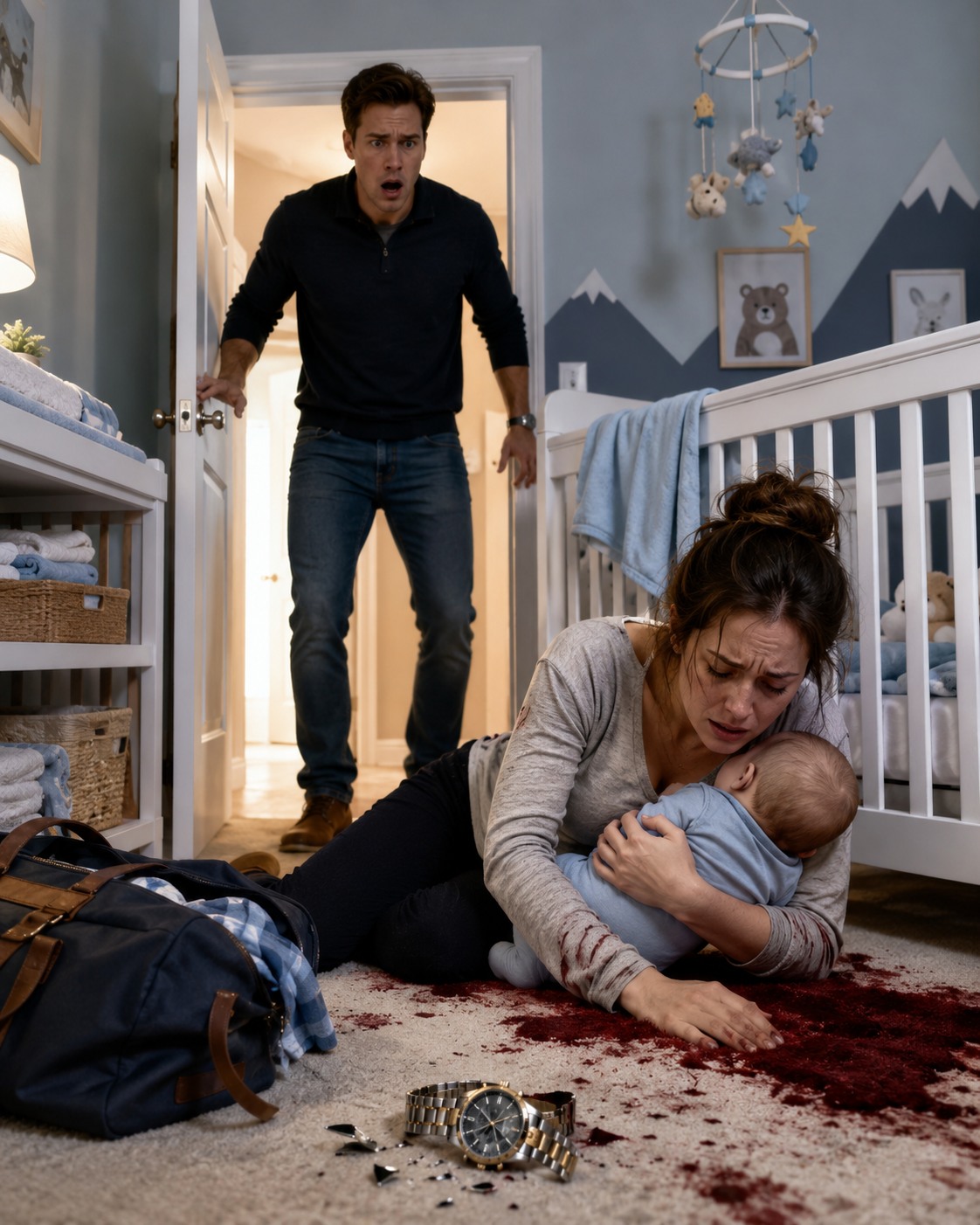
I Bled to Death on the Nursery Floor While My Husband Celebrated His Birthday in the Mountains
The person who entered my house that afternoon was not family.
It was not my husband, rushing back because some buried instinct told him his wife was dying.
It was not my mother, who lived two states away and had cried on FaceTime the night before because she couldn’t be there to help.
It was our new neighbor.
A woman I had spoken to exactly twice.
Her name was Vivian Hale.
She lived in the pale-blue house across the street, the one with trimmed hedges, white shutters, and no children’s toys in the yard. She was in her early sixties, elegant in a quiet way, with silver hair always pinned at the nape of her neck and eyes that seemed to notice everything.
I had first met her when I was eight months pregnant and struggling to carry grocery bags from the trunk. She had crossed the street without asking and taken half of them from my arms.
“You’re Emma,” she’d said.
I remember laughing awkwardly. “I am.”
“Vivian. Across the street. You should not be lifting those.”
That was our first conversation.
The second happened two weeks before Ethan was born. She had brought over a loaf of lemon bread wrapped in parchment and tied with string.
“New babies bring visitors,” she’d said. “Visitors bring germs and opinions. Eat this before they arrive.”
I thought she was strange.
Kind, but strange.
I had no idea she would save my life.
Vivian later told me she noticed Ryan leaving with luggage that Friday morning. She had been watering her porch plants when he backed his sports car out of the driveway too fast, music thumping loud enough to rattle glass.
She had lifted one hand.
He had not waved back.
That did not surprise her.
What did surprise her was the crying.
At first, she thought it was an animal. A thin, desperate sound slipping through the cracks of our closed windows. But then it stopped, started again, stopped, and started weaker.
Vivian had been a pediatric nurse for thirty-four years.
She knew the sound of a newborn in distress.
She crossed the street.
She rang the bell.
No answer.
She knocked.
No answer.
Then she looked through the narrow side window beside the front door and saw my hand on the hallway floor.
That was all she saw.
A hand.
Pale, still, streaked with blood.
Vivian did not scream. She did not panic. She stepped back, pulled a small emergency hammer from her gardening apron—because, as she later told me, “a woman living alone should always have a way through glass”—and broke the side window.
The alarm went off.
Inside the house, Ethan cried again.
Vivian reached through the broken glass, unlocked the door, and entered the home my husband had abandoned.
She found me half in the hallway, half in the nursery, soaked in blood and barely breathing.
She found Ethan in the bassinet, red-faced, hungry, and weakening.
She found my phone beside my cheek, still playing Ryan’s birthday story on loop.
Happy birthday to me.
Happy birthday to me.
Happy birthday to me.
Vivian called 911 before she even knelt beside me.
Then she wrapped Ethan in a blanket, checked his breathing, placed him safely on the floor beside her, and pressed both hands hard against my abdomen.
“Stay with me,” she commanded.
I did not hear her.
At least, not clearly.
I remember fragments.
A voice cutting through darkness.
The distant wail of sirens.
A flash of red light against the nursery ceiling.
Hands lifting me.
Someone saying, “Severe postpartum hemorrhage.”
Someone else saying, “Pressure’s dropping.”
Then Vivian’s voice, calm and fierce.
“She has a newborn. You do not lose her.”
After that, there was nothing.
Not sleep.
Not dreams.
Nothing.
When I opened my eyes again, the world was white.
White ceiling.
White walls.
White sheets.
A machine beeped beside me.
My mouth felt like dust.
For a moment, I did not know where I was.
Then memory came back in pieces, each one sharp enough to cut.
The nursery floor.
The blood.
Ethan crying.
Ryan leaving.
Ryan laughing.
I tried to sit up.
Pain exploded through me.
A nurse hurried to my side. “Emma, don’t move.”
“My baby,” I rasped. “Where’s my baby?”
“He’s okay,” she said quickly. “Your son is okay.”
Tears filled my eyes before I could stop them.
“He’s here?”
“He’s in the maternity ward nursery. He was dehydrated and hungry, but he’s stable. You both got here in time.”
In time.
Those two words broke something inside me.
Because I knew, with terrible certainty, that Ryan had not saved us.
A stranger had.
“Where’s my husband?” I asked.
The nurse’s face changed.
It was slight. Professional. But I saw it.
“He hasn’t been reached.”
I closed my eyes.
Of course.
Ryan was in Aspen, raising glasses with men who called their wives ball and chains. He was laughing under heated lamps while I received blood transfusions and my son fought weakness because no one had answered his cries.
“How long?” I whispered.
“You’ve been unconscious for almost two days.”
Two days.
Ryan had not noticed.
Two days, and my husband had not thought to check whether the wife he left bleeding on the nursery floor was alive.
The nurse adjusted my blanket. “There’s someone waiting to see you, but only when you’re ready.”
“Who?”
“Vivian Hale.”
I turned my face toward the window.
Snow fell softly beyond the glass.
“Let her in.”
Vivian entered with Ethan in her arms.
That was the moment I truly began to live again.
He was wrapped in a pale-blue hospital blanket, his tiny mouth pursed, one fist pressed against his cheek. His skin had regained color. His dark hair stuck up in soft little tufts. He looked impossibly small.
Vivian carried him as if he were made of light.
When she placed him against my chest, I sobbed so hard the monitors began beeping faster.
“I’m sorry,” I whispered into his hair. “I’m so sorry.”
Vivian stood beside the bed, watching us without speaking.
After a while, I looked up at her.
“Thank you.”
She nodded once. “You can thank me by getting stronger.”
I tried to smile, but my lips trembled.
“How did you know?”
Her eyes softened. “I heard him crying.”
I looked down at Ethan.
“He was alone because of me.”
“No,” Vivian said.
Her voice changed. It became the kind of voice nurses use when a patient says something foolish and dangerous.
“He was alone because your husband left you in a medical emergency.”
I flinched.
My husband.
The word felt foreign now, like a name from an old life.
“Has he called?” I asked.
Vivian’s mouth tightened.
“Several times now. After the police contacted him.”
“The police?”
“You were found unconscious in a house full of blood with a newborn. They had questions.”
I stared at her.
“What did you tell them?”
“The truth.”
My body went cold.
“The whole truth?”
Vivian’s eyes held mine.
“I found your phone still playing his video.”
For the first time since waking up, I felt something besides fear and grief.
I felt rage.
It rose slowly, like heat behind a locked door.
Ryan had always cared about appearances more than truth. The perfect house. The perfect wife. The perfect baby. The perfect image of a young executive with a beautiful family and expensive hobbies.
He chose Aspen because people would see it.
He posted the whiskey because people would envy it.
He mocked me because men like him needed an audience to confirm their cruelty was charming.
And now there was proof.
Not just of what he did.
Of who he was when he did it.
“Where is he now?” I asked.
“On his way home, I assume,” Vivian said. “The police told him you were hospitalized but not much else.”
I understood then.
Ryan did not know I was alive.
Not fully.
Not certainly.
He knew there had been blood. He knew police had gone to our home. He knew his wife and child had been taken by ambulance.
But he did not know what he would find when he came back.
A strange calm settled over me.
“Don’t tell him,” I said.
Vivian tilted her head.
“The hospital won’t give details without my consent, will it?”
“No.”
“Then don’t tell him I’m awake.”
Vivian studied me for a long moment.
“You need rest, Emma.”
“I need him to understand what he did.”
A shadow passed across her face.
“Men like Ryan do not understand through mercy.”
I looked at her sharply.
It was not just bitterness in her tone.
It was memory.
Before I could ask, Ethan stirred against me and whimpered. I lowered my face to him, breathing him in.
For the next day, I let the world think what it wanted.
The police came. A detective named Carla Moreno took my statement while Ethan slept in a clear bassinet beside my bed. She was careful, but not soft. She asked for every detail.
When did the bleeding worsen?
What did I tell Ryan?
What did he say?
Did he see the blood?
Did he know I could not stand?
Did he leave anyway?
Each question felt like another hand peeling skin from a wound.
I answered all of them.
Yes, he saw me.
Yes, I begged him.
Yes, he told me I was dramatic.
Yes, he left.
Yes, he posted a video mocking me.
Detective Moreno’s pen paused only once.
When I repeated his words.
“Don’t call me unless the house is actually on fire.”
Her jaw tightened.
But she wrote it down.
After she left, Vivian remained.
She came every few hours with coffee she did not drink and books she did not read. She held Ethan when nurses needed to examine me. She spoke to doctors with the authority of someone who had spent decades keeping people alive while families fell apart in waiting rooms.
On the third afternoon, she found me staring at the wall.
“You’re thinking about him going home,” she said.
I did not answer.
She sat beside me.
“The nursery has been sealed for now. The police finished processing it yesterday.”
“Will he see it?”
“Yes.”
A shiver ran through me.
I pictured Ryan opening the door.
The dried blood.
The empty bassinet.
The silence.
For three days, he had chosen not to return.
For three days, he had not known whether we were dead or alive.
Now he would stand in the consequence of his choice.
I should have felt satisfaction.
Instead, I felt hollow.
“He’ll make himself the victim,” I whispered.
Vivian’s expression did not change.
“Yes.”
“He’ll cry. He’ll say he didn’t know.”
“Yes.”
“He’ll say I exaggerate everything.”
“Probably.”
My hands curled around the blanket.
“What if people believe him?”
Vivian leaned forward.
“Then we make sure they hear you.”
That evening, Ryan came home.
I know because Detective Moreno told me later.
He pulled into the driveway just before sunset, tanned from mountain light, wearing designer boots and a cream-colored coat I had once told him made him look like someone trying too hard.
He was humming.
He carried a small shopping bag from an Aspen boutique.
Inside was the watch.
A gift for himself.
The front door still had plywood over the broken side window. Yellow police tape hung across the nursery doorway, though the officers had already cleared the scene.
Ryan stepped inside, called my name once, and stopped.
The smell hit him first.
Blood has a smell after it dries.
Metallic.
Sour.
Permanent.
His suitcase fell onto the floor.
He walked toward the nursery slowly, as though his body understood before his mind did.
He saw the rug.
He saw the dark stain spread across the cream fibers.
He saw my bloody handprint smeared against the side of the bassinet.
He saw Ethan’s empty blankets.
Then the souvenir watch slipped from his fingers and shattered on the hardwood.
He began screaming.
Not my name.
Not Ethan’s.
He screamed, “No, no, no,” again and again, because even then, it was about him.
His fear.
His consequence.
His ruined life.
He called 911. Then his mother. Then my phone.
My phone was in an evidence bag.
When no one answered, he called Vivian.
She was sitting beside my hospital bed when her phone lit up.
RYAN CARTER.
I looked at the name.
The rage came back.
Vivian looked at me, asking a silent question.
I nodded.
She answered and put it on speaker.
“Vivian?” Ryan’s voice cracked. “Oh my God. Oh my God, did you see what happened? Did you see Emma? Where is she?”
Vivian’s face was calm.
“Yes, Ryan. I saw.”
“Is she—” He choked. “Is she dead?”
The room went silent except for the steady beep of my monitor.
Vivian looked at me.
I did not move.
“She was taken to the hospital,” Vivian said.
“That doesn’t answer me.”
“No,” Vivian replied. “It doesn’t.”
He made a sound I had never heard from him before.
A broken, animal sound.
“Where’s my son?”
“With his mother.”
Another silence.
Then, very softly, “She’s alive?”
I closed my eyes.
Vivian ended the call.
Minutes later, my phone began ringing in the evidence bag at the nurses’ station. Ryan called again and again until Detective Moreno contacted the hospital and instructed staff not to connect him unless I consented.
I did not consent.
Not that night.
Not the next morning.
Not when his mother called crying.
Not when his father left a message saying, “This is a family matter.”
Not when Ryan sent a text through some web account because my phone was unavailable.
Emma please answer
I didn’t know
I swear I didn’t know
I thought you were being dramatic
I’m sorry
Please let me see my son
Please
You can’t punish me like this
You can’t punish me like this.
I read that line three times.
Then I laughed.
The sound frightened the nurse.
I wasn’t laughing because it was funny.
I was laughing because even after everything, Ryan still believed my survival was something I was doing to him.
By the fifth day, he hired an attorney.
By the sixth, his attorney requested access to Ethan.
By the seventh, Ryan posted online.
Not a video this time.
A statement.
“My family is going through an unimaginable medical crisis. I ask for privacy and prayers as we focus on healing. Please do not spread rumors during this painful time.”
He attached a black-and-white photo of his hand holding Ethan’s foot in the hospital after birth.
A photo I had taken.
A photo he had once complained made his fingers look weird.
The comments filled quickly.
Praying for you, bro.
Stay strong.
People love drama.
Ignore the haters.
He was already building the story.
The grieving husband.
The misunderstood father.
The man blindsided by an emergency no one could have predicted.
I stared at the post until the letters blurred.
Then I opened the saved screen recording Vivian had made from my phone.
Ryan on the balcony.
Whiskey in hand.
Snow behind him.
“Here’s to surviving high-maintenance wives. Sometimes you’ve gotta choose yourself. Happy birthday to me!”
His friends cheered.
I watched it once.
Then I sent it to Detective Moreno.
After that, I sent it to my attorney.
My attorney’s name was Nadine Cross, and she arrived wearing a charcoal suit and the expression of a woman who had not been surprised by human cruelty in at least twenty years.
She listened without interrupting.
When I finished, she folded her hands.
“Do you want a divorce?”
“Yes.”
“Custody?”
“Full.”
“Protective order?”
I looked at Ethan sleeping beside me.
“Yes.”
Nadine nodded.
“Then we begin today.”
Ryan tried to visit the hospital that evening.
Security stopped him in the lobby.
I did not see it happen, but Vivian did. She had gone downstairs for tea and returned with a face like stone.
“He brought flowers,” she said.
I laughed again, but this time there was no humor at all.
“What kind?”
“White lilies.”
Funeral flowers.
Of course.
“He said he just wanted to explain,” Vivian continued.
“What did you say?”
“I told security I had never known a man to explain a hemorrhage back into a woman’s body.”
For the first time in days, I smiled.
Vivian sat down, but there was tension in her shoulders.
“What is it?” I asked.
She hesitated.
Then she reached into her handbag and removed an envelope.
It was old, yellowed at the corners, sealed but not mailed.
“I was going to give this to you later,” she said.
My smile faded.
“What is that?”
“Something I should have given someone else a long time ago.”
I looked at the envelope.
There was a name written across the front in careful handwriting.
Mara.
“Who is Mara?”
Vivian’s eyes drifted toward Ethan.
“My daughter.”
I went still.
“You have a daughter?”
“Had.”
The word settled between us.
“I’m sorry,” I whispered.
Vivian nodded, accepting the words without leaning on them.
“She was twenty-seven. Married to a man everyone adored. Charming. Successful. Generous in public. Careless in private.”
My throat tightened.
“She died after giving birth?”
“No.” Vivian’s voice was quiet. “She survived the birth. She died six weeks later from an infection she kept insisting was serious. He told everyone she was anxious. He told the doctor she was emotional. He told me she needed space from my interference.”
She looked at me then.
“And I believed just enough of it to wait.”
Neither of us spoke.
The machines kept beeping.
Ethan sighed in his sleep.
Vivian’s fingers pressed against the envelope.
“By the time I forced my way in, it was too late. Mara was unconscious. Her baby was crying. Her husband was at a golf charity event.”
I felt all the air leave my lungs.
“That’s why you came.”
“Yes.”
Vivian looked toward the window, where the city lights glittered beyond the glass.
“When I heard Ethan cry, I heard my grandson. When I saw your hand on the floor, I saw hers.”
“What happened to the baby?”
Vivian’s face changed again, and I understood before she answered.
“He was raised by his father’s parents. They had more money. Better attorneys. They painted Mara as unstable and me as grief-stricken and irrational.”
“Vivian…”
“I visit his school concerts from the back row,” she said. “He does not know who I am.”
The envelope trembled once in her hand.
“I wrote this for Mara after she died. All the things I should have said. All the apologies. All the rage. I never opened it again.”
“Why show me?”
“Because you are not Mara,” Vivian said. “And Ethan is not going to become another child raised by the people who failed his mother.”
Something in me hardened.
Not cruelly.
Not suddenly.
But completely.
Ryan did not know it yet, but he had not simply abandoned a weak wife.
He had awakened every woman he had underestimated.
My discharge came four days later.
I did not go home.
Nadine arranged for me and Ethan to stay in a quiet rental under another name while legal filings began. Vivian came with us. She said her house was being watched, and she was right.
Ryan parked outside her place twice.
He left notes under her door.
He called her a meddling old woman in one voicemail and sobbed that he just wanted his family back in the next.
His mother called me selfish.
His sister posted that childbirth made some women “mentally unstable.”
His friends quietly deleted the Aspen videos.
Too late.
I had copies.
The custody hearing was scheduled quickly because Ethan was a newborn. Ryan arrived in court wearing navy blue, clean-shaven, eyes red enough to appear devastated but not swollen enough to suggest sleeplessness.
He looked at me across the courtroom.
For the first time since he left for Aspen, I saw him in person.
My body reacted before my mind did.
My hands shook.
My scars throbbed.
Milk leaked through my blouse because Ethan cried softly in Vivian’s arms behind me.
Ryan’s eyes flicked to the baby.
His face crumpled.
For one dangerous second, some old part of me remembered loving him.
Then the video played.
His voice filled the courtroom.
“Here’s to surviving high-maintenance wives. Sometimes you’ve gotta choose yourself. Happy birthday to me!”
Laughter.
Cheers.
The clink of glass.
Nadine let the silence after it stretch.
Then she played the 911 recording from Vivian’s call.
“My neighbor is hemorrhaging. She’s postpartum. Newborn present. She’s losing consciousness. Please hurry.”
The judge’s expression did not change, but his pen stopped moving.
Ryan’s attorney argued that Ryan had not understood the severity of my condition.
Nadine asked whether a reasonable adult should take seriously a postpartum woman lying on the floor saying she could not stand.
Ryan’s attorney argued that I had not called 911 myself.
Nadine asked whether unconscious women are generally expected to make phone calls.
Ryan’s attorney argued that I was preventing a father from bonding with his son.
Nadine replied, “Mr. Carter had three days to bond with his son. He chose Aspen.”
Temporary full custody was granted to me.
Ryan received supervised visitation only, pending further investigation.
He lowered his head when the judge spoke, but I watched his hands.
They curled into fists under the table.
Afterward, in the hallway, he broke through the invisible barrier everyone had tried to maintain.
“Emma,” he said.
Vivian stepped in front of me.
Ryan ignored her.
His eyes were wet.
“You have to know I didn’t think you were dying.”
I held Ethan close.
“You didn’t have to think I was dying,” I said. “You only had to care that I was asking for help.”
His face twisted.
“I made a mistake.”
“A mistake is forgetting milk.”
“Don’t do this.”
“You did this.”
His gaze shifted around the hallway. People were watching. That mattered to him. It always had.
His voice dropped.
“I can ruin you too.”
There he was.
Not the crying husband.
Not the remorseful father.
The man from the nursery doorway.
The man who could look at blood and call it inconvenience.
Nadine heard him. So did Detective Moreno, who had just stepped out of the elevator.
Ryan saw them and immediately changed his face.
“I just want peace,” he said loudly.
Vivian laughed once.
A small, sharp sound.
Ryan looked at her with hatred.
“You,” he whispered. “None of this was your business.”
Vivian’s eyes did not move.
“A crying baby is always my business.”
Two weeks passed.
Then three.
The world kept turning in the strange way it does after catastrophe. Bottles had to be washed. Diapers had to be changed. My body healed in slow, humiliating increments. I learned to walk without gripping furniture. I learned to sleep in bursts. I learned that trauma hides in ordinary sounds.
A car door slamming.
A phone notification.
A man laughing in another room.
Ryan attended supervised visits in a family center downtown. Reports described him as affectionate but focused on “reconciliation with mother.” He brought stuffed animals Ethan was too young to hold and asked the supervisor repeatedly whether I looked tired, whether I had mentioned him, whether I was dating anyone.
Dating anyone.
I was still bleeding.
One afternoon, Nadine called while Vivian rocked Ethan near the window.
“Emma,” she said, “Ryan’s team is changing strategy.”
“How?”
“They’re implying you staged the scene.”
I looked at the phone.
“What?”
“They’re suggesting the amount of blood in the nursery may have looked worse than it was. That you exaggerated your condition to punish him.”
I could not speak.
Nadine continued carefully. “They’ve requested your psychiatric history, messages to friends, anything that might support postpartum instability.”
Vivian looked at me from across the room.
She knew from my face.
“They’re going to say I did it to myself,” I whispered.
“They’re going to try.”
My knees weakened, and I sat down hard.
Ryan had left me to die.
Now he would accuse me of arranging the blood.
For attention.
For revenge.
For drama.
The word came back.
Drama queen.
That night, after Ethan fell asleep, I went through every message Ryan had ever sent me.
Not the sweet ones.
The others.
The ones I used to excuse.
You’re overreacting.
You always make things harder than they need to be.
Don’t embarrass me tonight.
Why can’t you just be normal?
No one else’s wife acts like this.
I found voicemails.
Emails.
A recording from when I was seven months pregnant and crying in the bathroom during his company dinner because I had contractions and wanted to leave.
His voice through the door: “If you come out looking like that, people will think I married a disaster.”
I saved everything.
Vivian sat with me until dawn.
At sunrise, she placed Mara’s unopened letter on the table.
“I think it’s time,” she said.
I looked at it.
“You want to open it?”
“No,” she said. “I want to stop writing letters to dead women.”
She slid it toward me.
On the back, beneath the old seal, something was written in smaller script.
For the woman I could not save, and for the next one I might.
I broke the seal.
Inside was not only a letter.
There were documents.
Medical notes.
A diary page.
A photograph of a young woman with Vivian’s eyes holding a newborn boy.
And beneath them, a newspaper clipping.
The headline made my stomach turn.
LOCAL MOTHER DIES AFTER “POSTPARTUM BREAKDOWN,” HUSBAND SAYS
I read the article once.
Then again.
The husband’s name was Daniel Pierce.
He described Mara as anxious, emotional, unstable after birth. He claimed she refused care. He said he had done everything possible.
In the photo beside the article, Daniel Pierce stood outside a church, wiping his eyes.
Behind him, partly visible near the church steps, stood a younger Ryan.
My breath stopped.
“Vivian.”
She looked up.
I held out the clipping.
“Why is Ryan in this picture?”
Vivian took it from me.
For the first time since I had known her, all color drained from her face.
“That’s impossible,” she whispered.
“You know him?”
“No.”
But she did.
Not by name.
By blood.
Her hands began to shake as she turned the clipping over. There were names written on the back in Mara’s handwriting, probably from some family gathering.
Daniel.
Claire.
Aunt Rose.
Cousin Ryan.
The room seemed to tilt.
Ryan had never told me he knew Vivian’s daughter.
He had never mentioned a cousin named Daniel.
He had never said there was another woman, another baby, another death that looked too much like mine.
Vivian gripped the edge of the table.
“My daughter’s husband was Ryan’s cousin.”
The words entered the room like a key turning in a lock.
Ethan began crying from the bassinet.
Vivian did not move.
I picked him up with numb arms.
All at once, Ryan’s cruelty no longer felt random.
It felt inherited.
Practiced.
Taught in quiet family rooms where women were called unstable after they were no longer around to defend themselves.
The next morning, Nadine filed a motion to expand discovery.
Detective Moreno reopened questions around Ryan’s family connections.
Vivian gave a sworn statement about Mara.
And Ryan disappeared.
Not legally.
Not completely.
But he stopped attending visits.
Stopped answering his attorney.
Stopped posting online.
For forty-eight hours, no one heard from him.
Then, on the third night, a package arrived at the rental.
No return address.
Vivian wanted to call the police before opening it.
I should have listened.
Inside was Ethan’s hospital blanket.
The one he had been wrapped in the day we left.
The one that had gone missing from my bag during the custody hearing.
Folded inside it was Ryan’s shattered Aspen watch, repaired.
Its glass face gleamed perfectly.
The hands had been set to 10:14.
I knew that time.
It was the timestamp on his birthday video.
The moment he toasted surviving me while I was bleeding on the floor.
Beneath the watch was a note written in Ryan’s neat, expensive handwriting.
You think Vivian saved you.
Ask her what really happened to Mara’s baby.
Vivian read it over my shoulder.
Then she staggered backward as though struck.
“Vivian?” I whispered.
She covered her mouth.
Her eyes filled with a terror I had never seen in her before.
Outside, across the dark street, a car idled with its headlights off.
And from the baby monitor on the kitchen counter, through the soft hiss of static, Ryan’s voice whispered from Ethan’s empty nursery back at the house.
“Happy birthday to me.”
THE END OF PART 2 – LIKE, SHARE AND COMMENT “FULL STORY” IF YOU WANT TO READ FULL STORY.
