PART 3
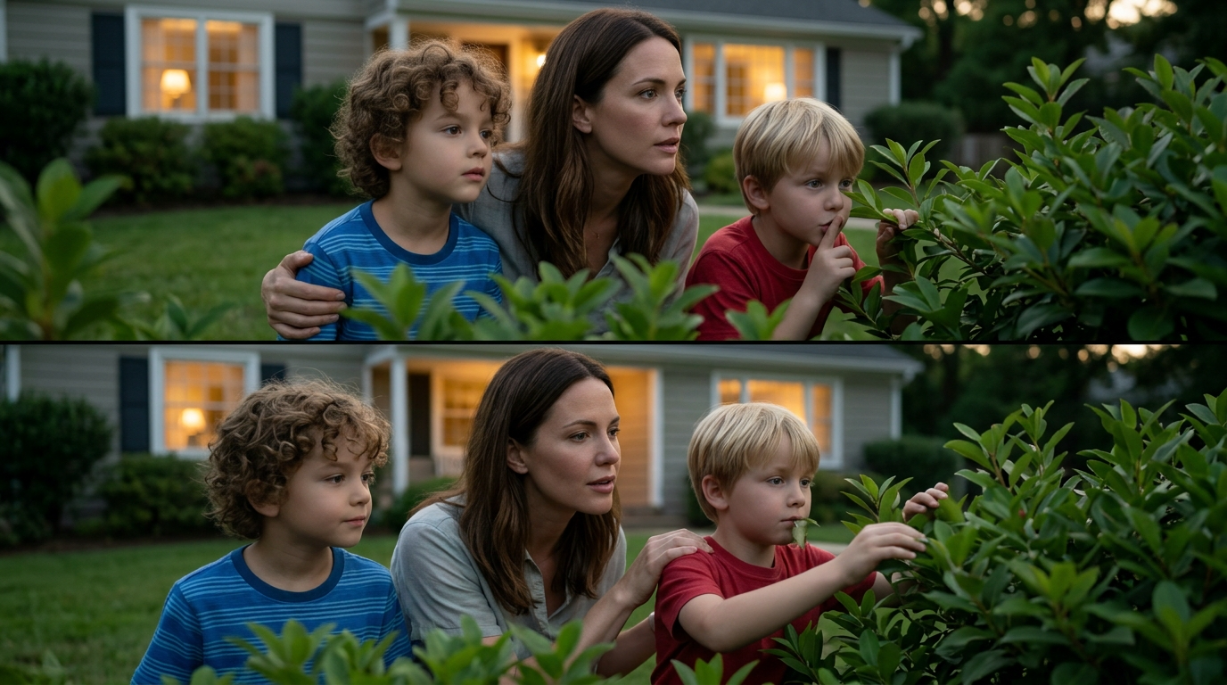
I pressed one hand over Tyler’s mouth before he could say anything.
Advertisement
My son looked at me with wide eyes.
Mark stood beside the dining table.
He looked at the three untouched plates.
Then he slowly pulled out a chair.
Advertisement
He sat down.
For several seconds, he did absolutely nothing.
Then he picked up Noah’s fork.
Turned it over.
Placed it back beside the plate.
He was waiting.
For us to come back.
For someone to make a mistake.
I felt Noah trembling against me.
“Mommy said Daddy would come,” he whispered so quietly I almost didn’t hear him.
I leaned closer.
“What did your mother tell you?”
Noah swallowed.
“She said if Daddy ever came here asking for me, I had to hide.”
My stomach dropped.
Emily had never said anything like that to me.
Not once.
The last time I’d spoken to my sister, she had sounded tired but normal.
She’d told me Noah needed a few weeks away.
She’d said she had some things to deal with.
I’d assumed it was marriage trouble.
I had been wrong.
Completely wrong.
Mark suddenly stood.
He walked toward the hallway.
Then stopped.
His head turned slightly.
He was listening.
I held my breath.
The house became painfully quiet.
Then my phone vibrated inside my pocket.
I nearly screamed.
I grabbed it and looked at the screen.
Unknown number.
One text.
DO NOT CALL THE POLICE YET. HE KNOWS SOMEONE IS WATCHING HIM.
My fingers went numb.
Another message appeared.
GET THE BOYS TO THE SHED. THERE IS A SECOND EXIT.
I stared at the words.
Who was texting me?
How did they know where we were?
Before I could think, Mark walked toward the back door.
I gently pulled Tyler and Noah deeper into the bushes.
The door opened.
Mark stepped outside.
He looked left.
Then right.
His eyes moved slowly across the backyard.
The pool.
The patio.
The fence.
The flowerpots.
Then the bushes.
My heart stopped.
He took one step toward us.
Then another.
Noah suddenly grabbed my hand.
He pointed toward the far corner of the yard.
The old garden shed.
I remembered it had a small door on the opposite side leading toward the alley.
Tyler had used it once when he lost a baseball.
I nodded.
We waited until Mark turned toward the pool.
Then I moved.
One hand around Tyler’s wrist.
One around Noah’s.
We crawled through the mulch.
Every branch sounded like a gunshot in my head.
A twig snapped beneath Tyler’s knee.
Mark turned.
I froze.
He stared directly at the bushes.
Then his phone rang.
He answered.
“Yeah.”
A pause.
“No. They’re not here.”
Another pause.
His expression changed.
“How do you know?”
I couldn’t hear the voice on the other end.
But Mark’s face became darker.
“Then find them before she calls anyone.”
He ended the call.
My blood ran cold.
He wasn’t looking for Noah because he was worried about his son.
Someone else was looking for us too.
We reached the shed.
I opened the tiny door.
The boys slipped inside.
I followed and pulled it closed behind us.
It was dark.
The smell of old lawn equipment and damp wood filled the tiny space.
Tyler whispered, “Mom, what’s happening?”
I put my finger to my lips.
Outside, footsteps moved across the grass.
Mark was searching.
Noah reached into his pocket.
His little fingers pulled out a folded piece of paper.
“I have something else.”
“What is it?”
He unfolded it.
A child’s drawing.
A house.
A blue car.
A woman.
And three red X’s.
I stared at it.
“Who drew this?”
“Mommy.”
“Why?”
Noah looked down.
“She told me to remember.”
I unfolded the paper completely.
There was writing on the back.
Emily’s handwriting.
My sister had written:
Sarah, if Noah reaches you, don’t trust anyone who says I’m dead.
I stopped breathing.
“What?”
Tyler looked at me.
“What does it say?”
I couldn’t answer.
Because at that exact moment, headlights appeared through the cracks in the shed.
A vehicle had entered the alley behind our house.
Someone was coming from the other side.
Then my phone vibrated again.
THE MAN IN YOUR HOUSE IS NOT ALONE.
I looked at Noah.
“Where is the blue envelope?”
He shook his head.
“I hid it.”
“Where?”
He looked toward the house.
“In the place Daddy would never look.”
Before I could ask what that meant, we heard the sound of the back door opening again.
Then a second man’s voice.
“Mark.”
Mark answered immediately.
“They’re not here.”
The stranger replied:
“Then check the shed.”
My blood turned to ice.
The boys stared at me.
Someone knew exactly where we were.
I reached for the shed door.
There was nowhere else to go.
Then Noah whispered:
“There’s another way.”
He pointed toward the floor.
Beneath an old tarp was a wooden hatch.
I had owned this house for eleven years.
I had never known it existed.
Noah lifted the tarp.
There was a small metal ring.
I pulled it.
The hatch opened.
A narrow staircase disappeared into darkness beneath the shed.
Tyler looked at me.
“Mom?”
I didn’t know where it led.
I didn’t know who had built it.
And I didn’t know why my six-year-old nephew knew about it.
But footsteps were already approaching the shed.
So I climbed down.
The boys followed.
I pulled the hatch shut above us.
Darkness swallowed us whole.
For several seconds, none of us moved.
Then I heard someone step into the shed.
The floorboards creaked directly above our heads.
A man’s voice whispered:
“Search everything.”
Tyler squeezed my hand.
Noah pointed down the tunnel.
And then, for the first time that night, I saw something that made me realize this had been planned long before Mark ever arrived at my house.
On the wall was a message painted in white.
Three words.
TRUST SARAH ONLY.
I stared at it.
Because I suddenly understood.
My sister hadn’t sent Noah to me because she was having marital problems.
She had sent him because she was running from something.
And somehow…
she had known exactly where we would hide.
PART 4
The tunnel was so narrow that I had to turn my shoulders sideways to keep moving.
Behind me, Tyler’s breathing was fast and uneven.
Noah was strangely quiet.
Too quiet.
I kept one hand against the wall and the other wrapped around Tyler’s wrist.
“Stay close,” I whispered.
Above us, the men were still searching the shed.
I could hear them dragging boxes.
Something heavy scraped across the floor.
Then a man’s voice said:
“There’s a hatch.”
My blood froze.
“They’re underneath us.”
Tyler looked at me.
I shook my head gently.
No sound.
No panic.
We had to keep moving.
The tunnel sloped downward.
Cold air brushed my face.
Then I saw a faint light ahead.
We hurried toward it.
The passage ended at an old concrete wall.
At first I thought we’d reached a dead end.
Then Noah reached past me.
His small hand found something hidden between two bricks.
A metal latch.
He pulled it.
A section of the wall moved inward.
Beyond it was a small underground room.
There was a flashlight on a table.
Two bottles of water.
Three blankets.
A first-aid kit.
And a wooden chair.
Someone had prepared this place.
Recently.
I stepped inside.
“What is this?”
Noah walked toward a shelf.
“Mommy showed me.”
I stared at him.
“When?”
“Before she disappeared.”
The word hit me harder than anything else.
Disappeared.
Not left.
Not traveled.
Not went away.
Disappeared.
I turned toward him.
“What happened to your mother?”
Noah’s eyes filled with tears.
“Daddy said she went away because she didn’t love us.”
Tyler whispered, “That’s not true.”
Noah shook his head.
“I know.”
He walked to the shelf and pulled out a small plastic box.
Inside were photographs.
My sister Emily.
Noah as a baby.
Emily standing beside Mark.
And several pictures of people I didn’t recognize.
I picked up one.
It showed Emily standing outside an office building.
Beside her was a man in a dark suit.
On the back, Emily had written:
M. Reynolds — Federal Investigator
I looked at Noah.
“Who is he?”
“Mommy said he was helping her.”
My heart began pounding again.
Another photograph showed Emily getting into a car.
Another showed Mark speaking to the same man.
Then I saw something that made my stomach twist.
A photograph of my own house.
Taken from across the street.
My house.
My driveway.
My bedroom window.
And the date written beneath it was six months earlier.
Someone had been watching us long before Noah arrived.
I turned the photograph over.
Emily had written four words.
They know about Sarah.
A sound came from the tunnel.
Someone was coming.
I quickly switched off the flashlight.
Darkness returned.
We crouched behind the table.
Footsteps approached.
Slow.
Careful.
Then a figure appeared at the tunnel entrance.
A flashlight beam swept across the room.
I held my breath.
The light moved over the shelves.
The photographs.
The blankets.
Then stopped.
The man stepped inside.
I couldn’t see his face.
He moved toward the table.
His flashlight suddenly pointed directly at us.
I pulled Tyler against me.
Noah whispered:
“Uncle David?”
The man froze.
Then lowered the flashlight.
“Sarah?”
I recognized the voice.
Mr. Foster.
Our neighbor.
The retired police officer.
He stepped closer.
“It’s me.”
I nearly collapsed from relief.
“What are you doing here?”
He looked at Noah.
Then at Tyler.
“Trying to keep you alive.”
I stared at him.
“You knew about this?”
He nodded.
“Your sister came to me three weeks ago.”
My heart stopped.
“Emily?”
“Yes.”
“She’s alive?”
He hesitated.
That hesitation terrified me more than an answer would have.
“I don’t know.”
“What do you mean you don’t know?”
Mr. Foster lowered his voice.
“She came to my house after midnight. She was terrified. She told me Mark was involved with something dangerous.”
“What?”
“I don’t know the whole story.”
“Then tell me what you do know.”
He looked toward the tunnel.
“Mark isn’t the person in control.”
My skin prickled.
“Who is?”
“That’s what Emily was trying to find out.”
He handed me a sealed envelope.
My name was written across the front.
SARAH.
My hands shook as I opened it.
Inside was a single page.
My sister’s handwriting.
Sarah,
If you’re reading this, Noah reached you.
That means I failed to protect him myself.
I’m sorry.
Please don’t trust Mark.
But don’t assume everyone around him is his enemy either.
There is someone inside the police department helping him.
That’s why I couldn’t report everything normally.
The evidence is hidden where we used to play as children.
You will know the place.
The blue envelope contains the key.
Find the evidence before they do.
And Sarah…
If Mark tells you I’m dead, don’t believe him.
I lowered the letter.
My hands were shaking.
“The place where we used to play?”
Mr. Foster looked at me.
“You know where she means?”
I nodded slowly.
There was only one place.
The old lake house.
When we were children, Emily and I used to spend every summer there with our parents.
We had built a tiny wooden fort behind the property.
We buried things there.
Secret notes.
Photographs.
Childhood treasures.
But the lake house had been sold years ago.
Or so I thought.
I looked at Noah.
“Where’s the blue envelope?”
He pointed toward the wall.
“Behind the clock.”
Mr. Foster frowned.
“The clock?”
I walked over.
There was an old battery-powered clock hanging above the shelf.
I removed it.
Behind it was a narrow compartment.
Inside was a blue envelope.
I pulled it out.
The envelope was sealed.
My name was written across it.
But before I could open it, my phone rang.
Unknown number.
I answered without speaking.
For several seconds, there was silence.
Then a woman’s voice whispered:
“Sarah.”
I knew that voice.
My knees nearly gave out.
“Emily?”
“Listen carefully.”
My sister was crying.
“I don’t have much time.”
“Where are you?”
“I can’t tell you.”
“Are you alive?”
“Yes.”
I closed my eyes.
Relief crashed through me.
“Where is Noah?”
“With me,” I said.
Silence.
Then:
“No. Sarah…”
Her voice broke.
“Noah cannot be with you.”
I looked at my nephew.
He was staring at me.
“What do you mean?”
Emily whispered:
“Because if Noah reached you, they already know where the evidence is.”
The call suddenly crackled.
A man’s voice shouted something in the background.
Emily gasped.
“Sarah, you have to leave the house!”
“We’re already underground.”
“Good.”
She breathed rapidly.
“Go to the lake house.”
“I don’t have a car.”
“Foster does.”
Mr. Foster looked at me.
Emily continued:
“Do not trust the police.”
“I know.”
“And don’t trust Mark.”
“I know.”
“But Sarah…”
She paused.
“Don’t trust the man who rescued you either.”
I looked at Mr. Foster.
He went completely still.
Then the call ended.
Nobody spoke.
Mr. Foster slowly reached for his phone.
“She shouldn’t have said that.”
I stepped backward.
“What does that mean?”
He looked at me.
“Sarah, there are things I haven’t told you.”
The boys moved behind me.
I held the blue envelope tighter.
“What things?”
Mr. Foster sighed.
Then he said something that made everything suddenly more complicated.
“I was the one who gave Emily the first warning about Mark.”
I stared at him.
“But I was also the person who told Mark where she was hiding.”
The room went silent.
Tyler whispered:
“Mom…”
Mr. Foster raised both hands.
“Wait.”
I stepped between him and the boys.
“Why would you do that?”
“Because I had no choice.”
“Everyone says that!”
His expression hardened.
“You think I’m working with Mark?”
“I don’t know what to think.”
He looked at the blue envelope.
“Open it.”
“Why?”
“Because your sister left something inside that will explain everything.”
I looked down at the envelope.
Then at Noah.
Then at Tyler.
Slowly, I tore it open.
Inside was a small brass key.
A memory card.
And one photograph.
I turned the photograph over.
Written on the back were five words:
The truth about Noah’s father.
My heart began pounding.
I inserted the memory card into my phone.
One video appeared.
The file was dated four days before Noah arrived at my house.
I pressed play.
Emily appeared on the screen.
Her face was bruised.
Her eyes were swollen from crying.
She looked directly into the camera.
“Sarah, if you are watching this…”
She took a trembling breath.
“…then you need to know the truth.”
The video suddenly froze.
Then the screen went black.
A message appeared:
FILE ENCRYPTED.
Below it was a password prompt.
Noah stepped forward.
“I know the password.”
I looked at him.
“You do?”
He nodded.
“Mommy taught me.”
“What is it?”
He whispered six words.
And when I heard them, I realized the secret Emily had been protecting wasn’t only about Mark.
It was about Noah himself.
The password was:
“Daddy is not my real father.”
CONTINUE READING NEXT PART_My 6-Year-Old Nephew Whispered, “Hide Right Now
