 Reading Time: 40 minutes
My father let the laughter breathe for several seconds. Then he looked directly at me from the center of the ballroom, microphone still in his hand.
“Some people,” Arthur Sterling continued, “simply need a little more time to find their place in the world.” More laughter. Not from everyone.
But enough.
Enough that I could hear glasses clinking as people leaned toward one another.
Enough that I could see my mother covering her smile with two perfectly manicured fingers.
Enough that Chloe lowered her face toward Flynn’s shoulder, pretending she was embarrassed while very obviously laughing.
My father loved rooms like this.
Rooms filled with people who knew his name.
Rooms where nobody challenged him.
Rooms where wealth and reputation could be mistaken for character.
He had spent my entire childhood teaching me one lesson:
Whoever controlled the room controlled the truth.
For most of my life, I had believed him.
That night, I finally understood that he had been wrong.
Because the truth did not need control.
It only needed a chance to walk through the door.
My father raised his champagne glass.
“To Chloe,” he said.
Everyone applauded.
I remained seated.
Arthur noticed.
Of course he noticed.
His expression tightened almost imperceptibly.
Then he stepped away from the microphone.
The orchestra started preparing for the first dance.
People returned to their conversations.
I looked at my phone.
Luca had sent another message.
“Downstairs.”
I typed back only three words.
“Come up now.”
Then I placed my phone beside my plate.
I should have known my father would not leave it alone.
Humiliating me from fifty feet away had never been enough for him.
He preferred proximity.
He liked seeing whether his words landed.
He liked watching the exact moment someone’s face changed.
Less than a minute later, Arthur was walking toward Table 21 with a glass of Cabernet in his right hand.
My mother followed several steps behind him.
Chloe came too.
So did Aunt Patricia.
It was almost funny.
A family procession.
They surrounded my little table beside the kitchen doors as though they had been waiting all evening for an audience.
“You could at least smile,” my father said.
“I am smiling.”
“You look miserable.”
“I’m not.”
Mother crossed her arms.
“Jessi, your father just included you in his speech. The least you can do is look grateful.”
I glanced toward the head table.
“You mean the part where he told three hundred people that I’m professionally and socially unsuccessful?”
Mother sighed.
“There you go again.”
“There I go where?”
“Turning everything into an attack.”
Chloe laughed softly.
“Can we please not do this tonight?”
I looked at her.
“I wasn’t doing anything.”
“You always say that.”
“I was sitting beside the kitchen.”
“You know what I mean.”
No.
Actually, I didn’t.
That was the strange thing about my family.
They could provoke you, insult you, exclude you, laugh at you, and then become offended by your reaction.
My father leaned closer.
“This is your sister’s night.”
“I know.”
“Then act like it.”
“I came when I was invited. I brought a gift. I’ve spoken to almost nobody. I’m sitting exactly where you placed me. What precisely would you like me to do differently?”
His eyes hardened.
He hated questions that required actual answers.
Mother gave me a warning look.
“Jessi.”
“What?”
“Your tone.”
I nearly laughed.
Thirty-two years old.
Director of Global Strategy.
Responsible for decisions that could move hundreds of millions of dollars.
And my mother was still correcting my tone as though I were twelve years old at the dinner table.
Chloe looked down at my dress.
Her smile changed.
“You know,” she said, “I actually meant to ask you about that.”
“About what?”
“The color.”
I looked at my gown.
It was ivory.
Not white.
Not bridal.
Ivory.
Simple.
Elegant.
High-necked.
Long-sleeved.
There was nothing remotely bridal about it.
Chloe knew that.
Everyone standing there knew it.
But she wanted a reason.
My father wanted one too.
“What about it?” I asked.
“Did you really think ivory was appropriate?”
My cousin Kelly, who had wandered over to watch, made a little sound of agreement.
I stared at my sister.
“You approved the dress.”
Her expression flickered.
Only for a second.
Three months earlier, Chloe had asked what I planned to wear.
I had sent her photographs of three dresses.
She selected this one.
She had even texted:
“Wear the ivory. It’s elegant and not flashy.”
Now she lifted one shoulder.
“I don’t remember that.”
Of course she didn’t.
My father took a slow drink of wine.
“Whether she approved it or not, you could have used common sense.”
I looked at him.
“I did.”
“That’s debatable.”
I reached for my water.
That should have ended it.
A normal person would have walked away.
My father had never been a normal person when his pride was involved.
He stepped closer.
“You’ve been sulking all night.”
“No.”
“People have noticed.”
“No one has noticed anything.”
“I have.”
“That isn’t the same thing.”
His face changed.
There it was.
The thing I had seen throughout my childhood.
That small tightening around his mouth.
The warning.
The moment he decided that being respected was not enough.
He needed me diminished.
He looked at my dress.
Then at the wine in his hand.
What happened next took less than two seconds.
He tilted the glass.
And poured it directly over me.
Not an accident.
Not a splash.
Not a clumsy movement.
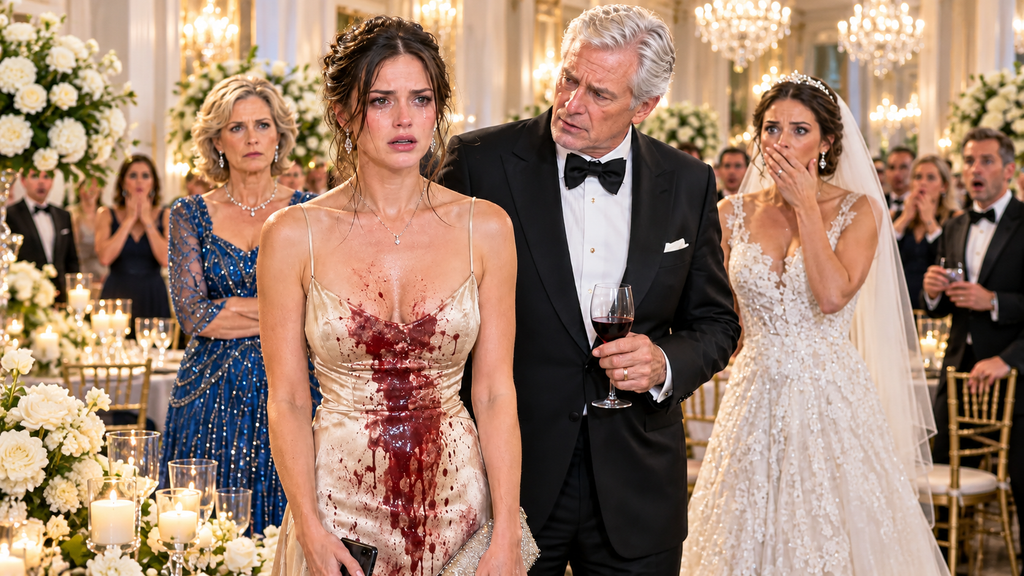
He deliberately emptied the entire glass down the front of my ivory silk gown.
Cold liquid hit my shoulder first.
Then my chest.
Then my waist.
The smell of red wine rose immediately around me.
A dark stain spread through the pale fabric like blood through water.
Someone behind us gasped.
The orchestra stopped tuning.
Conversations died one after another until the ballroom fell into a silence so complete I could hear a spoon strike a saucer ten tables away.
My father placed the empty glass onto my table.
Then he smiled.
“For once in your life,” he said loudly, “stop trying to steal the spotlight.”
My mother laughed.
Aunt Patricia laughed.
Then Chloe did.
It was quieter than my mother’s.
But I heard it.
I think that was the moment something finally ended inside me.
Not broke.
Ended.
Breaking implies pain.
This was different.
This was clarity.
I looked at my father.
At the man whose approval I had once spent years trying to earn.
At the man who had skipped my university honors ceremony because Chloe had a beauty pageant rehearsal.
At the man who had told me I was “difficult to love” when I was seventeen because I confronted him about reading my private journal.
At the man who had once refused to speak to me for six weeks because I accepted a scholarship at a university he had not chosen.
I had imagined this moment so many times throughout my life.
Not the wine.
The moment when I finally stood up to him.
In those imaginary scenes, I always shouted.
I listed every insult.
Every betrayal.
Every cruel little sentence they pretended to forget.
But sitting there with red wine soaking into a dress that cost more than my first car, I discovered something.
I didn’t want to scream.
I didn’t want to explain.
I didn’t need him to understand.
So I reached inside my clutch.
My mother’s laughter faded.
I took out my phone.
Arthur watched me.
“What are you doing?”
I unlocked the screen.
“Making a call.”
“To whom?”
I looked at him.
“You’ll see.”
I pressed Luca’s name.
He answered immediately.
“Jessi?”
“Come in.”
A pause.
Then his voice changed.
“What happened?”
I looked down at my dress.
“My father poured wine on me.”
Silence.
Luca did not swear.
He did not shout.
That was never his way.
The quieter Luca became, the more concerned everyone around him usually needed to be.
“Are you hurt?”
“No.”
“Are you sure?”
“Yes.”
“I’m coming.”
The line disconnected.
My father laughed.
“You called someone because wine got on your dress?”
“No.”
“Then what was that supposed to be?”
I set my phone beside my plate again.
“Nothing you need to worry about.”
That sentence bothered him.
I could see it immediately.
For the first time all evening, he did not know what was happening.
And my father hated not knowing.
Mother leaned toward me.
“You’re being ridiculous.”
“I’m sitting quietly.”
“You’re creating a scene.”
I looked around at the three hundred people staring at us.
“Interesting interpretation.”
Several guests lowered their eyes.
My mother flushed.
Chloe crossed her arms.
“If you ruin my wedding over a dress—”
I looked directly at her.
“I have not ruined one thing tonight.”
Her mouth closed.
Then the ballroom doors opened.
Four men entered.
Dark suits.
White shirts.
No ties on two of them.
Small communication devices at their ears.
Their movements were calm, coordinated, almost invisible in their precision.
One walked to the left side of the ballroom.
Another went right.
Two remained near the entrance.
People began whispering.
My father turned toward them.
His first expression was annoyance.
“Excuse me,” he called. “This is a private event.”
The men did not respond.
The hotel’s event manager hurried toward them.
Then suddenly stopped.
His expression shifted.
He nodded.
And stepped aside.
My father frowned.
“What is this?”
Nobody answered him.
A fifth figure appeared in the doorway.
Tall.
Dark charcoal suit.
No overcoat.
His hair still slightly windblown from the helicopter ride.
Luca.
My husband entered the ballroom with the calm expression I had seen him wear before billion-dollar negotiations.
He scanned the room once.
Then his eyes found me.
And stopped.
Everything in his face changed.
His gaze moved from my face to the red stain covering my dress.
Then toward my father.
I saw Luca’s jaw tighten.
Across the ballroom, someone whispered loudly enough to be heard.
“Oh my God.”
Another voice followed.
“That’s Luca Vance.”
My father went completely still.
He knew exactly who Luca was.
Of course he did.
Most of the room did.
Luca rarely attended celebrity events, but his face appeared often enough in business publications.
Founder and CEO of Vance Global.
Technology.
Energy systems.
Telecommunications.
Aerospace investments.
Infrastructure.
His company operated in twenty-three countries.
More importantly, at least to my father, Vance Global was currently reviewing outside legal counsel for a series of acquisitions expected to generate tens of millions of dollars in legal fees over the next several years.
Arthur’s firm had been pursuing that account for months.
I knew because he had bragged about it during Christmas dinner.
He had spent forty minutes explaining how securing Vance Global would “cement his legacy.”
At the time, I had sat silently beside him.
Luca and I had exchanged a glance across our kitchen the next morning when I told him.
We had laughed.
We hadn’t interfered.
His company’s legal team made its own decisions.
Now my father watched Luca crossing the ballroom.
Color drained slowly from his face.
Mother whispered:
“Arthur…”
“I know who he is.”
Luca walked directly to me.
He did not acknowledge my father.
He did not greet Chloe.
He did not react to the hundred phones beginning to appear around the room.
He simply stopped beside my chair.
His eyes softened.
“Are you okay?”
“I’m fine.”
He crouched slightly in front of me.
His fingers touched my wrist.
“Did any glass break?”
“No.”
“Did he touch you?”
“No.”
“Just the wine.”
“Yes.”
Only then did Luca stand.
He removed his suit jacket.
Carefully, he placed it around my shoulders.
The gesture was so simple that it nearly broke the control I had maintained all evening.
Not because I needed the jacket.
Because I suddenly remembered what respect felt like.
Luca looked at my father.
Arthur straightened instinctively.
Years of professional reflex.
“Mr. Vance.”
Luca said nothing.
My father cleared his throat.
“I’m Arthur Sterling. Sterling, Carlisle and Bennett.”
“I know who you are.”
Arthur forced a laugh.
“Well, then, I’m sure you understand this is simply a family misunderstanding.”
Luca’s expression remained unreadable.
“A misunderstanding?”
“Yes.”
My father gestured toward me.
“My daughter can be rather dramatic.”
Luca looked at me.
Then back at him.
“Your daughter?”
“Yes.”
A strange silence settled over our little circle.
Luca looked at me again.
“Would you like to tell him?”
For the first time that night, I smiled.
Not because I enjoyed humiliating my father.
I didn’t.
I smiled because the secret no longer felt like protection.
It felt like freedom.
I stood.
Luca’s jacket remained draped over my wine-stained dress.
Then I faced my family.
“Dad,” I said quietly, “this is Luca.”
My father looked confused.
“I know who Mr. Vance is.”
“No.”
I shook my head.
“You know his name.”
Then I slipped my left hand from beneath Luca’s jacket.
The diamond band I normally wore on a chain while visiting my family was on my finger.
I had put it on in the elevator before the reception.
My mother’s eyes dropped toward it.
Her face changed first.
Then Chloe’s.
I reached for Luca’s hand.
“This is Luca Vance.”
I paused.
“My husband.”
Nobody laughed.
Not one person.
My father stared at me.
Then at Luca.
Then back at me.
“What?”
“My husband.”
Mother actually took a step backward.
“You’re married?”
“Yes.”
“To him?”
Luca raised one eyebrow.
I almost laughed.
“Yes, Mom. To him.”
“How long?”
“Two years.”
Chloe’s mouth fell open.
“Two years?”
“Yes.”
“And you never told us?”
“No.”
My mother pressed one hand to her chest.
The performance had begun.
I recognized it immediately.
“You hid your wedding from your own mother?”
“I protected my marriage from my family.”
“That is disgusting.”
“No, Wendy.”
The words came from behind Luca.
A woman had entered the ballroom.
Eleanor Vance.
Luca’s mother.
Chairwoman emeritus of the original Vance Technology Group.
Elegant.
Silver-haired.
Seventy years old and still capable of making a room full of executives straighten their posture without raising her voice.
My father recognized her too.
That was the second moment his face collapsed.
Eleanor approached me and kissed my cheek.
“My darling girl.”
She looked at my dress.
Her expression became cold.
Then she turned toward my mother.
“What is disgusting is pouring wine over your own daughter at a public event and laughing about it.”
Mother’s lips parted.
“I don’t believe we’ve met.”
“No,” Eleanor said. “Jessi thought it was wiser that we didn’t.”
The words landed harder than any insult could have.
My mother looked at me.
“You’ve met his family?”
“Of course.”
“How many times?”
“Many.”
“You spend holidays with them?”
“Sometimes.”
Mother stared at me as though I had confessed to stealing something.
In her mind, perhaps I had.
Access.
Status.
A family they would have desperately wanted to impress.
A world they had spent their lives trying to enter.
And I had quietly belonged to it without giving them the chance to use it.
Chloe shook her head slowly.
“This is insane.”
“No,” I said. “It’s just something you didn’t know.”
“You let us think you were alone.”
I looked at her.
“You never asked whether I was happy, Chloe.”
Her face tightened.
“That isn’t true.”
“When was the last time you asked?”
She said nothing.
I continued.
“You asked what I earned once because you wanted to compare salaries. Mom asked whether I was dating because Aunt Patricia’s daughter had gotten engaged. Dad asked whether I’d been promoted because he wanted to know if I could increase my share of Mom’s birthday trip.”
I swallowed.
“But none of you ever asked whether I was happy.”
The ballroom remained silent.
I realized dozens of people were listening.
Normally that would have frightened me.
That night, I didn’t care.
My father finally found his voice.
“Regardless, concealing a marriage like this from your family is—”
“What?”
I asked.
“Embarrassing?”
His mouth closed.
“Disrespectful?”
Nothing.
“Disappointing?”
My voice did not rise.
“I’ve heard those words before.”
Luca’s thumb brushed slowly across the back of my hand.
Grounding me.
Not controlling me.
Not speaking for me.
Simply reminding me he was there.
My father looked toward him.
“Mr. Vance, whatever Jessi has told you about us—”
Luca interrupted him.
“She barely tells me anything about you.”
That hurt him more.
I could see it.
Arthur had expected accusations.
Stories.
A campaign against him.
The idea that I had simply moved on from needing to discuss him was worse.
Luca continued.
“What I know tonight, I watched with my own eyes.”
My father glanced toward the ceiling.
Cameras.
The hotel ballroom had several.
Arthur noticed them.
His expression changed.
“It was a joke.”
I actually laughed then.
A short, astonished sound.
“A joke?”
He looked at me.
“You know I didn’t mean anything by it.”
“You poured an entire glass of wine over me.”
“And now you’re standing there perfectly fine.”
There it was.
The family philosophy.
If the wound did not kill you, they had done nothing wrong.
I looked at him for a long moment.
Then I said:
“Do you remember my eighteenth birthday?”
His brows drew together.
“What?”
“My eighteenth birthday.”
“This is hardly the time—”
“I wore a blue dress.”
Mother’s face changed.
She remembered.
I continued.
“You told me the dress made me look heavier than Chloe.”
My father shifted.
“I have no memory of that.”
“I do.”
I turned toward my mother.
“And you told me not to eat cake until after the photographs.”
Mother looked toward the floor.
“Jessi—”
“Do you remember my college graduation?”
Nobody answered.
“You didn’t come.”
My father sighed.
“We had already discussed this.”
“Chloe had a pageant rehearsal.”
“It was an important competition.”
“I graduated first in my class.”
My voice trembled for the first time.
I hated that.
Then I decided not to.
Let it tremble.
Some truths deserved to carry the weight of the years behind them.
“I kept looking at the doors during the ceremony.”
My father looked away.
“I knew you probably weren’t coming. But every time those auditorium doors opened, I still looked.”
The ballroom had disappeared around me.
For one moment, I was twenty-two again.
Black graduation robe.
Gold honors cords.
Hundreds of families cheering.
And one empty row containing three reserved seats with my family’s names.
“I told myself traffic was bad.”
My throat tightened.
“I told myself maybe the pageant ended late.”
I breathed.
“Then Chloe posted photographs from dinner.”
Mother whispered:
“That was a long time ago.”
“Yes.”
I nodded.
“It was.”
I looked at all three of them.
“That’s the point.”
Silence.
“It was always a long time ago by the time I was allowed to be hurt.”
My sister stared at me.
I had never said that aloud before.
Not even to Luca.
“If I confronted you immediately, I was dramatic. If I mentioned it later, I was holding a grudge. If I stayed quiet, you assumed it didn’t matter.”
I looked down at the wine stains.
“So tonight matters.”
Arthur’s expression hardened again.
He needed control back.
“Enough.”
I looked up.
“No.”
His eyes widened.
“No?”
“No.”
He had probably never heard the word from me so calmly.
“I’m not finished.”
“You will not use your sister’s wedding to conduct some childish family trial.”
I stared at him.
“You were the one who picked up the microphone.”
A ripple moved through the room.
Not laughter exactly.
Recognition.
My father heard it.
His jaw tightened.
“And then,” I continued, “you walked to my table and poured wine over my dress.”
“I already said it was a joke.”
“No.”
I shook my head.
“You said I embarrassed you.”
“You have embarrassed us.”
Mother jumped in.
“Keeping a marriage secret for two years? Letting your family walk around looking like fools?”
I turned toward her.
“You did that yourselves.”
Her face went scarlet.
“Excuse me?”
“You decided I was unsuccessful.”
I looked toward Aunt Patricia.
“You decided I rented my dress.”
Kelly looked down.
“You decided I was alone because nobody wanted me.”
Patricia took half a step backward.
“And none of you asked a single question.”
My mother’s voice sharpened.
“So what exactly do you do?”
There it was.
Not “Are you happy?”
Not “Why did you feel you couldn’t trust us?”
Not “How did we miss two entire years of your life?”
What do you do?
Status.
Title.
Worth.
The only language they understood.
I almost refused to answer.
Then Luca looked at me.
Not urging.
Simply waiting.
I realized something.
I was tired of hiding.
Not because they deserved access to my life.
Because I no longer needed secrecy to feel safe.
I straightened my shoulders.
“I’m Director of Global Strategy at Sterling & Vance Capital.”
My father blinked.
“What?”
I repeated it.
Slower.
“I’m Director of Global Strategy at Sterling & Vance Capital.”
Flynn’s father, Marcus Reed, stood abruptly from the head table.
That attracted more attention than anything else had.
Marcus stared at me.
“Jessi Sterling?”
I turned.
“Yes.”
His face went pale.
My father looked between us.
“You know her?”
Marcus gave a disbelieving laugh.
“Know her?”
He came toward us.
“Arthur, your daughter led the consortium that restructured the Westbridge infrastructure fund.”
My father stared at me.
Marcus continued.
“She negotiated the Armitage technology acquisition.”
Someone across the room whispered something.
Marcus shook his head.
“She sits on three strategic investment committees. Reed Financial has spent the last six months trying to secure a co-financing position with her group.”
My mother’s mouth opened.
Nothing came out.
Marcus looked at me with an expression somewhere between shock and embarrassment.
“I had no idea you were Chloe’s sister.”
“That makes two of us,” I said.
A few people actually laughed.
Marcus did not.
He looked genuinely disturbed.
Then he glanced toward my father.
“You told me Jessi did administrative work.”
Arthur’s face reddened.
“I was given to understand—”
“No.”
I interrupted him.
“You weren’t given anything.”
He looked at me.
“You never asked.”
That silence was different.
He had no defense against it.
Because it was true.
My mother had spent years introducing me as:
“Our older daughter. She works in finance somewhere.”
Sometimes she added:
“Nothing exciting.”
Once, at Christmas, my father had asked whether I could print something for him because, as he put it, “You’re basically an office person, aren’t you?”
I had printed it.
Thirty minutes earlier, I had approved the risk framework for a $640 million transaction.
But I had printed his airline tickets because arguing felt exhausting.
Marcus Reed looked toward Flynn.
The groom had risen from his chair too.
His expression was unreadable.
Chloe looked between everyone.
Then at me.
“You make that kind of money?”
I stared at her.
Of all possible questions.
“That’s what you heard?”
Her cheeks reddened.
“No. I just mean… why would you live in that apartment?”
My apartment.
The “tiny” one my family mocked.
A three-bedroom penthouse I kept under a holding company and deliberately never invited them to visit.
I almost smiled.
“I don’t.”
Chloe blinked.
“What?”
“I haven’t lived there in three years.”
Mother whispered:
“Then where do you live?”
I looked at Luca.
“Mostly with my husband.”
“Where?”
Luca finally smiled.
“Wendy.”
Something in his tone stopped her.
My husband rarely needed to raise his voice.
He simply had a way of reminding people that access to our private life was not theirs by default.
Mother looked humiliated.
For once, I felt no urge to rescue her.
My father adjusted his jacket.
Professional mask returning.
“All right.”
He cleared his throat.
“Clearly there have been misunderstandings on both sides.”
On both sides.
Of course.
He continued.
“Jessi should have told us certain things. We perhaps could have made more effort to understand her career.”
Perhaps.
More effort.
As though my thirty-two years were a clerical oversight.
“So,” he said, “why don’t we stop making a spectacle of ourselves and return to the wedding?”
I looked at him.
He genuinely believed that was how this ended.
A reset.
No apology.
No accountability.
Simply close the door and protect appearances.
“No.”
Again that word.
His face changed again.
“Jessi.”
“I’m leaving.”
Chloe immediately stepped forward.
“Oh, come on.”
I turned toward her.
“It’s your wedding. Enjoy it.”
“So you’re going to storm out after making everything about you?”
For the first time, anger sparked through me.
“Chloe.”
She stopped.
“I sat beside a kitchen door for four hours while Dad publicly mocked me, and then he emptied wine over my head.”
I pointed toward the dark stain covering my body.
“You laughed.”
Her face changed.
“I didn’t—”
“You did.”
“I was uncomfortable.”
“You laughed.”
“I didn’t know what else to do.”
I stared at her.
“You could have said stop.”
She looked away.
That was the difference between Chloe and my parents.
My parents usually believed they were right.
Chloe knew when something was wrong.
She simply preferred comfort.
Every time.
“I’m not trying to ruin your wedding,” I said more quietly.
“I came because you invited me.”
A bitter smile touched my mouth.
“Although apparently you invited me mostly so the family photographs would contain both daughters.”
Her eyes filled.
That surprised me.
“Jessi…”
I shook my head.
“Not tonight.”
I started gathering my clutch.
Then my father said the wrong thing.
Again.
“You are not leaving.”
I slowly looked at him.
He repeated it.
“You are not walking out of this wedding after creating this chaos.”
I almost couldn’t believe him.
“What are you going to do?”
He glanced toward the four security men positioned near the doors.
Then apparently remembered they had arrived with my husband.
His mouth tightened.
“You think having a wealthy husband means you can treat your family any way you want?”
Luca stepped forward.
But I squeezed his hand.
This was mine.
“No.”
I looked directly at my father.
“Having a good husband showed me how badly my family treated me.”
That sentence silenced him completely.
Luca looked at me.
His expression softened.
I kept going.
“When I met Luca, I thought kindness always came with conditions.”
My voice grew quieter.
“I thought apologies meant someone wanted something. I thought disagreement meant punishment. I thought love could be withdrawn the moment I disappointed somebody.”
My mother’s eyes shifted.
“For almost a year, every time Luca and I argued, I packed an overnight bag.”
Luca’s eyes closed briefly.
He remembered.
“I never told him why at first.”
The ballroom was so quiet that I could hear myself breathing.
“Because when I was growing up, Dad sometimes refused to speak to me for days.”
My father scoffed.
“That is ridiculous.”
I looked at him.
“Six weeks.”
His mouth closed.
“When I chose my university.”
I looked at my mother.
“You told me to apologize.”
“You were disrespectful.”
“I accepted a scholarship.”
“You defied your father.”
“There.”
I nodded slowly.
“That.”
Mother stared at me.
“That is exactly why I never told you about Luca.”
No one moved.
“I had one good thing that belonged completely to me.”
I squeezed Luca’s hand.
“One place in my life where I wasn’t being measured against Chloe. One family dinner where no one made jokes about my clothes or my relationship status. One home where silence wasn’t used as punishment.”
Eleanor Vance’s eyes glistened.
I looked at her.
For two years, that woman had remembered my birthday.
Not because her assistant reminded her.
Because she cared.
When I had pneumonia during my first winter married to Luca, she had shown up at our home with soup and three novels, then sat downstairs for six hours because Luca had meetings and she did not want me alone.
The first Christmas I spent with the Vances, Eleanor had given me a framed copy of the handwritten note Luca sent after our first transaction.
The one that said:
“You were right. This annoys me more than it should.”
My own mother had given me anti-aging serum that same year.
I turned back to Wendy.
“I didn’t hide my marriage because I was ashamed of my husband.”
I swallowed.
“I hid it because I was ashamed of how you would treat him once you realized who he was.”
Mother’s face crumpled.
Not with remorse.
With offense.
“That is an unbelievable thing to say.”
“Is it?”
I looked toward my father.
“Dad spent Christmas bragging about trying to win Vance Global as a client.”
Arthur’s eyes flashed.
I continued.
“If I had told him Luca was my husband, how long would it have taken before he asked me for an introduction?”
“I would never—”
“Ten minutes?”
“Jessi.”
“Five?”
His face told me everything.
Luca remained silent.
Then Arthur looked at him.
The desperation was beginning now.
I recognized it.
“Mr. Vance, since this has come up, I hope you understand that my professional relationship with your company has absolutely nothing to do with a private family disagreement.”
Luca regarded him for several seconds.
“My company does not have a professional relationship with you.”
Arthur blinked.
“Our firms are currently in discussions.”
“Your firm submitted a proposal.”
“My understanding was that we were on the final shortlist.”
“You were.”
Past tense.
Arthur caught it.
So did everyone else.
His complexion changed.
Luca continued before he could speak.
“And to be very clear, Jessi has never influenced that process.”
I looked at my husband.
“Not once,” he added.
Then he looked at my father.
“I made certain of it because she asked me to.”
Arthur frowned.
Luca’s voice remained calm.
“She did not want your treatment of her to affect anyone else at your firm.”
My father stared at me.
That surprised him.
Of course it did.
He had expected revenge.
The idea that I had protected his coworkers from his behavior did not fit the version of me he had created.
Luca continued.
“But tonight changes something.”
Arthur’s posture stiffened.
“This is a private event.”
“No.”
Luca looked toward the phones pointed in our direction.
“Tonight became public when you took a microphone and humiliated your daughter in front of three hundred people.”
Arthur looked around.
Several guests immediately lowered their phones.
Others did not.
Luca went on.
“I will not personally decide what happens with your firm’s proposal. That would be improper.”
Arthur visibly relaxed.
Only slightly.
“The legal committee will make that decision.”
Then Luca added:
“But your behavior tonight will be disclosed to them because character and judgment matter when choosing counsel expected to represent our organization.”
Arthur’s face drained again.
He opened his mouth.
Closed it.
For the first time in my life, my father had nothing useful to say.
No threat.
No joke.
No correction.
No lecture.
He looked small.
Not physically.
Morally.
There is a strange moment that happens when you finally see a parent clearly.
When you are a child, they are giants.
Even cruel parents.
Especially cruel parents.
Their moods become weather.
Their approval becomes oxygen.
Their disappointment becomes proof that something is wrong with you.
Then one day, if you are fortunate, you grow old enough to see them at human scale.
Flawed.
Afraid.
Sometimes selfish.
Sometimes cruel.
And suddenly you realize:
They were never gods.
They were simply people who had power over a child.
I looked at my father.
And for the first time, I was not afraid of him.
Not even a little.
Then another voice interrupted.
“Arthur.”
Marcus Reed had stepped forward.
My father turned.
Marcus looked furious.
But not for the reason anyone expected.
He looked toward me first.
“Jessi, I owe you an apology.”
I frowned.
“For what?”
“For sitting there.”
He gestured toward the head table.
“Listening to that speech.”
He shook his head.
“I should have stopped it.”
My father scoffed.
“Marcus, don’t be absurd.”
Marcus turned on him.
“Your daughter is one of the senior decision-makers in a consortium currently evaluating a financing partnership with my bank, and somehow that is the least important part of what I just learned about her.”
My father froze.
Marcus continued.
“You poured wine over your own child.”
“Adult daughter.”
I almost laughed at the correction.
Marcus stared at him.
“As though that makes it better?”
Arthur’s lips tightened.
“This is family business.”
“No.”
Marcus shook his head.
“This is judgment.”
Then he glanced toward Flynn.
His son had come closer.
Chloe’s new husband looked devastated.
Not angry at me.
At her.
He looked at Chloe.
“You laughed?”
Chloe’s eyes filled.
“Flynn…”
“Did you?”
“I was nervous.”
“Did you laugh?”
Tears slipped down her cheeks.
“Yes.”
Flynn stared at her.
That one word changed the air.
Chloe reached for him.
“Please.”
He stepped back.
My heart twisted unexpectedly.
This was still her wedding.
Her first night as a wife.
I had no desire to destroy her marriage.
I never had.
“Flynn,” I said.
He looked at me.
“Don’t make a permanent decision tonight because of me.”
Chloe looked surprised.
So did my mother.
I continued.
“But don’t ignore what you saw either.”
Flynn gave a slow nod.
“That’s fair.”
Chloe stared at me.
I could not read her expression.
Then my father said:
“Can everyone please stop behaving as though Jessi is some victim?”
The sentence traveled through me like cold water.
Mother whispered:
“Arthur…”
But he was too angry now.
Humiliation had stripped away the polished attorney.
What remained was the man I knew.
“She hid her marriage.”
He pointed toward me.
“She lied about her career.”
“I never lied.”
“You let us believe—”
“Believe what?”
“That you were struggling.”
“I never said that.”
“You let us pity you.”
“I never asked you to.”
“You sat there smugly all these years knowing things we didn’t.”
I stared at him.
And suddenly I understood the real offense.
I had escaped the role he assigned me without asking permission.
He could tolerate believing I was less successful than Chloe.
He could tolerate imagining me lonely.
He could tolerate treating me badly as long as he believed I needed his family.
What he could not tolerate was discovering that I had built a beautiful life entirely outside his control.
“I wasn’t smug,” I said.
“I was private.”
“Same thing.”
“No.”
I shook my head.
“They only look the same to someone who thinks he is entitled to know everything.”
His nostrils flared.
“You are my daughter.”
“Yes.”
“Then I am entitled to know when you get married.”
“No.”
The room seemed to inhale.
I had finally said the thing I spent half my life learning.
“No, you weren’t.”
His eyes widened.
“You were entitled to be treated respectfully.”
I continued.
“You were entitled to an invitation if we had the kind of relationship where I wanted you there.”
His face darkened.
“You weren’t entitled to my wedding simply because you’re my father.”
Mother began crying.
Quietly.
For real this time.
I looked at her.
Some part of me still wanted to go to her.
That instinct had been trained into me over decades.
Whenever she cried, we comforted her.
Even when we were the ones who had been hurt.
Especially then.
I stayed where I was.
Mother whispered:
“Was I really that terrible?”
That question hurt more than my father’s anger.
Because there was something almost childlike in it.
I looked at her.
“You laughed.”
Her face crumpled.
“At what?”
“When Dad poured wine on me.”
She looked toward my dress.
For once, she had no defense.
“I thought…”
She stopped.
“What?”
“I thought he was just trying to make a point.”
“With wine?”
She wiped her cheek.
“I didn’t know how serious he was.”
“Mom.”
My voice softened.
“You laughed before you knew whether I was hurt.”
Her eyes closed.
That reached her.
Finally.
Not everything.
But something.
“I’m sorry,” she whispered.
My father turned sharply.
“Wendy.”
She looked at him.
“What?”
“Don’t encourage this.”
Something changed in my mother’s face.
Thirty-eight years of marriage flickered there.
All the moments she had laughed because agreeing with him was easier.
All the moments she had helped him isolate someone because being beside the powerful person felt safer than being the target.
She looked toward me again.
“I’m sorry.”
My eyes burned.
I wanted that apology for years.
Now that it had arrived, I discovered it could not repair everything.
But it still mattered.
I nodded once.
“Thank you.”
She looked relieved.
Too relieved.
So I added:
“I’m still leaving.”
Her expression fell.
“I know.”
That answer surprised me.
My father stared between us.
“This is unbelievable.”
“No, Arthur.”
Mother’s voice was different now.
Quiet.
Tired.
“You poured wine on her.”
He looked at her as though she had betrayed him.
“Are you taking her side?”
Mother looked at the stain.
Then at me.
“I think maybe there shouldn’t have been sides.”
I will remember that sentence for the rest of my life.
Not because it erased the past.
It didn’t.
But because it was the first time I ever heard my mother admit there had been something wrong with the battlefield she helped create.
Chloe was crying now.
Her makeup had begun to streak near the corners of her eyes.
She looked suddenly much younger than thirty.
“Jessi.”
I looked at her.
“Can I talk to you somewhere private?”
I almost said no.
Then I looked toward Flynn.
He gave the smallest nod.
I sighed.
“Five minutes.”
We walked into a small bridal preparation room off the ballroom.
Luca started to follow.
I touched his arm.
“I’m okay.”
“You sure?”
“Yes.”
He kissed my forehead.
“I’ll be outside.”
The simple trust in that gesture nearly undid me again.
Chloe closed the door.
For several seconds, neither of us spoke.
The little room looked like a wedding had exploded inside it.
Makeup brushes.
Champagne flutes.
Half-eaten strawberries.
White garment bags.
A curling iron still plugged into the wall.
Bouquets everywhere.
Chloe stood in the center of all that expensive beauty and cried.
“I didn’t know.”
I crossed my arms beneath Luca’s jacket.
“About which part?”
“You.”
“That doesn’t answer the question.”
“Any of it.”
She wiped her face.
“I didn’t know you were married. I didn’t know your job was… all that. I didn’t know Dad skipped your graduation because of my rehearsal.”
I stared at her.
“Yes, you did.”
Her face changed.
“What?”
“You knew.”
“No, I thought they told you—”
“You knew they weren’t there.”
She looked down.
“I was sixteen.”
“You were sixteen, not six.”
She flinched.
I continued.
“You posted the dinner pictures that night.”
Her lower lip trembled.
“I wasn’t thinking.”
“That has been your excuse for half our lives.”
Her eyes flashed.
“That’s not fair.”
“No?”
“No.”
For the first time all night, Chloe looked angry at me rather than ashamed.
And strangely, I welcomed it.
Anger was at least honest.
“You think it was easy being me?” she asked.
I almost laughed.
“Chloe.”
“No. Listen.”
She wiped her cheeks.
“You think being the favorite meant everything was perfect.”
“I never said perfect.”
“Dad had my entire life planned.”
She looked toward the door.
“Pageants. Clubs. Which school. Which friends. Which internships. Even Flynn.”
My expression changed.
“What about Flynn?”
“Dad pushed us together.”
I stared at her.
“You love him.”
“I do.”
She answered instantly.
“That’s not what I mean.”
She lowered her voice.
“Dad has been talking about the Reed family since I was twenty-four.”
That sounded exactly like Arthur.
“I was the good daughter because I did what they wanted.”
Chloe gave a bitter laugh.
“You were the difficult one because you escaped.”
I said nothing.
She sat at the vanity.
“I used to hate you.”
That surprised me.
“You hated me?”
“Yes.”
“Why?”
“Because you could say no.”
I stared at her.
She looked at herself in the mirror.
“I know that sounds ridiculous.”
“A little.”
“I would spend three hours getting ready for some charity dinner I didn’t want to attend, and you would come downstairs in jeans and say you had a study group.”
A sad smile touched her mouth.
“Dad would complain about you the entire drive.”
“He complained about me regardless.”
“I know.”
She looked at me through the mirror.
“But you stayed home.”
That was true.
Eventually I had stopped attending.
“You went away to school.”
She continued.
“You chose your career. You moved out. You stopped answering Mom’s calls every time she wanted something.”
She swallowed.
“And I became the daughter they loved because I stayed inside the lines.”
I leaned against the wall.
For the first time, I saw my sister differently.
Not innocent.
Definitely not innocent.
But not free either.
“Why did you laugh tonight?”
She closed her eyes.
There it was again.
The question.
“I don’t know.”
“Yes, you do.”
She cried quietly.
“Because that’s what I always do.”
I waited.
“When Dad targets someone else,” she whispered, “I laugh.”
The words sounded ugly.
She knew it.
“Because then he isn’t targeting me.”
That was honest.
Painfully honest.
“And I’m sorry.”
I looked at her.
“Not because Luca is rich.”
She stood.
“Not because of your job.”
She breathed unevenly.
“I’m sorry because I saw your face when he poured that wine.”
My eyes burned.
“And I laughed anyway.”
Silence.
For the first time that night, an apology reached the actual wound.
I looked away.
“I don’t know what our relationship looks like after tonight.”
Chloe nodded.
“I know.”
“I’m not going back to pretending everything is fine.”
“I know.”
“I’m not letting you call only when Mom needs me to fix something.”
She wiped her tears.
“Okay.”
“And if Dad insults me, you don’t get to stay neutral.”
She gave a weak laugh.
“I don’t think Dad believes in neutral.”
“He doesn’t.”
We stood there.
Two sisters who had spent decades playing roles assigned by the same parents.
Golden child.
Black sheep.
Good daughter.
Difficult daughter.
One rewarded for obedience.
One punished for escape.
Neither role had allowed us to know each other.
Chloe looked toward my stained dress.
“I really did tell you to wear ivory.”
I looked at her.
“I know.”
A tiny, miserable laugh escaped her.
“I remembered the second Dad poured the wine.”
I stared at her.
Then, against my better judgment, I laughed too.
Not because it was funny.
Because sometimes absurdity is the only thing left after pain.
Chloe laughed through her tears.
Then stopped.
“I’m so sorry.”
This time I believed her.
Not completely.
Trust does not rebuild in five minutes.
But I believed that she meant the apology while she said it.
“That’s a beginning,” I told her.
She nodded.
“Is Flynn going to leave me?”
“I don’t know.”
Her eyes filled again.
“You told him not to make a decision tonight.”
“Yes.”
“Why?”
I looked at her.
“Because I’m not Dad.”
She flinched.
Then nodded.
I opened the door.
Before I stepped out, Chloe said my name.
I turned.
“Are you happy?”
The question was so simple.
It almost brought me to tears.
No one in my immediate family had asked me that in years.
I looked through the doorway.
Luca stood twenty feet away speaking quietly with Eleanor.
He glanced toward me automatically.
Our eyes met.
His entire expression softened.
“Yes,” I said.
“I am.”
Chloe nodded.
“I’m glad.”
Then I walked back into the ballroom.
Something had changed while we were gone.
The music had not resumed.
My father was standing near the bar with two of his law partners.
One looked furious.
The other looked terrified.
I later learned that at least six people had sent video clips of the wine incident to friends before I even entered the bridal room.
By midnight, one clip had reached a local society reporter.
By morning, it was circulating well beyond the wedding.
But that was later.
At that moment, I simply wanted to leave.
Luca approached me.
“Ready?”
“Yes.”
Eleanor touched my cheek.
“My car is downstairs.”
“I’m okay.”
“I know.”
She smiled.
“But you’re coming to my suite first.”
I raised an eyebrow.
“Why?”
“Because I have a dress.”
I laughed.
“You brought a spare evening gown?”
“I’m seventy, rich, and have attended charity galas for forty years.”
She looked offended.
“Of course I brought a spare evening gown.”
Luca smiled.
I hugged her.
It was spontaneous.
Tight.
She froze for half a second.
Then wrapped both arms around me.
That was when I finally cried.
Not dramatic sobbing.
Just tears.
Quiet and hot against her shoulder.
Eleanor held me.
“I’ve got you,” she whispered.
Four simple words.
I had heard versions of them from Luca hundreds of times.
But something about hearing them from a mother opened a place in me I had kept locked for years.
“I’m sorry,” I whispered.
She pulled back.
“For what?”
“Crying.”
Her expression hardened.
“Never apologize to me for crying.”
I laughed through the tears.
“Yes, ma’am.”
“That’s better.”
Then we walked toward the ballroom doors.
We almost made it.
“Jessi.”
My father.
I stopped.
Luca looked at me.
I turned.
Arthur stood several yards away.
He looked older.
I do not mean defeated.
I do not mean humbled.
Not yet.
Men like my father did not transform because a room stopped applauding.
But something had cracked.
Perhaps only his certainty.
Sometimes that is where change starts.
Sometimes it isn’t.
“I want to speak to you,” he said.
“Not tonight.”
“When?”
“I don’t know.”
“I’m your father.”
“I know.”
“You can’t simply cut me out.”
I looked at him.
“You taught me that people who embarrass this family face consequences.”
His face tightened.
I continued.
“I’m finally applying the lesson.”
Then I walked away.
Outside the ballroom, the hotel corridor felt impossibly quiet.
The doors closed behind us.
I could still hear muffled voices.
Luca took my hand.
We entered the elevator.
The second the doors shut, I leaned back against the mirrored wall.
He pressed the button for the penthouse floor.
I looked at him.
“You brought four security officers?”
“I was coming directly from the aviation facility.”
“That is not an answer.”
He looked mildly guilty.
“Eleanor was with me.”
“I can hear you,” she said from the other side of the elevator.
Luca smiled.
“My mother travels like a head of state.”
“I have enemies,” Eleanor said.
“You have a bridge club.”
“One of them cheats.”
Despite everything, I laughed.
Really laughed.
My body shook with it.
Then the laughter dissolved into tears.
Luca caught me immediately.
I pressed my face against his chest.
“I thought I was done caring.”
He held me.
“I know.”
“I thought tonight wouldn’t hurt.”
“I know.”
“I knew what they were like.”
“That doesn’t make it painless.”
I clutched the fabric of his shirt.
“Why does it still hurt?”
He kissed the top of my head.
“Because you loved them.”
That answer destroyed me.
Not because I loved who they were.
Because part of me had spent my whole life loving the possibility of who they could become.
The father who might eventually be proud.
The mother who might finally defend me.
The sister who might one day choose me instead of joining the laughter.
Hope is difficult to mourn.
People understand mourning what existed.
It is much harder to explain grieving something you waited decades to receive.
Upstairs, Eleanor disappeared into her suite and returned carrying a deep blue evening gown.
“It will be slightly loose,” she warned.
“I don’t care.”
“You will when you see the photographs tomorrow.”
I groaned.
“There are going to be photographs?”
Luca and Eleanor exchanged a look.
“What?”
Neither answered.
“Luca.”
“There were three hundred people downstairs.”
“Oh God.”
“And approximately two hundred ninety-eight phones.”
I closed my eyes.
“I’m moving to Iceland.”
“I own a data center in Iceland.”
I opened one eye.
“Of course you do.”
“Convenient.”
I laughed again.
Then changed clothes.
When I came out, my stained gown lay folded inside a hotel garment bag.
I stared at it.
Luca followed my gaze.
“Burn it?”
“No.”
He looked surprised.
“I’m keeping it.”
“Why?”
I touched the stained silk.
“Because I spent years thinking I needed proof that things were as bad as I remembered.”
I looked at him.
“I don’t anymore.”
The next morning, my phone contained eighty-seven missed calls.
Twenty-three from my mother.
Fourteen from Chloe.
Eleven from Aunt Patricia.
Nine from people I had not spoken to in years.
Seven from journalists.
Six from colleagues.
Three from my father.
The rest were unknown numbers.
I turned the phone face down.
Luca slid a cup of coffee across the breakfast table.
“Do you want to know?”
“No.”
“Good.”
“What happened?”
“You just said no.”
“I changed my mind.”
He smiled.
“Video is online.”
I groaned.
“How bad?”
“Depends on your perspective.”
“Luca.”
He picked up his tablet.
“The first video starts during your father’s toast.”
“Oh no.”
“The second catches the wine.”
I covered my face.
“The third begins when I enter.”
“Of course it does.”
He continued.
“One finance account identified you.”
“That was fast.”
“You’re more famous in certain circles than your family apparently realized.”
I gave him a look.
He took a drink of coffee.
“Several news organizations have requested comment.”
“No comment.”
“Already told them.”
I looked at him.
“Thank you.”
Then his expression became more serious.
“There’s something else.”
“What?”
“Your father’s firm.”
My stomach tightened.
“What happened?”
“The managing committee called an emergency meeting.”
“Because of the video?”
“Partly.”
“What does that mean?”
“They have placed him on temporary administrative leave while they review the incident and several internal complaints.”
I froze.
“Internal complaints?”
Luca nodded.
“I don’t know details.”
I felt uneasy.
“Did you do that?”
“No.”
“Did anyone at Vance?”
“No.”
He leaned forward.
“Jessi, I told our legal committee only that the incident occurred and that you had never been involved in evaluating your father’s firm.”
I searched his face.
“We haven’t taken action.”
“Then why would his own firm suspend him?”
“Probably because public behavior rarely appears from nowhere.”
That stayed with me.
Over the next two weeks, I learned he was right.
The wine video did not destroy my father.
It opened a door.
Three associates at Sterling, Carlisle and Bennett came forward describing Arthur’s treatment of junior lawyers.
Two former employees submitted complaints.
One woman said he had repeatedly mocked her pregnancy during a major case and suggested motherhood would make her less committed.
Another employee described a culture where Arthur humiliated people publicly, then dismissed it as “motivation.”
The wedding video gave people evidence that the polished man behind the boardroom door was capable of being someone else entirely.
His firm did not fire him immediately.
Real life is rarely that cinematic.
There were investigations.
Meetings.
Lawyers.
Internal reviews.
But three months later, Arthur Sterling resigned as managing partner.
The official statement said he wanted to “focus on personal matters.”
My father called me the morning it was announced.
I almost ignored the call.
Then I answered.
“Hello?”
Silence.
“Dad?”
His voice sounded different.
“They accepted my resignation.”
I closed my eyes.
“I heard.”
“Did Luca arrange this?”
“No.”
“Did you?”
“No.”
“Your company?”
“No.”
Silence.
“You expect me to believe this happened by coincidence?”
“No.”
I stood beside the window of my office.
Thirty floors below, taxis moved through rain.
“I think it happened because people finally felt safe enough to speak.”
He breathed heavily.
“This has ruined my reputation.”
I almost responded instinctively.
Then stopped.
“That sounds difficult.”
He laughed bitterly.
“Is that all you have to say?”
“What do you want me to say?”
“That you’re sorry.”
I stared at the rain.
“For what?”
“You know exactly what.”
“No.”
He was silent.
“You want me to apologize because people saw you pour wine on me.”
“That is not what happened.”
“That is literally what happened.”
“You know what I mean.”
“Yes.”
I did.
He wanted me to apologize because his actions had consequences.
Not for causing them.
For failing to protect him from them.
I had done that my entire life.
Protected his reputation.
Changed the subject.
Stayed quiet.
Smiled in photographs.
Accepted apologies that were not apologies.
He believed silence was a daughter’s duty.
“I’m not sorry,” I said.
He inhaled sharply.
“You’re enjoying this.”
“No.”
“Don’t lie.”
“I’m not enjoying it.”
And I meant that.
I took no pleasure in watching my father’s career collapse.
That surprised some people.
They wanted me to.
People online wrote comments like:
“Perfect revenge!”
“She destroyed him!”
“Queen behavior!”
But I had not destroyed him.
He had built a career on judgment, control, and intimidation.
One viral video simply made it harder to hide the cost.
“I wanted you to stop hurting me,” I told him.
“I never wanted your life destroyed.”
He was quiet.
“You could have defended me.”
I almost laughed.
“Dad.”
I closed my eyes.
“I spent thirty-two years defending you.”
“What is that supposed to mean?”
“When friends asked why you missed my graduation, I said you had a work emergency.”
He said nothing.
“When professors asked why my family never visited, I said everyone was busy.”
Silence.
“When Luca asked why I panicked after disagreements, I told him I was just anxious.”
I swallowed.
“When people asked why my own parents didn’t know I was married, I said we weren’t close.”
My voice shook.
“I never told them why.”
The line remained quiet.
Then, for the first time in my life, I heard my father cry.
One breath.
Sharp.
Almost inaudible.
I pressed my lips together.
He whispered:
“I don’t know how to fix this.”
There it was.
Not an apology.
Not yet.
But it was the first honest sentence I could remember hearing from him in years.
So I gave him an honest answer.
“You don’t start by fixing anything.”
“What?”
“You start by understanding it.”
“How?”
“Therapy.”
He actually scoffed.
I almost smiled.
There was my father.
“I’m serious.”
“I don’t need some stranger—”
“Then we have nothing else to talk about.”
“Jessi.”
“No.”
I spoke gently.
“You don’t get access to me because your life is difficult now.”
Silence.
“If you want a relationship with me, get help.”
“I’m your father.”
“I know.”
“And if I refuse?”
“Then nothing changes.”
I paused.
“Except I won’t be there to absorb it anymore.”
He breathed.
Then said:
“I’ll think about it.”
It was not enough.
But it was more than he had ever given me before.
“Okay.”
I ended the call.
My hands shook for ten minutes afterward.
Healing, I discovered, did not always feel powerful.
Sometimes it felt like standing alone in an office after telling your father no and needing both hands to hold a coffee cup.
Six months passed.
My relationship with Chloe changed slowly.
Painfully.
Honestly.
She and Flynn stayed married.
Not because he ignored what happened.
Because they confronted it.
Flynn insisted on couples counseling after the honeymoon.
Chloe began individual therapy too.
For the first time in her life, she told our parents no.
The first time she did, she called me immediately afterward.
I answered while walking through an airport.
“You won’t believe what I just did.”
“What?”
“I told Mom we’re spending Thanksgiving with Flynn’s family.”
I laughed.
“Congratulations?”
“No, you don’t understand.”
She sounded breathless.
“She went quiet.”
“I understand perfectly.”
“Then Dad got on the phone.”
“Oh no.”
“And I told him we’d already decided.”
I smiled.
“How did that feel?”
“Terrible.”
Then she laughed.
“Also amazing.”
“That sounds about right.”
A month later, she asked whether she could visit me.
Not my old apartment.
My actual home.
I hesitated.
Then said yes.
When she arrived, she stood in our entrance hall staring at the city skyline through floor-to-ceiling windows.
“You really didn’t live in that apartment.”
“No.”
“You let Mom complain about the neighborhood for three years.”
“I found it entertaining.”
Chloe laughed.
Then grew quiet.
She walked through our living room.
Stopped beside a framed wedding photograph.
It was my favorite.
Luca and I barefoot on the beach.
My hair blowing everywhere.
His forehead against mine.
No designer spectacle.
No ballroom.
No three hundred guests.
Just peace.
Chloe touched the edge of the frame.
“You looked beautiful.”
“Thank you.”
“I wish I had been there.”
That was difficult.
I stood beside her.
“Me too.”
She looked at me.
“Really?”
“Yes.”
Her eyes filled.
“But the version of you I wanted there didn’t exist yet.”
She nodded.
“I understand.”
Then she surprised me.
“I hope someday she does.”
I hugged her.
Not because everything was fixed.
Because she was trying.
My mother took longer.
For weeks after the wedding, she sent messages that began like apologies and ended like accusations.
“I’m sorry you were hurt, but…”
“I’m sorry things became uncomfortable, although…”
“I’m sorry if you misunderstood…”
I stopped responding.
Then one afternoon she sent something different.
No excuse.
No “but.”
Only:
“I laughed when you were being humiliated because agreeing with your father has been easier for me than standing up to him. I have done that to you more times than I want to admit. I am ashamed of it. I don’t expect you to forgive me now. I just needed to finally say the truth.”
I read that message five times.
Then I sent back:
“Thank you for saying it.”
That was all.
Three weeks later, we met for coffee.
She arrived without makeup.
That alone startled me.
My mother always wore makeup in public.
She looked smaller.
Older.
More human.
“I started therapy,” she said.
I stared at her.
“Dad?”
“No.”
She looked down.
“I did.”
I nodded.
“That’s good.”
“I realized something.”
“What?”
“I don’t know who I am when I’m not managing his mood.”
The words sounded painfully familiar.
We talked for two hours.
Not as mother and daughter repairing everything.
As two women cautiously meeting each other for the first time.
She apologized for my graduation.
For the comments about my appearance.
For comparing me to Chloe.
For laughing at the wedding.
Some apologies were specific.
Some were clumsy.
One became defensive halfway through and she stopped herself.
“That’s what I do,” she said suddenly.
“What?”
“I explain why I hurt you instead of just admitting I hurt you.”
I sat very still.
“Yes.”
She nodded.
“I’m working on that.”
It was not a miracle.
We did not leave the café arm in arm.
I did not suddenly invite her into every part of my life.
But I called her on her birthday.
For us, that was progress.
My father remained the hardest.
For almost four months, I heard nothing.
Then a package arrived at my office.
Inside was a photograph.
My university graduation photograph.
The one taken by a classmate after the ceremony.
Me standing alone beneath an oak tree in my graduation robe.
I had not seen that picture in years.
On the back, my father had written:
“I found this in an old box. I should have been standing beside you.”
No excuse.
No explanation.
Underneath it was a card from a therapist’s office showing his next appointment date.
I sat at my desk and cried.
Then I put the photograph in my drawer.
I did not call him that day.
Forgiveness is not a door someone knocks on once and you are obligated to open.
It is not payment for an apology.
It is not the cancellation of consequences.
Sometimes forgiveness means releasing the need for someone else to suffer.
Sometimes reconciliation comes later.
Sometimes it never comes.
I was still deciding which one belonged to my father.
Almost one year after Chloe’s wedding, I received an invitation.
Her first anniversary party.
Small.
Forty people.
Immediate family.
Close friends.
She had handwritten a note inside mine.
“Table 1. Beside me. No kitchen doors. I promise.”
I laughed so hard Luca came into the room.
“What?”
I handed him the invitation.
He read it.
Then smiled.
“Should we go?”
I looked at him.
“Yes.”
The anniversary dinner was held at a vineyard outside the city.
Nothing like the wedding.
No photographers.
No orchestra.
No giant floral arches.
Just long tables beneath string lights.
Flynn grilled steaks himself.
Chloe wore a simple green dress.
She hugged me when we arrived.
Then hugged Luca.
And for once, she did not treat him like Luca Vance.
She treated him like my husband.
That mattered.
My mother arrived alone.
That surprised me.
“Where’s Dad?”
She looked nervous.
“He’s coming.”
I understood immediately.
“You planned this?”
“No.”
“Mom.”
“He asked.”
I closed my eyes.
“If you don’t want him here, I’ll tell Chloe—”
“No.”
I looked toward the road.
“I can handle it.”
Twenty minutes later, my father arrived.
No tailored power suit.
No driver.
No audience.
He wore gray trousers and a blue shirt with the sleeves folded at his wrists.
He looked thinner.
He saw me.
Stopped.
For several seconds, neither of us moved.
Then he approached.
“Hello, Jessi.”
“Hi, Dad.”
He looked toward Luca.
“Mr. Vance.”
Luca gave him a look.
“Luca is fine.”
My father nodded awkwardly.
“Luca.”
That alone almost made me smile.
Then he looked at me.
“Could we talk?”
I glanced toward Luca.
He kissed my temple.
“I’ll steal food from Flynn.”
“You always do.”
Then he walked away.
My father and I moved toward the edge of the vineyard.
Rows of vines stretched toward the hills.
The evening sun painted everything gold.
For a while, we stood silently.
Then Arthur said:
“I’ve been going to therapy for seven months.”
“I know.”
“How?”
“Your card.”
“Oh.”
He put his hands in his pockets.
“I almost stopped after the second session.”
“I’m not surprised.”
He laughed softly.
It may have been the first time I heard my father laugh at himself.
“My therapist says I confuse obedience with respect.”
I said nothing.
“He says I treat disagreement like rejection.”
Still nothing.
“He also says I use shame to regain control when I feel embarrassed.”
I looked toward him.
“That sounds accurate.”
He nodded.
“Yes.”
No argument.
That surprised me.
He stared toward the vineyard.
“My father did that.”
I stiffened slightly.
Here it comes, I thought.
The explanation.
The excuse.
But he surprised me again.
“That isn’t a defense,” he said.
I looked at him.
“He did it to me.”
Arthur swallowed.
“And I hated him for it.”
His eyes became wet.
“Then I became him.”
I did not know what to say.
He continued.
“I told myself I was making you stronger.”
A sad laugh.
“But you became strong in spite of me.”
My throat tightened.
“I was proud of you.”
I looked at him sharply.
He nodded.
“I know you don’t believe that.”
“I don’t.”
“That’s fair.”
He breathed.
“When you got the scholarship, I told everyone at work.”
I stared at him.
“What?”
“I carried a copy of your acceptance letter in my briefcase.”
My eyes burned.
“Then why didn’t you tell me?”
His mouth trembled.
“Because you had chosen a school I didn’t want.”
There it was.
The tragedy of my father in one sentence.
Love strangled by control.
“I thought praising you would mean admitting I had lost.”
“Lost what?”
“I don’t know.”
He looked ashamed.
“Control, I suppose.”
I turned away.
For years, I had wondered what was wrong with me.
Why excellence never earned warmth.
Why achievement always became criticism.
Why nothing was enough.
And the answer was standing beside me.
It had never been about my worth.
It had been about his fear.
That realization did not excuse him.
But it finally separated his failures from my identity.
“I should have gone to your graduation,” he said.
“Yes.”
“I should never have compared you to Chloe.”
“Yes.”
“I should have asked about your life instead of assuming.”
“Yes.”
“And I should never have poured that wine.”
I looked at him.
“No.”
A tear moved down his cheek.
My father did not wipe it away.
“I’m sorry.”
No “if.”
No “but.”
No defense.
I waited.
For thirty-two years, I had imagined those words healing everything.
They didn’t.
Nothing magical happened.
The vineyard did not brighten.
The past remained the past.
But something inside me loosened.
Not completely.
Enough.
“I believe you’re sorry,” I said.
He closed his eyes.
When he opened them, he nodded.
“That is more than I deserve.”
“Probably.”
He almost smiled.
Then I said:
“I’m not ready for things to go back to normal.”
“I know.”
“And honestly, I don’t want the old normal.”
“Neither do I.”
“If you start insulting me again, I leave.”
“Yes.”
“If you use silence to punish me, I won’t chase you.”
He nodded.
“If you disrespect Luca—”
“I won’t.”
“If you do, we’re done.”
“I understand.”
I studied him.
“And this isn’t because you lost the Vance account?”
To my surprise, he laughed.
“No.”
Then he rubbed one hand over his face.
“For the record, our firm withdrew before the final decision.”
I raised an eyebrow.
“Really?”
“I told the committee there was a conflict.”
“What conflict?”
“My daughter is married to the CEO.”
I stared at him.
“That didn’t stop you before.”
“No.”
He looked embarrassed.
“I’m trying to become less terrible.”
I laughed.
He smiled.
It was awkward.
Imperfect.
Real.
Then we walked back toward dinner.
Chloe spotted us.
She raised her eyebrows at me.
I gave the smallest nod.
Her shoulders relaxed.
At dinner, she stood holding a glass.
“For anyone concerned,” she announced, looking directly at me, “this contains only sparkling water.”
Everyone laughed.
Even me.
My father stared into his own glass of red wine.
Then quietly traded it with Flynn for water.
I saw him do it.
He caught me watching.
Neither of us said anything.
Sometimes apologies live inside small choices long after the words are spoken.
Later, the sun disappeared behind the hills.
Music played softly.
Luca and I walked away from the tables.
He put one arm around my waist.
“How are you?”
I rested my head against him.
“Good.”
“Really?”
I thought about it.
“Yes.”
He kissed my hair.
“I’m proud of you.”
I smiled.
There was a time in my life when those words would have destroyed me because I needed them so desperately from my father.
Now they simply felt warm.
Safe.
I looked toward the tables.
Chloe was laughing with Flynn.
My mother was speaking to Eleanor.
God help us all.
And my father sat slightly apart, listening while one of Flynn’s cousins told a story.
Not controlling the room.
Not holding court.
Just listening.
Would everything stay peaceful?
Probably not.
Families do not transform into perfect people after one dramatic night.
There would be arguments.
Boundaries.
Old habits.
Mom would occasionally say something passive-aggressive and catch herself.
Chloe would sometimes call me only to complain about Dad.
Dad would still struggle when someone told him no.
I would still occasionally hear his old voice in my head whenever I made a mistake.
Healing did not erase history.
It taught us how not to keep repeating it.
And I learned something else.
The four men in dark suits were never the reason my father finally lost his smile that night.
It wasn’t Luca’s wealth.
It wasn’t my title.
It wasn’t the law firm account.
Those things shocked him.
But they were not the real reversal.
The real reversal happened when he realized I no longer needed his approval.
For thirty-two years, my father believed he controlled my value because he controlled whether I felt accepted by the family.
That wedding was the night he discovered I had built a life where his rejection could hurt me without defining me.
That is a very different kind of power.
People online later called what happened “revenge.”
I never did.
Revenge would have been hiding my position so I could someday destroy him with it.
That was never why I kept my life private.
I hid my happiness because I was protecting it.
There is a difference.
The world expected me to retaliate by taking something from my family.
Instead, I did something far more important.
I stopped giving them the power to take anything from me.
A year after the wedding, the stained ivory dress was still hanging in the back of my closet.
One evening Luca found me looking at it.
“You’re seriously keeping that forever?”
“I might.”
He leaned against the closet door.
“Sentimental?”
“Very.”
He looked at the enormous red stain.
“That is a strange definition of sentimental.”
I smiled.
“I used to hate that dress.”
“And now?”
I touched the fabric.
“Now I think it’s beautiful.”
He stared at me like I had lost my mind.
I laughed.
“Not because of the stain.”
“Good.”
“Because of what happened afterward.”
He came closer.
“What happened afterward?”
I looked up at him.
“I stopped being afraid.”
His expression softened.
He took my hand.
“You were never weak.”
“I know that now.”
Then I switched off the closet light.
The ivory dress disappeared into darkness.
And for the first time, I understood that I didn’t need to throw it away to move forward.
Some scars do not have to disappear.
They simply stop hurting when you touch them.
That wedding did not give me a wealthy husband.
I already had one.
It did not give me a successful career.
I had built that myself.
It did not turn me into someone worthy of respect.
I had always been worthy of it.
What the wedding gave me was the moment I finally understood all of that.
My father poured wine over my dress believing humiliation would put me back in my place.
Instead, it showed me I had outgrown the place he built for me years ago.
I was no longer the awkward daughter at the wrong table.
I was no longer the little girl waiting for the auditorium doors to open.
I was no longer the sister expected to laugh along so everyone else could stay comfortable.
I was Jessi Sterling Vance.
A strategist.
A wife.
A sister learning how to become a sister again.
A daughter with boundaries.
A woman who had finally stopped confusing family approval with self-worth.
And when I think about that ballroom now, I do not remember the laughter first.
I do not remember the wine.
I do not even remember my father’s shocked expression when Luca walked through those doors.
I remember something much quieter.
My own hand reaching into my clutch.
My own voice making one call.
And the strange, peaceful certainty settling over me as I realized:
I did not have to run away crying anymore.
I could simply stand up.
And leave the people who humiliated me sitting at the table they had chosen for themselves.
Because sometimes the greatest revenge is not destroying the people who tried to make you feel small.
Sometimes it is building a life so full of love, dignity, and peace that their cruelty can no longer reach the center of you.
And sometimes the most powerful thing a daughter can finally say to the family that spent years deciding who she was allowed to become is simply:
“No.
You don’t get to decide that anymore.”
THE END! THANK YOU FOR READING!❤️