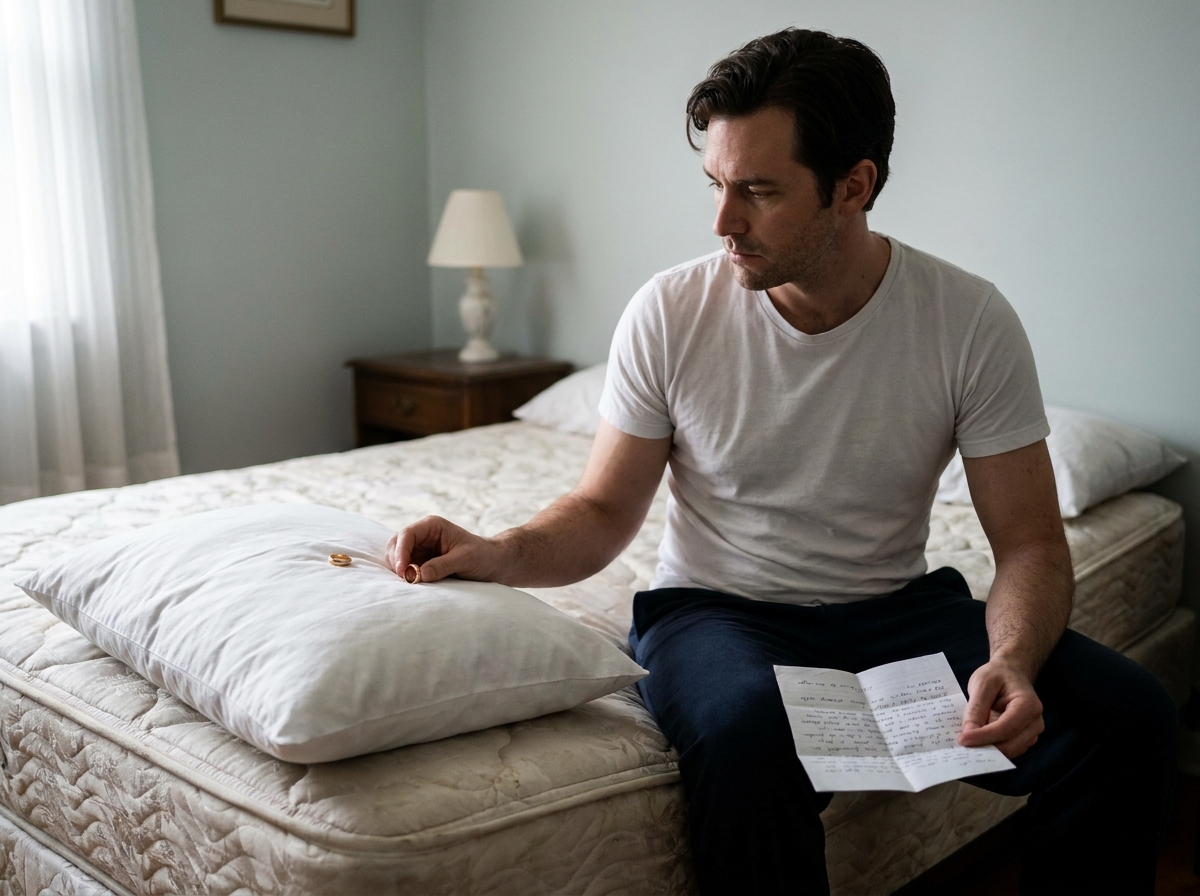
I slept with my ex-wife three years after our divorce, and when I woke up she was gone, her wedding ring sitting in the middle of my pillow. I told myself it was goodbye. But two weeks later, a nurse from a hospital in Tulsa called me and asked one question that made me understand why Rachel really signed those papers.
We hadn’t ended with shouting or slammed doors. After twenty-two years of marriage, I still can’t point to one fight that broke us. The ending came in smaller pieces, so small that I kept believing there would be time to notice what was happening.
Rachel began going to bed earlier. I stayed later at the shop. We stopped reaching for each other during conversations. Eventually, we became two polite people sharing a coffee maker and a house.
When she asked for the divorce, she held my hand while she said it.
“You deserve a full life, Danny,” she told me.
I remember looking at her because I didn’t understand the sentence.
“What does that mean?” I asked.
She squeezed my hand once. “It means you shouldn’t spend your life waiting for something.”
“I’m not waiting.”
Rachel gave me a tired smile. “You are. You just don’t call it that.”
I signed the papers. She moved in with her sister in Tulsa, and I kept the house, the porch swing and the habit of making coffee for two.
I tried to change that habit. It lasted a few days at a time, then returned without my permission.
For three years, Rachel and I stayed in contact only when something required it. A birthday message. A question about mail. A short conversation when one of us heard from Karen, our godson’s mother, who had never accepted that the marriage was over.
Karen believed love could be repaired with enough food and a well-planned seating chart. When our godson got married in June, she proved it by placing Rachel and me at the same table.
I saw the place cards before I saw her. Rachel arrived a few minutes later, and when she noticed where we were sitting, she laughed.
“That was Karen,” she said.
“She means well.”
“She means to interfere.”
“That too.”
Rachel sat across from me. She looked thinner than I remembered. Her dress seemed to hang differently on her, and there was a carefulness in the way she lowered herself into the chair. I noticed it, but I didn’t ask. At the time, I told myself I was being respectful. Looking back, I know I was afraid of the answer.
We talked through dinner and the toasts. Not about the divorce, at first. We talked about people we both knew, Karen’s habit of arranging other people’s lives and the fact that our godson looked nervous every time someone raised a glass.
Rachel watched me over the rim of her glass.
“You still study every room before you sit down,” she said.
“I do not.”
“You just checked the exits.”
“I checked whether Karen had put us near the speakers.”
“That’s not better.”
It was the first time in years that being with her felt easy. Not repaired, not explained. Just familiar.
Later, the band played the song from our wedding. Karen had requested it, and she didn’t even pretend otherwise.
Rachel turned toward me. “One dance. For the old days.”
“Are you sure?”
“That depends. Have you gotten worse?”
“At dancing?”
“At everything.”
I stood up. “You look beautiful.”
“You were always a bad liar,” she said. “It’s my favorite thing about you.”
We danced for one song. I felt the distance of three years, then the older knowledge underneath it. Rachel knew when I was about to step backward. I knew the slight tilt of her head that meant she was trying not to cry.
When the song ended, neither of us moved right away.
“Do you want to go home?” I asked.
She looked at me. “Which home?”
I didn’t have a good answer. After a moment, she said she wanted to come to the house. I understood what she meant, and I also understood that neither of us was promising anything beyond that night.
The drive was quiet. At the house, Rachel stopped in the kitchen and looked around as if she had entered a place she remembered from somebody else’s life. She touched the coffee maker, then pulled her hand back.
“You kept it,” she said.
“I never thought about replacing it.”
“You never think about replacing anything.”
“That isn’t true.”
She looked at me. “Name one thing.”
I couldn’t.
She gave a small laugh, but there was no teasing in it. “You’re still a bad liar.”
We sat for a while without deciding what came next. Then she asked if I still had the old room ready. I told her it was there. She shook her head.
“I don’t want the old room.”
That was all she had to say.
The night we spent together did not feel like a mistake. It felt like a sentence someone had finally finished. We did not discuss getting remarried or moving back in together. We didn’t even discuss what we would say in the morning.
I woke up alone.
Rachel was gone. Her wedding ring, the one I had put on her finger when we were twenty-five, sat in the middle of my pillow.
I called her. The call went to voicemail.
“Rachel, it’s me. Please call me back.”
I sent a text, then another one later that day. She answered three days afterward.
“Please don’t make this harder, Danny. Be happy. That’s the only thing I ever asked of the both of us.”
I read the message until the words stopped looking like language. I wanted to drive to Tulsa. I wanted to demand an explanation. I wanted to believe that the ring meant she had changed her mind and then punish myself for believing it.
Instead, I let it be.
God forgive me, I let it be.
Two weeks later, my phone rang at 6:40 in the morning. The number was from Tulsa.
“Is this Daniel Whitmore?” a woman asked.
“Yes.”
“Sir, I’m a nurse at Saint Anne’s. You’re listed as the emergency contact for Rachel Whitmore. Can you come in?”
My first thought was that there had been a mistake.
“Is she there now?”
“Yes.”
“What happened?”
The nurse paused. “I’m not able to explain everything over the phone. Can you get here?”
“I’m coming.”
I don’t remember much of the drive. I remember the parking lot, my hands on the steering wheel and the feeling that I had been moving toward this moment without knowing it.
A young nurse met me inside and checked my name before leading me down a hallway. She carried a folder against her chest. I kept asking whether Rachel was awake, and she kept telling me that the doctor would speak with me.
After a few steps, she stopped.
“Are you her husband?” she asked.
“Ex-husband.”
The nurse looked at her clipboard, then back at me. She was careful with her next words.
“Her chart lists you as her husband. She updated the file herself.”
I thought I had misunderstood. “She did that recently?”
“I don’t know when she changed it. I only know what’s in the chart.”
She glanced toward the closed door at the end of the corridor.
“She’s been coming to this floor for a long time,” the nurse continued. “Her first surgery is in the file from four years ago.”
The number stayed between us.
“Four years?” I said.
The nurse nodded.
“We divorced three years ago.”
“I understand.”
“No, I don’t think you do. She never told me she was sick.”
The nurse lowered her voice. “I’m sorry. I shouldn’t say more than I can.”
“You called me.”
“Because you’re the emergency contact.”
“Because she put me down as her husband.”
“Yes.”
I looked through the small window in the door. I could see part of the room and a monitor, but not Rachel’s face.
“Can I see her?”
The nurse didn’t answer immediately. Instead, she opened the folder and removed a sealed envelope. My name was written across the front in Rachel’s handwriting.
“She keeps this with her chart,” the nurse said. “She told us that if a man ever showed up saying he was her husband, we were to give him this first.”
My throat tightened. “She said that?”
“That’s what she told us.”
There was a date in the corner of the envelope. It had been written the same week Rachel asked me for the divorce.
I had spent three years thinking she had decided I was no longer part of her life. The date told me that she had been carrying my letter through every appointment, every surgery and every uncertain visit to that floor.
I opened it in the hallway.
Danny,
If you are reading this, you came.
That was the first line. I had to stop there.
The letter did not name a diagnosis, and it did not describe the kind of future her doctors expected. Rachel wrote only that she had begun a long course of treatment and that she did not know how much of her life would be taken by hospitals.
She wrote that she had watched me put my own needs aside during our marriage. She had seen me make room for her without being asked, and she knew I would do it again.
“I love you,” she wrote. “That is why I cannot ask you to build your life around my appointments and bad news.”
She explained that when she said I deserved a full life, she had not meant she wanted freedom from me. She meant she wanted me to have a choice before fear made it for me.
The letter also explained the wedding ring. Leaving it on the pillow had been the only way she could walk out without trying to stay. She had brought it with her after the divorce, but she wanted me to understand that the night together had not been an invitation to become her caretaker.
“I wanted one night where we were only Danny and Rachel,” she wrote. “Not patients, paperwork, decisions or the people we might become.”
At the bottom, she had added one more line.
“I’m sorry I made the choice for you.”
The nurse waited while I folded the letter.
“Is she awake?” I asked.
“Yes,” she said. “She’s tired, but she knows you’re here.”
“Did she ask for me?”
“She asked whether anyone had come.”
That answer hurt more than I expected.
The nurse opened the door and stepped aside. “You can go in.”
Rachel looked smaller in the bed than she had at the wedding. A machine beeped beside her, and a line of light from the hallway fell across the floor. When she saw me, her face changed before she could hide it.
“You came,” she said.
“You put me down as your husband.”
“I know.”
“I thought you wanted me gone.”
“I wanted you to be free.”
“That isn’t the same thing.”
“No,” she said. “It isn’t.”
I pulled the chair close to the bed but didn’t sit right away. I was angry with her. I was frightened for her. I was also ashamed that the nurse had known more about her life than I did.
“Why didn’t you tell me?” I asked.
Rachel looked toward the ceiling. “Because you would have stayed.”
“You don’t know that.”
“I do know that.”
“You didn’t give me the chance to decide.”
Her eyes filled, but she did not look away. “I thought deciding for you was kinder.”
“It wasn’t.”
“I know that now.”
For a while, neither of us spoke. The hospital sounds continued outside the room, people passing, doors opening and closing, a cart moving down the hall. None of it gave us a better sentence.
Finally, Rachel said, “I didn’t leave because I stopped loving you.”
“I know.”
“No, you didn’t.”
“I read the letter.”
She closed her eyes. “Then you know I was trying to protect you.”
“I know what you were trying to do. I don’t know if it was protection.”
She looked at me again.
“I can’t promise you anything,” she said.
“I didn’t come for a promise.”
“Then why did you come?”
I thought about the ring on my pillow and the message she had sent me. I thought about all the ordinary days I had mistaken for evidence that she was fine.
“Because you called me,” I said. “And because I should have come when you first left.”
Rachel turned her face toward the window. “You didn’t know.”
“That doesn’t make it feel better.”
“No,” she said. “It doesn’t.”
I sat beside her. We did not decide what would happen after she left the hospital. We did not erase the divorce or pretend the years between us had been harmless. Rachel still had treatment ahead of her, and neither of us knew exactly what that would demand.
But the choice was no longer hers to make alone.
I told her I would come back the next day. She asked whether I meant it, and I told her I did. This time, I was not saying it to make her feel safe or to keep her from leaving. I was answering the question she should have been allowed to ask three years earlier.
Rachel reached for my hand.
She had signed those papers because she loved me and believed love meant removing herself from my burdens. I could understand why she had done it without accepting that she had been right.
When I left the room, the nurse was waiting near the door.
“She’s been carrying that letter for a long time,” she said.
“I know.”
“Are you staying in town?”
“Yes.”
The answer came easily. Not because I knew how the story would end, and not because Rachel’s treatment had suddenly become simple. I stayed because she was my former wife on paper, but she was still Rachel, and this time she had asked me to come.
