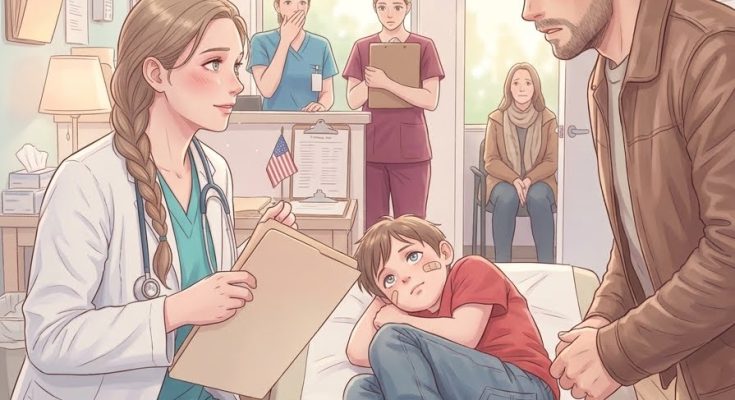
- The rain began falling before dusk and never truly let up.
- By the time I secured the front door of my small neighborhood clinic, the sidewalks gleamed beneath the streetlights, and the gutters carried narrow, turbulent streams of rainwater toward the storm drains.
- The first thing I noticed was the sound.
- The constant, relentless patter of rain against the glass.
- The aging heater softly humming beside the empty waiting area.
- The faint, metallic scrape of my keys as I prepared to close up and head home for the evening.
- Then another sound reached me.
- A child struggling to catch his breath.
- I turned toward the glass entrance and found him standing there on the rubber mat.
- He looked no older than five years old, completely drenched from the storm, wearing a t-shirt far too large that slipped off his narrow shoulders as though it belonged to someone twice his size. His sneakers were split wide open near the toes. Drops of water fell steadily onto the worn tile beneath his feet, forming a pooling puddle.
- Clutched tightly in both hands was a small, crumpled plastic grocery bag. He held it the way someone might cradle something priceless—not because the flimsy plastic held any value, but because everything inside represented every single thing he owned in this world.
- “Doctor,” he murmured. His voice was barely louder than the falling rain. “Can you fix me? I brought money.”
- Throughout my medical career, I have treated hundreds of patients. I have cared for shattered bones, deep lacerations, terrified parents, and people doing everything humanly possible to mask their fear.
- Yet there was something heartbreakingly unusual about this child. He did not resemble a young boy asking for medical assistance. He looked like a child feeling deeply, profoundly sorry for needing any at all.
- He carefully opened the bag. Inside sat dirt-covered coins, two flattened aluminum cans, and three empty soda bottles with peeling labels.
- “The recycling man said they’re worth twelve dollars,” he explained softly, his wide eyes searching my face. Then he added, “I can bring more tomorrow.”
- Those words would never leave me. Because no five-year-old child should ever understand the price of compassion.
- He told me his name was Noah. At least, that was the name he said everyone used for him.
- His right leg was seriously injured. The swelling was impossible to miss, and the alignment of the bone beneath the skin was clearly, terribly wrong—the exact kind of traumatic injury that forces every medical instinct into immediate action before emotion even has time to register.
- I brought him into the treatment area and gently helped him climb onto the examination table.
- Then, as I rolled up his damp pant leg, I began noticing things that could not have come from a simple, accidental fall.
- Older, fading bruises in shades of yellow and purple.
- Tiny, dark circular marks scattered across his arms.
- Patterns on his skin that revealed a story of terror no child should ever have to carry.
- I looked back into his face. That was the exact moment everything changed.
- The curve of his forehead.
- That fierce, determined little chin.
- Those dark brown eyes.
- They were mine.
- Five years earlier, I had been married to a man named Michael Hayes. Michael belonged to the sort of prominent, high-society family people in town admired without question. They had immense wealth. They had political influence. They knew everyone who considered themselves important.
- I came from an entirely different world. I operated a modest clinic inside a rented storefront. I wore secondhand scrubs. I built my career through quiet patience instead of powerful connections.
- When our son was born, his family decided I was an unacceptable flaw in their legacy—someone who could simply be erased. They insisted Noah would have a vastly superior life without me. They laid cold legal documents before me on a conference table. They placed a massive check beside them. They transformed the absolute worst moment of my life into cold, transactional paperwork.
- A signature.
- A financial exchange.
- A choice they expected me to accept forever.
- I had survived the agonizing years since by convincing myself there had been no alternative. But seeing my son standing before me with twelve dollars, three empty bottles, and a deformed leg made me understand one horrific truth: the little boy they stole from my arms had spent five years learning how to beg for the smallest shred of human kindness.
- “Who did this to you, Noah?” I asked gently.
- Noah lowered his gaze toward the tile floor. “I was bad.”
- I will never erase those three words from my memory. Not because they reflected the truth, but because he truly, completely believed them.
- “I spilled some water,” he went on, his voice trembling. “I didn’t wipe it up fast enough. I fell asleep before I finished washing the dishes.”
- Some people hide cruelty behind gentler, sanitized language. They call fear “discipline.” They call suffering “a lesson.” But children always recognize when something is terribly, horribly wrong.
- As I reached out toward his injured ankle with maximum care, he immediately lifted both hands over his head, shielding his face.
- “Please don’t hit me!” he sobbed, shrinking into the corner. “I’ll be good now! I promise!”
- That single sentence shattered something deep inside me. I had to step away for a brief moment, turning my back to get my rising rage and grief under control.
- Then I returned. I washed my hands at the sink. I opened a fresh package of sterile bandages. And I gave him the words he needed to hear most in this world:
- “No one is ever going to hurt you here, Noah.”
- At 6:18 p.m., I began systematically documenting every inch of his condition. I photographed every single injury from multiple angles. I logged each bruise on the medical intake report. I preserved the X-ray findings on the lightboard. I understood that the truth required far more than righteous outrage—it required unassailable legal evidence.
- At 6:47 p.m., I completed a comprehensive medical incident report, recording every single fact I could confirm. The bottles. The coins. The worn-out, split shoes. The severe injuries. The timeline of events. The truth would not disappear simply because someone powerful wished it away.
- I offered Noah a thermos of soup from my lunch bag. He ate with remarkable, agonizing caution—far too cautiously. Not like a hungry child eager for a meal, but like someone expecting the food to be violently snatched away at any given moment.
- When he finished, he looked down at the empty bowl and quietly asked whether he should go wash it in the sink.
- That question lingered with me more than anything else. A little boy who should have been asking for toys or playing with blocks was asking permission just to exist.
- The waiting room remained dead silent, except for the drumming rain outside. A small American flag stood beside the sign-in clipboard on the reception counter—a simple, ordinary decoration. Yet at that moment, it served as a stark reminder of how ordinary places are meant to be safe harbors for anyone who enters them.
- Noah had not been safe anywhere before he crossed my doorway.
- I gently carried him into the back room and laid him on the narrow cot. His forehead burned hot with a fever. While he drifted off to sleep, he whimpered words that left my hands trembling with fury:
- “Don’t lock me inside…”
- “Noah will listen…”
- I sat beside the cot, watching my son sleep. My son. A little boy I had spent five agonizing years grieving, even though he had been alive this entire time.
- Then, my hand shaking, I reached for my phone. The number had remained saved in my contacts for half a decade—the one number I had sworn I would never, ever dial again.
- Michael answered on the second ring. “Emma?”
- I didn’t bother with greetings. “I found Noah.”
- The suffocating silence that followed on the line revealed everything I needed to know.
- Twenty minutes later, a heavy black SUV slammed to a halt outside the clinic. Michael crossed the rain-slick pavement without bothering to carry an umbrella.
- For the very first time since I had known him, Michael Hayes looked utterly terrified. Not ashamed. Not irritated. Terrified.
- Part of me wanted him to understand what it meant to lose everything. For one dark, bitter moment, I wanted to leave him standing outside in the freezing downpour. I wanted him to feel the cold. I wanted him to experience even the smallest fraction of what Noah had endured.
- But my anger would never heal my son.
- So I unlocked the door. “Come with me.”
- Without a word, he followed me into the back room.
- Noah was asleep on the cot. One small hand was tucked beneath his pale cheek, while the other remained curled protectively over his head—as though, even in the safety of sleep, he never truly felt secure.
- Michael slowly reached out toward his son’s brow.
- Even in his deep sleep, Noah flinched violently at the approach of a hand.
- “Don’t hit me,” the little boy murmured, shifting in distress. “Don’t lock me up…”
- Michael froze as if struck. The room fell into a dead, suffocating silence.
- The man who had once stood by and allowed his powerful family to tear our infant apart now stood before the broken child he had promised to protect. At long last, he finally understood the true, horrific price of everything that had happened.
- Because love is never measured by the grandiose promises people make when life is easy and comfortable. It is measured by the choices they make when someone helpless is standing right before them.
- Noah slowly opened his eyes. He blinked through the dim light, looked up at Michael’s drenched face, and whispered a single word:
- “Daddy…”
- Michael almost lost his balance entirely, grabbing the edge of a chair.
- For five long years, he had conveniently convinced himself that everything had been taken care of—that the cold, legal decision his family had made had given Noah a brighter, more prosperous future.
- Instead, the horrific truth lay exposed before him on a narrow clinic bed. The son he should have shielded with his life had learned absolute terror long before he ever learned trust.
- The hours that followed would raise far more questions than they could immediately answer. There would be grueling conversations that should have taken place half a decade ago. There would be forensic evidence, police reports, and legal battles. There would be painful, devastating truths about those missing five years that none of us were fully prepared to face.
- But that night had begun with a tiny, terrified boy walking through the freezing rain carrying twelve dollars and a bag of sticky, empty bottles.
- And it ended with a father finally realizing that he had never truly known what was happening to his own son—and a mother who would never let him go again.