They Seated My Kids At The Back During Her Dad’s Birthday — After I’d Flown Everyone In And Paid For…
arrow_forward_iosRead more
Pause
00:00
00:30
01:31
Mute
They Seated My Kids At The Back During Her Dad’s Birthday — After I’d Flown Everyone In And Paid For
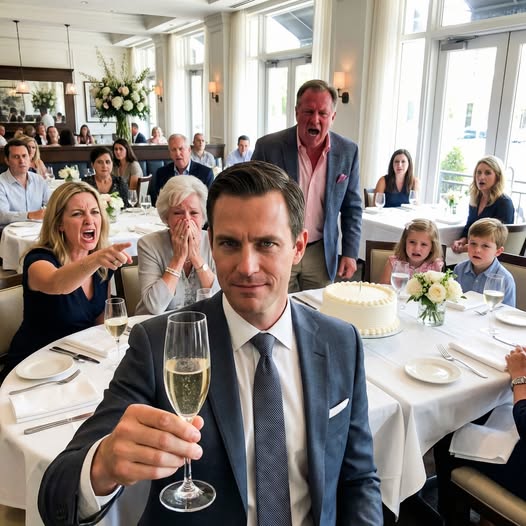
They seated my kids at the back during her dad’s birthday after I’d flown everyone in and paid for the hotel. Her sister smirked, “Your kids don’t belong here.” Her mom nodded. I raised my glass and said, “20 seconds.” At five, her brother covered his mouth. At 10, her dad stood. At 20, her mom whispered, “Is that true?” My name is Benjamin and for most of my adult life, I made one fatal mistake.
I confused being dependable with being respected. I’m 38, a systems engineer, the kind of guy people call when things break and nobody else knows where to start. I design infrastructure for hospitals, manufacturing plants, and data centers. The work is demanding, precise, and expensive to get wrong. I’ve built a career on seeing weak points before other people even realize there’s a problem.
Funny thing is, I could spot a fault line in a network spread across three states, but I somehow missed the one running straight through my marriage. It started at my father-in-law’s 70th birthday dinner. Or maybe that’s just where it finally became impossible to ignore. The whole thing had been my idea. My wife Claire’s family lived scattered across the country and after her father had a health scare the year before, everyone had been saying the same sentimental nonsense.
We really need to do something special. Dad deserves one big weekend with all of us together. We never make enough memories. I should have known what that meant. In her family, we usually meant me. My money, my planning, my effort, their smiles. So, I took care of it. I booked the flights, 11 of them. I reserved a block of hotel rooms at the nicest historic hotel in the city because Claire said her mother would feel embarrassed anywhere less polished.
I hired a private dining room at a waterfront restaurant her father loved. I arranged a vintage jazz trio because her dad had spent half his life pretending he was born in the wrong era. I even had custom menus printed with William Hartley’s 70th birthday celebration embossed in navy and gold. And because Claire insisted this weekend was about family, I made sure our children, my son Noah, nine, and my daughter Ellie, seven, were included in every plan. That part matters.
Remember it because by the time dessert arrived, her sister would be looking my children in the face and saying they didn’t belong there. The first warning sign came in the hotel lobby. Claire’s mother, Diane, kissed Claire on both cheeks, squeezed her hands, then looked past me like I was an employee carrying luggage, which technically I was. “Oh good,” she said.
“You handled the check-ins.” Not hello Benjamin, not thank you, not even a fake smile. Her younger sister, Vanessa, breezed in behind her in sunglasses the size of dessert plates, dragging two designer suitcases and wearing the smug expression she reserved for moments when she thought someone else was beneath her. She looked at my kids and frowned.
“I thought this was supposed to be elegant,” she said. Noah was wearing a navy blazer. Ellie had on a pale blue dress and little white shoes she’d picked out herself because she wanted to look fancy for Grandpa Bill. Claire heard it. I know she did. She just adjusted her purse strap and said, “Vanessa, not now.” Not don’t say that.
Not apologize. Just not now. That was Claire’s specialty. She never defended me or the kids outright. She just managed tone, smoothed surfaces, protected appearances. When you live with someone like that long enough, you start mistaking silence for neutrality. It isn’t neutrality. It’s permission. The second warning sign came an hour before dinner when I walked into the hotel suite her parents were using and found Claire’s brother Mark laughing with Vanessa over the seating chart.
Mark was the kind of man who made failure look effortless. 41 years old, permanently between opportunities, always one scheme away from turning things around. Over the last six years, I had covered a security deposit for him, paid off one emergency dental bill, loaned him money to keep his car from being repossessed, and once let him use my company miles to visit a girlfriend who dumped him before his return flight.
He still treated me like I’d won a raffle I didn’t deserve. “What’s so funny?” I asked. Vanessa slid the seating chart face down. “Nothing.” I held out my hand. “Let me see it.” Claire was by the mirror touching up lipstick. “Ben, don’t start.” “Start what?” Mark leaned back in his chair. “It’s just logistics. Relax.
” That word, relax, always said by people behaving badly when they want you to make their lives easier. I picked up the chart. At the main long table near the windows sat Diane, William, Claire, Vanessa, Mark, Vanessa’s husband, two of William’s oldest friends, and Claire’s aunt and uncle.
At a small round table near the back, half hidden by a decorative column, and close enough to the service station to hear silverware being sorted, were four names: Benjamin, Noah, Ellie, kids, buffet placement. I stared at it. Then I looked at Claire. She didn’t meet my eyes. “Why are my children at the back?” I asked quietly. Diane answered instead.
“That table is more appropriate for them.” “For them?” I repeated. “They’re young,” she said, like that settled it. “They’ll get restless.” Noah and Ellie were invited to celebrate their grandfather. Vanessa gave a small laugh. “My grandfather. Let’s not get carried away.” There are moments when a room changes temperature around you.
The air gets thinner, sounds sharpen. You hear things with brutal clarity. I heard Ellie in the next room asking the hotel concierge whether the cake had strawberries. I heard Noah explaining to a valet why engineers basically teach giant machines how to behave. And I heard Diane Hartley say, “It will look better this way.
” I turned to Claire. “Say something.” She finally looked at me then, but not the way a wife looks at her husband when he’s been insulted. It was the look people use on someone difficult at a board meeting. “Ben,” she said softly, “it’s one dinner.” “That’s your answer?” Her jaw tightened. “Don’t make this a scene.” A scene.
Not they’re wrong. Not our children stay with us. A scene. I folded the seating chart and put it in my jacket pocket. “Understood,” I said. Claire exhaled, relieved, because she thought I was letting it go. That was her third mistake that weekend. The first had been allowing her family to treat me like a sponsor instead of a husband.
The second had been letting them treat my children like accessories. The third was believing I still needed their approval badly enough to swallow it. At the restaurant, everything looked perfect. Candles flickered against cut crystal. Soft trumpet and piano drifted through the room. The harbor lights shimmered beyond the windows.
Waiters moved with synchronized calm. William looked pleased in that restrained, old-school way of his, like a man allowing himself exactly 10% more joy than usual. And then the host led my children toward the back. Ellie looked at me confused. “Daddy, aren’t we sitting with you?” Before I could answer, Vanessa crouched slightly in front of her, smiling with all the warmth of a knife.
“Sweetheart, the grown-ups are sitting up front.” Noah frowned. “But mom said this was family dinner.” Vanessa straightened and smirked. “Your kids don’t belong here.” She didn’t even lower her voice. Diane, standing beside her, gave one slow nod. I will remember that nod for the rest of my life.
Ellie’s face crumpled in the instant before tears. Noah did that stiff thing boys do when they’re trying not to cry in public. He put his hand on his sister’s shoulder and looked at the floor. And Claire looked away. That was the moment my marriage ended. Not legally, not on paper, but in every way that counts. I bent down to my children. “Go with Mr.
James for 1 minute,” I said to the waiter. “Get whatever you want to drink. Extra cherries, extra whipped cream. I’ll be right there.” Noah searched my face. “Are we in trouble?” I smiled, calm, warm, the kind of smile I save for outages and emergencies when everyone else is panicking. “Not even a little.
” The waiter led them away. I stood up slowly, picked up my champagne glass, and tapped it with a fork. The room quieted. William smiled at first, probably expecting a toast. Diane folded her hands, pleased. Vanessa looked smug. Mark was already halfway through his second bourbon. Claire’s expression changed when she saw my face.
There is a tone engineers use in catastrophe calls, steady, measured, so precise it scares people more than shouting ever could. I used that voice. “I just want to say a few words before dinner begins,” I said. William lifted his glass. “Benjamin, that’s very thoughtful.” “Oh, I’m being thoughtful,” I said. “Very.” A few people laughed uncertainly. I raised my glass slightly.
“20 seconds.” Vanessa blinked. “What?” I checked my watch. “At five,” I said, “Mark is going to cover his mouth.” Mark frowned. “What are you talking about?” “At 10, William is going to stand.” William’s smile faded. “At 20, Diane is going to ask a question.” Specifically, she’ll whisper, “Is that true?” Nobody spoke.
Claire hissed, “Ben.” I looked at her only briefly. “No. You had your chance to speak. Then, I set my glass down. I paid for every flight here, every room in that hotel, this private dining room, the musicians, the cake, the wine package your mother insisted on. I did it because Claire said this weekend was about family.
My eyes moved to Diane and Vanessa. And tonight, after I brought everyone here, after I paid for every single polished little detail, you seated my children in the back and told them they don’t belong.” A murmur rippled through the table. William’s old friend Leonard shifted in his seat. Claire’s aunt looked horrified.
One of the waiters froze with a basket of bread. Diane drew herself up. “Benjamin, this is inappropriate.” I checked my watch. Five. Mark’s hand shot to his mouth. Because at that exact moment, his phone buzzed on the white tablecloth. Then buzzed again and again. He glanced at the screen and all the color drained from his face.
I knew what he was seeing. Three days before the trip, while confirming hotel billing, I had found charges on the family card Claire and I used for travel incidentals, charges I didn’t recognize. A boutique liquor store, two online betting sites, a cash advance. Total, just over $11,000. Not Claire’s spending habits. Mark’s. I’d said nothing.
I just made one call to a friend in banking fraud, then another to my attorney. Because there’s one thing about people who think you’re harmless. They get sloppy. Mark had used an old digital copy of my signature from a reimbursement form Claire once emailed him when I helped with one of his business ideas. He’d forged authorization and added himself as a secondary card holder to an account linked to my corporate travel rewards and personal guarantee.
He’d been stealing under my name for months. And I had proof. He was reading the fraud alert notification and account freeze. I looked at him and smiled without warmth. “Hi, Mark.” “Ben,” Claire whispered, panic rising now. “Please.” 10. William stood so abruptly his chair scraped backward because his phone had lit up, too.
Earlier that afternoon, before dinner, I had forwarded a packet to him. Not to the whole family, just to him. Copies of invoices, transfers, messages, and hotel booking records. Enough to show that while he had been thanking Claire for organizing this weekend, she hadn’t paid for a single thing. More importantly, the packet also contained evidence that Claire and Diane had been planning to pressure him into changing the trust structure after this birthday.
Moving assets away from all grandchildren except Vanessa’s children. Because, as Diane had written in one email, “Benjamin’s children have his blood, not ours. We need to think carefully about legacy.” William was old-fashioned, vain, proud, and often passive, but nothing enraged him like greed dressed up as family concern.
He stared at Claire first, then at Diane, then at the printed menu in front of him as though it had personally betrayed him. “What is this?” he asked, voice shaking. Claire went pale. “Dad, I can explain.” “Can you?” he said. Vanessa’s smirk was gone now. The room had shifted hard. I checked my watch one last time.
Diane leaned toward William, lips barely moving. “Is that true?” Exactly as predicted. Because in that same packet was something else. A set of emails I had found not by snooping, but because Claire had once logged into our shared tablet and never signed out of the family group account she used with Diane and Vanessa.
A week earlier, when I was finalizing airfare, a message banner popped up. “Make sure Ben keeps the kids occupied during dinner. They change the atmosphere.” I should have stopped there. I didn’t. I opened the thread. There it was. Months of it. Jokes about me being useful. Remarks about my job making me good husband material, if not breeding material.
Complaints that Noah looked too much like my side of the family. Worries that Ellie was sweet, but not really a Hartley. A whole disgusting undercurrent of bloodline, image, inheritance, and class. And buried among those messages was the real bomb. Claire had known for over a year that William’s long-time accountant suspected serious irregularities in a charitable foundation Diane managed in his name.
Money redirected, personal expenses disguised as donor hospitality, quiet transfers benefiting Vanessa and indirectly, Mark. Claire hadn’t told William she’d helped keep it quiet. So, when Diane whispered, “Is that true?” she wasn’t asking about the children. She was asking whether I really had documents showing she’d been siphoning from her husband’s foundation.
I reached into my inner pocket and laid a slim envelope on the table. “Yes,” I said. Nobody touched it. The jazz trio had stopped playing. A waiter backed out of the room. Claire stared at me like she no longer recognized the man she married. That part almost made me laugh because this was who I had always been.
She just mistaken patience for weakness. William picked up the envelope with unsteady hands. “Benjamin,” he said carefully, “where did you get this?” “From your own records, your daughter’s carelessness, and one forensic accountant who doesn’t enjoy being lied to.” Diane stood up so fast her napkin fell. “This is insane.
You’re trying to ruin this family over a seating arrangement?” “No,” I said. “The seating arrangement just reminded me I had no reason left to protect any of you.” Claire’s voice cracked. “Protect us?” I looked at her. Really looked at her. At the woman I had loved for 12 years. The woman whose student loans I helped finish paying.
The woman whose career moved to another city I supported by commuting 3 hours twice a week until we found a house. The woman who had held my hand when Noah was born and whispered, “We’re a team.” I had believed her. “That’s what you still don’t understand,” I said quietly. “I’ve been protecting you for years.” Her eyes flickered. She knew.
Not all of it, but enough. Because there was one final piece I hadn’t mentioned yet. 18 months earlier, Claire had begged me not to tell her father about a temporary cash issue involving Vanessa’s event business. She said it would humiliate the family. She said her dad’s heart couldn’t take the stress.
She said if I loved her, I would help quietly. So, I did. I covered $64,000 in back taxes and vendor debts through a private loan agreement Claire promised Vanessa would repay. She never did. Diane knew. Mark knew. Claire kept stalling every time I brought it up. And now tonight, after all that, they had the nerve to tell my children they didn’t belong.
I let the silence stretch until it hurt. Then I said, “I want everyone in this room to understand something clearly. My children will never again sit at the back so this family can perform elegance.” Noah and Ellie had reappeared near the doorway by them, drawn back by the tension. Noah was holding Ellie’s hand.
She had tears on her cheeks. He looked furious in that small, brave way only children can. I walked over to them. I knelt. “Get your jackets,” I said softly. “We’re leaving.” Claire hurried toward us. “Benjamin, don’t do this in front of them.” I rose to my full height. “In front of them?” I said. “You let your sister tell them they don’t belong.
Don’t lecture me about in front of them.” Ellie pressed into my side. Claire reached for her, but Ellie flinched. That tiny movement hit Claire harder than anything I said. Her hand froze in midair. “Ellie,” she whispered. My daughter hid behind me. William sank slowly back into his chair like a man discovering his age all at once.
Vanessa started crying then. Loud, offended tears, the kind that always arrive when consequences finally due. “This is ridiculous,” she snapped. “You’re blowing up Dad’s birthday because you’re insecure.” I laughed once. “Insecure men beg for acceptance. I’m done with that.” Mark muttered. “You can’t prove half of this.
” I glanced at him. “I don’t need to. The bank already has enough.” His face changed again. Diane tried one last maneuver. Cold dignity. Family matriarch mode. “Benjamin, whatever grievances you have, they should be handled privately.” I picked up my coat with one hand and my son’s shoulder with the other. “You lost the right to private when you humiliated my children publicly.
” Then, I looked at Claire. “I’ll have my attorney contact you Monday.” The whole room went still. “Attorney?” she said. “Yes.” “Ben, stop.” “No.” Her eyes filled. “You’re divorcing me over this?” I held her gaze. “I’m divorcing you because this revealed who you are when you think I won’t leave.” For 1 second, I saw the truth finally land.
Not in full, maybe, but enough. She hadn’t thought I’d leave. She thought I’d absorb it, rationalize, calm down, make a quiet boundary, return to normal. Because people get addicted to the person in the family who can take the hit and still keep things running. The first time that person stops, everyone acts shocked.
I took Noah and Ellie out through the side exit. Behind us, I heard raised voices. William shouting for the first time in all the years I’d known him. Diane denying everything. Mark trying to slip away. Vanessa sobbing. Claire calling my name once, twice, then not at all. Outside, the night air was cold enough to clear poison from the lungs.
We stood by the harbor while the city lights broke across the dark water. Noah looked up at me. Did we do something wrong? That question. That’s the one that stays with you. When adults are cruel, children look inward first. They assume the problem must be them. Something in their face, their voice, their existence.
I crouched so I was eye level with both of them. No, I said. You did absolutely nothing wrong. Some people get so obsessed with looking important that they forget how to be kind. That’s not your fault. Ellie sniffled. Grandma doesn’t like us? I chose honesty without brutality. Grandma likes control more than she likes being loving.
Noah nodded slowly, absorbing that with the solemnity he always had. Are we going home? Yes. And Mom? That answer hurt more. Mom has some choices to make. We went back to the hotel only long enough to pack. Claire beat us there by 10 minutes. She was standing in the suite when the elevator doors opened. Mascara smudged, breathing hard.
Please don’t do this, she said. I walked past her to the closet. The kids went to the bedroom without a word. You stood there, I said, folding Noah’s clothes into a suitcase. You watched them be humiliated. I froze. No, you prioritized your family over your children. That’s not fair. I turned then. No, Claire.
Fair was me paying for your brother’s disasters, your sister’s debts, your mother’s impossible standards, and your father’s comfort because I believed I was investing in family. What happened tonight was honesty. She sank onto the edge of the sofa. I never thought they’d say it like that. I stared at her. That was what she had to offer? Not I should have stopped them. Not I failed our kids.
Just I didn’t think they’d say it out loud. That was the thing with Claire. Her loyalty always lived in the space between private agreement and public denial. I have copies of everything, I said. The messages, the transfers, Mark’s fraud trail, Vanessa’s unpaid loan, your mother’s foundation records. Her head jerked up.
Why would you gather all that? Because some part of me had known. Maybe not consciously, maybe not all at once, but over the last year, I had begun documenting. Quietly, methodically, like an engineer tracing a recurring fault through layers of interference until the real source becomes visible. Because patterns matter, I said.
And this pattern ends here. The divorce process was uglier than I wanted and cleaner than Claire expected. Her family closed ranks at first. They always do. Diane called me unstable. Vanessa posted vague things online about narcissistic men and financial abuse, which would have been funny if it weren’t so lazy.
Mark left three voicemails threatening to sue me until the fraud investigator contacted him directly, after which he became mysteriously spiritual and talked a lot about healing. William didn’t speak to anyone for 2 weeks. Then he called me. Not to reconcile, not exactly. To apologize. His voice sounded older, thinner.
I should have seen it, he said. Yes, I answered. I was a coward. Yes. A long pause. How are the children? Better since they haven’t been told where they do and don’t belong. He breathed out shakily. I deserve that. He did. But to his credit, he did one thing none of the others managed. He accepted the truth without asking me to make it easier.
Within 3 months, he removed Diane from the foundation completely, brought in outside auditors, and amended parts of his estate. Not to favor me. I didn’t want that. But he set aside direct trusts for all grandchildren equally in legally protected structures no one can manipulate later. That mattered. Claire moved into a condo across town.
Shared custody began slowly. The first few weeks, Ellie refused overnight visits. Noah went, but came back quieter each time. Claire cried during pickups. Sometimes, genuine remorse arrives late enough to be almost useless. Still, I never poisoned the children against her. I didn’t need to. Kids know who made them feel safe.
And then something happened I never expected. 6 months after the birthday dinner, Claire asked if we could talk after a custody handoff. Not in the house, not in front of the kids. Just on the porch. She looked smaller somehow. Not physically, structurally. Like someone whose whole internal architecture had been built around impressing the wrong people and had finally collapsed.
I went no contact with my mother, she said. I nodded once. She said the kids were turning me sentimental. That sounded like Diane. Claire looked down at her hands. I keep replaying that night. Ellie flinching from me. Noah asking if he did something wrong. Her voice broke. I don’t know how I became someone who could stand there.
I believed she meant it, but meaning it and undoing it are different things. You became that person gradually, I said. That’s how it happens. One excuse at a time. Tears slid down her face. I’m sorry. I know. She looked up, almost hopeful. But some bridges don’t burn in a flash. They rot from inside, then collapse under one final step.
You can regret the fall all you want. It doesn’t make the bridge reappear. We are never getting back together, I said gently. She closed her eyes. I know. And for the first time in a long time, I felt no anger, just clarity. A year later, Noah plays soccer and wants to build robots. Ellie still loves dressing up for dinner, but now she insists her stuffed rabbit gets a seat, too.
So nobody sits in the back alone. We laugh when she says it. Though sometimes there’s still a little ache under the laughter. I bought a house with a big kitchen table. One table. No hidden corners. No lesser seats. Every birthday now, I let the kids decide where everyone sits. They always put me in the middle. Last week, Ellie asked while doing homework at the counter, Daddy, why did Aunt Vanessa say we didn’t belong? Kids circle back.
They test old wounds to see if they still hurt. I set down my coffee and told her the truth. She can grow into, because some adults confuse belonging with control. They think if they can rank people, they can feel bigger. But belonging doesn’t work like that. You don’t earn your place by making someone else smaller. She considered that seriously, then nodded.
Okay, she said. That means she was wrong. Yes. Very wrong. Exceptionally wrong. That made her smile. As for William, he sees the children now without Diane. He comes alone, brings books, listens more than he talks. There’s regret in him and shame, but also effort. Real effort. At his age, that counts for something.
Mark ended up taking a plea deal on the fraud charges tied to my accounts and two others. Vanessa’s business folded. Diane is still Diane, from what I hear. Polished, bitter, convinced she was betrayed by everyone except herself. Maybe she believes that. People like her usually do. But me? I no longer confuse being needed with being loved. That was the lesson.
Not that family can be cruel. Most people know that already. It’s that the moment someone tells your children they don’t belong, your job is not diplomacy. It’s not optics. It’s not timing. It’s protection. I raised a glass that night and said, 20 seconds. What I really meant was this. You had 20 seconds left to live in the version of the world where I kept saving you from yourselves.
And when those 20 seconds were over, I chose my children. I’d do it again in 10.
