Chapter 1
The cold, ribbed metal of the jet bridge floor bit into my cheek before I even registered the fall.
There was a sharp, tearing sound—the heavy wool of my favorite navy-blue pea coat ripping—followed immediately by a sound that hurt far worse than the impact: a laugh.
A crisp, amused, utterly merciless little laugh.
“Maybe you should have waited for wheelchair assistance, sweetie. Some of us actually have places to be.”
I lay there for a second, the breath knocked completely out of my seventy-two-year-old lungs. My knee, the one with the surgical pins from a life I left behind decades ago, throbbed with a sudden, vicious heat.
I didn’t move right away. Over the years, you learn that when the world tries to knock you down, the worst thing you can do is scramble. So, I closed my eyes, forced a slow breath through my teeth, and remembered who I was.
My name is Josephine. I am a Black woman, a grandmother of four, and a retired combat nurse who spent her youth pulling bleeding kids out of places most people only see in nightmares. I have earned every silver hair on my head, and I had certainly earned my seat in First Class on Flight 804 to Seattle.
But to the woman stepping over my legs right now, I was just an obstacle. An annoyance. Someone who didn’t belong in her line of sight.
The tension had started twenty minutes earlier at Gate B14.
I had been sitting quietly near the boarding podium, holding my ticket. I was wearing my best coat. Pinned to the inside lapel, just over my heart, was a small, unassuming piece of metal and ribbon. I rarely wore it, but I was flying out to attend the funeral of my former commanding officer. It felt right to wear it today.
That’s when she arrived.
She looked to be in her late forties, draped in beige cashmere and smelling of expensive, heavy perfume. She had a Louis Vuitton carry-on that she kept ramming into the ankles of anyone who dared stand too close.
When the gate agent announced boarding for Group 1, I stood up, grabbing the handle of my small roller bag. My joints are stiff these days, so I don’t move with the lightning speed of my twenties, but I move with purpose.
I stepped into the priority lane.
The woman in cashmere immediately closed the gap behind me, huffing loudly. I could feel her breath on the back of my neck.
“Excuse me,” she had snapped, her voice dripping with that specific brand of polite venom. “This is the Priority lane. Group 1. Main cabin boards later.”
I didn’t turn around. I just held up my ticket, the bold ‘GROUP 1’ facing over my shoulder.
She scoffed. It wasn’t an apology. It was a sound of sheer disbelief. I know that sound intimately. It’s the sound of someone looking at my dark skin, my sensible orthopedic shoes, my worn hands, and doing a mental calculation that concludes I must be in the wrong place.
“Well,” she muttered to the man standing behind her. “I guess they just hand out upgrades to anyone these days. So much for paying premium.”
I swallowed the tight knot of anger in my throat. I’ve spent a lifetime swallowing that knot. You tell yourself it’s not worth the fight. You tell yourself that retaining your dignity in silence is the ultimate victory.
But silence has a way of making people bold.
When they scanned our tickets and we started walking down the slanted, enclosed tunnel of the jet bridge, the air grew claustrophobic. The incline was steep, and I took it carefully, making sure my bad knee locked securely with each step.
“Oh, for God’s sake,” the woman hissed behind me. “Could you move any slower?”
“I am moving as fast as I safely can, ma’am,” I replied, keeping my voice even, my eyes fixed straight ahead.
“Well, your ‘fast’ is holding up the entire plane. Move aside.”
“There is no room to pass safely here,” I said. “We will be at the plane door in ten seconds.”
Apparently, ten seconds was too long.
I felt her hand before I saw it. She didn’t just push past me. She reached out, wrapped her manicured fingers around the thick collar of my coat, and yanked me backward and to the side to clear her path.
The sheer force of it caught me completely off guard. My heavy roller bag twisted, catching my ankle.
The world tilted. My bad knee buckled instantly.
I hit the metal floor hard. My purse spilled open, scattering a pack of tissues, my reading glasses, and a faded photograph of my late husband across the dirty grating of the jet bridge.
And as my coat pulled open, exposing the inner lapel, the woman didn’t stop to help. She didn’t gasp.
She stepped right over my shins, looked down at me with a smirk that I will never forget as long as I live, and let out that terrible, mocking laugh.
“Stay out of the way next time,” she said, tossing her hair over her shoulder as she strutted toward the aircraft door.
I lay there, staring at the ribbed ceiling of the tunnel. My knee was screaming. A hot, prickly wave of humiliation washed over me. I could hear the footsteps of the other passengers behind us stopping, a collective murmur of shock rippling through the line, but no one stepped forward immediately.
I slowly pushed myself up onto my elbows, my hands shaking—not from the pain, but from a sudden, rising tide of pure, unadulterated fury.
I brushed the dirt off the inside lapel of my coat. The medal was still there. Still pinned tight.
I gathered my things, my jaw set like stone. She thought she had put me in my place. She thought she had won.
But as I pulled myself up and limped toward the cabin door, I had no idea that the flight captain was standing just inside the galley.
And I had no idea that he had seen exactly what she did.
Chapter 2
The ribbed metal of the jet bridge was freezing, the kind of cold that seeps directly through your clothes and settles deep into the marrow of your bones. I stayed down for a long moment, listening to the rhythmic, unapologetic clicking of her designer heels fading down the enclosed tunnel.
Click. Click. Click.
It sounded like a metronome ticking down the last remnants of my patience.
My name is Beatrice. I am seventy-two years old, and my skin is the deep, rich color of roasted coffee—a color that has dictated how the world interacts with me since the day I was born in a segregated hospital in Alabama. I have lived through the Civil Rights movement. I have survived a war. I have buried a husband, raised three children, and earned a quiet, peaceful retirement. Yet, as I lay there on the dirty floor of a Delta Airlines jet bridge, humiliated by a woman who looked at me and saw nothing but an inconvenience, I was reminded of a bitter, exhausting truth: for some people in this country, my existence will always be an affront to their entitlement.
I placed my hands flat against the cold grating. My right knee, reconstructed with titanium screws and sheer willpower forty years ago, screamed in protest. It wasn’t a sharp, sudden pain, but a deep, familiar agony. It was a ghost from a jungle half a world away.
Slowly, methodically, I pushed myself up.
A young man in a grey business suit stepped around me, his eyes glued to his phone, pretending he didn’t see an elderly Black woman struggling to her feet. A teenager with oversized headphones paused, looking like she wanted to help, but her mother grabbed her elbow and hurried her along, casting a nervous, embarrassed glance in my direction.
“Don’t stare, Chloe,” the mother hissed, pulling her daughter past my scattered belongings.
People are fascinating creatures when confronted with sudden, ugly aggression. They freeze. Their eyes dart away. They convince themselves that stepping in will only make things worse, or worse yet, that it isn’t their business. I didn’t blame them. I was used to fighting my own battles.
I leaned heavily on my good leg and surveyed the damage. My favorite navy-blue wool coat—a gift from my late husband on our fortieth anniversary—was torn at the seam near the left shoulder. The heavy brass button had been violently ripped off, leaving a frayed, jagged hole.
I knelt back down, my joints popping, and began gathering my spilled purse. A crumpled pack of tissues. My reading glasses, thankfully unbroken. And finally, the faded, dog-eared photograph of my late husband, Arthur, and my former commanding officer, Major Thomas Vance.
Seeing Thomas’s face in the harsh, fluorescent light of the jet bridge hit me harder than the physical fall.
Thomas was the reason I was on this flight to Seattle. He had passed away three days ago from pancreatic cancer, and I was making the journey to say goodbye.
My fingers trembled as I brushed a speck of dust off the photograph. In the picture, taken in 1971, we were all so impossibly young. I was twenty-three, wearing dirt-stained olive-drab fatigues, my natural hair cropped close to my scalp, standing in front of a Medevac helicopter in Da Nang, Vietnam. Thomas was beside me, his arm slung over my shoulder, his face smeared with grease and exhaustion, but smiling that bright, indomitable smile.
I closed my eyes, and suddenly, I wasn’t in a sterile airport tunnel in 2026. I was back in the suffocating heat of the jungle. I could smell the sharp, metallic tang of jet fuel, blood, and burning foliage.
It had been the tail end of the monsoon season. Our Huey had been shot down during a critical extraction of wounded infantrymen. I was the triage nurse onboard. When the tail rotor gave out and we spun out of the sky, tearing through the canopy and slamming into the muddy earth, the world turned into a chaotic blur of fire and screaming metal.
My leg had been crushed under a collapsed bulkhead. The pain had been white-hot, blinding. I remember the smell of aviation fuel leaking everywhere, ticking like a time bomb. I remember the sheer, unadulterated terror.
I had resigned myself to dying in that mud. But Thomas Vance hadn’t.
Despite having a fractured collarbone and a deep laceration across his forehead, Thomas had crawled back into the burning wreckage. He didn’t see a Black woman, or a subordinate, or a statistic. He saw a member of his team. He saw me. He used his bare hands to pry the burning metal off my crushed leg, ignoring the flames licking at his own uniform. He dragged me out just seconds before the fuel tank ignited, shielding my body with his own as the shockwave rolled over us.
He saved my life that day. But the story didn’t end there.
While we were waiting for the rescue chopper, pinned down by enemy fire, Thomas passed out from blood loss. It was my turn. With my knee shattered, dragging my useless leg behind me, I had applied tourniquets, packed his wounds, and kept him breathing for six grueling hours under the suffocating canopy, returning fire with a standard-issue sidearm until the cavalry arrived.
Months later, standing on crutches in a sterile military hospital in Hawaii, they pinned a piece of metal to my chest.
The Distinguished Service Cross.
It is the second-highest military award that can be given to a member of the United States Army for extreme gallantry and risk of life in actual combat. It is rarely awarded to medical personnel. It is almost never awarded to women. And back then, for a young Black woman to receive it? It was practically unheard of.
I opened my eyes, the memory fading back into the sterile reality of the jet bridge.
I looked down at the inside lapel of my torn coat. The woman who had pushed me hadn’t noticed it, but there it was, securely pinned to the inner lining: the small, bronze cross hanging from a ribbon of red, white, and blue. I kept it hidden on the inside of my coat. I didn’t wear it for glory. I didn’t wear it for the gratitude of strangers. I wore it today, hidden close to my heart, specifically for Thomas.
I tucked the photograph safely back into my purse, gripped the handle of my roller bag, and forced myself to stand perfectly straight. The pain in my knee was a low, constant roar, but I locked my jaw.
I would not limp. I would not give her the satisfaction.
I resumed my walk down the tunnel, my pace slower but deliberate. As I stepped over the threshold and into the brightly lit, immaculate cabin of the airplane, the change in atmosphere was jarring. The air smelled of expensive espresso and sanitized leather. Soft, ambient jazz played through the overhead speakers.
“Welcome aboard, ma’am,” a young, impeccably groomed flight attendant greeted me at the door. His name tag read Julian. He had a kind, observant face. His eyes briefly flicked down to my torn coat, a microscopic furrow appearing on his brow, but his customer-service smile remained perfectly intact. “Right this way. First Class is just to your left.”
“Thank you, Julian,” I said, my voice steady, betraying none of the adrenaline still surging through my veins.
I stepped into the First Class cabin. It was an oasis of privilege. Wide, plush seats, warm lighting, and passengers settling in with pre-departure flutes of champagne.
And there she was.
The woman in the beige cashmere. Let’s call her Clara.
Clara was already comfortably settled into seat 2B—an aisle seat. Her oversized Louis Vuitton bag was stuffed carelessly into the overhead bin, taking up far more space than necessary. She had kicked off her designer loafers and was aggressively typing on her latest-model iPhone, a glass of champagne already resting on the center console. She looked completely unbothered. Completely at peace.
She had violently pushed an elderly woman to the ground not three minutes ago, and her heart rate hadn’t even elevated. To her, I wasn’t a person. I was a pebble she had kicked out of her path.
I took a deep breath, clutching my boarding pass, and looked at the number printed in bold black ink.
Seat 2A.
The window seat. Right next to her.
The universe has a spectacular, twisted sense of humor.
I walked down the short aisle, the heavy wheels of my bag rolling silently over the thick carpet. When I reached Row 2, I stopped. I stood right beside Clara’s outstretched, stockinged feet.
I didn’t say a word. I simply stood there, waiting for her to acknowledge me, waiting for her to move so I could access my seat.
For a solid ten seconds, she ignored me. She kept typing, the harsh blue light of her screen reflecting in her carefully Botoxed forehead. She took a delicate sip of her champagne.
“Excuse me,” I said quietly.
Clara sighed—a heavy, theatrical sigh that practically sucked the oxygen out of the cabin. She slowly lowered her phone and looked up.
When her eyes met mine, for a fraction of a second, I saw it. The recognition. The brief, microscopic flash of panic. She remembered exactly who I was. She remembered the push. She remembered the fall.
But people like Clara do not apologize. Apologies require accountability, and accountability is something her tax bracket had likely shielded her from her entire life. Instead of shame, her face quickly morphed into a mask of pure, defensive annoyance.
She looked me up and down, taking in my torn coat, my sensible slacks, my scuffed orthopedic shoes, and her lip curled in a barely concealed sneer.
“You have got to be kidding me,” she muttered under her breath, loud enough for me to hear.
She didn’t stand up to let me in. Instead, she lazily shifted her knees a few inches to the side, leaving a gap barely wide enough for a child to pass through, let alone a grown woman with a bad knee and a heavy winter coat.
“I need to access my seat. Seat 2A,” I said, keeping my tone unnervingly calm.
“I moved,” she snapped, gesturing vaguely to the tiny sliver of space. “Squeeze through. I’m comfortable and I’m not getting back up.”
Every instinct in my body—the combat nurse who survived the Tet Offensive, the Black mother who had to stare down racist school board members in the 1980s—screamed at me to tear her apart. To loudly, publicly humiliate her. To ask her if she enjoyed assaulting grandmothers in jet bridges.
But I knew the rules of engagement in this specific battlefield.
If I raised my voice, if I showed anger, the narrative would instantly flip. It wouldn’t matter that she had physically assaulted me. It wouldn’t matter that my coat was ripped and my knee was swelling. Society has a very specific, very dangerous script for women who look like me. If I lost my temper, I would instantly be labeled the “Angry Black Woman.” I would become a threat. The flight attendants would be called. Security would be involved. Clara would play the frightened, fragile victim, clutching her pearls, and I would be the one escorted off the flight in zip-ties.
It is an exhausting, soul-crushing calculus that I have had to perform every day of my life.
I refused to give her the weapon she needed to destroy me.
“Stand up, please,” I said. My voice was low, measured, and completely devoid of emotion. It was a command, not a request. “You are blocking the walkway, and I have a bad leg.”
Clara’s eyes narrowed. She was not used to being spoken to like this. She was used to deference. She was used to invisible people remaining invisible.
“I said, I’m not getting up,” she hissed, her voice rising just enough to draw the attention of the businessman in 1B. “If you can’t fit, maybe you shouldn’t be flying.”
Before the standoff could escalate further, Julian, the flight attendant, appeared at the end of the aisle.
“Is there a problem here, ladies?” he asked, his voice a soothing, professional purr, though his eyes darted nervously between Clara’s flushed face and my stoic posture.
“Yes, there is,” Clara immediately pounced, her tone completely shifting into a whiny, victimized pitch. “This… person… is demanding I move, and she’s being incredibly aggressive about it. Furthermore, I’m pretty sure she’s in the wrong cabin. Could you check her ticket? I paid for a premium experience, not to be harassed.”
Julian looked at me. I didn’t say a word. I simply held out my boarding pass, keeping my hand perfectly still.
Julian inspected it. “She is in 2A, ma’am. That is her assigned seat.” He turned back to Clara, his customer-service smile straining at the edges. “I’ll need you to step into the aisle for just a moment to allow the passenger to board safely. It’s FAA regulation to keep the pathways clear during boarding.”
Clara’s face turned an ugly shade of puce. Being corrected by “the help” was clearly unacceptable. She snatched her champagne glass, glared daggers at me, and aggressively shoved past me into the aisle, intentionally bumping my shoulder with hers.
“Unbelievable,” she spat. “They really are just letting anyone up here now. It’s like riding a city bus.”
I ignored her. I carefully maneuvered into the window seat. As I sat down, my bad knee locked, sending a sharp, agonizing spike of pain all the way up to my hip. I had to bite the inside of my cheek so hard I tasted copper to keep from wincing.
I unbuttoned my torn coat, slowly folding it over my lap. I made sure to fold it inward, keeping the inner lapel and the bronze medal hidden against my stomach. I wasn’t ready to reveal it. Not to her. Not yet.
Clara slammed herself back into seat 2B, intentionally dropping her elbow onto the shared armrest, claiming the territory like a conquering general. She picked up her phone and immediately hit a speed dial.
“Yes, David, it’s me,” she said loudly into the phone, making sure her voice carried. “No, the flight hasn’t taken off yet. It’s a nightmare. The boarding process was a joke, and you wouldn’t believe who they sat next to me.”
She paused, casting a sideways glance at me.
“Exactly,” she continued, lowering her voice to a theatrical whisper that was entirely audible. “Zero class. Honestly, I don’t know why we pay for First Class when the airline just upgrades that kind of element. I had an encounter with her on the bridge. Completely lacking in manners. It smells like mothballs and cheap lotion over here.”
I sat perfectly still, staring out the oval window at the tarmac. The rain had started to fall in Seattle-like sheets, blurring the neon lights of the runway.
I thought about Major Vance. I thought about the mud, the blood, and the fire. I thought about what real bravery looked like, what real sacrifice tasted like. And sitting next to this hollow, pathetic woman, spewing her venom into a piece of glass and metal, I didn’t feel angry anymore.
I felt a profound, chilling pity.
I reached into my bag and pulled out my noise-canceling headphones, slipping them over my ears. I didn’t turn the music on. I just wanted the physical barrier. I closed my eyes and focused on the breathing exercises they taught us in the VA trauma group. In through the nose. Hold for four. Out through the mouth.
I didn’t know that while Clara was loudly complaining on her phone, and while I was silently battling the ghosts in my knee, someone else had been watching the entire exchange.
The cockpit door, located just a few feet ahead of Row 1, had been propped open during boarding.
Captain Miller, a man in his late fifties with salt-and-pepper hair and the sharp, authoritative bearing of a former military pilot, had stepped out to hand a piece of paperwork to Julian.
He had been standing in the galley area when I boarded. He had watched the entire interaction at Row 2. He had heard Clara’s comments about the “city bus.” He had seen the tear in my heavy winter coat, the jagged missing button, and the way I favored my right leg.
But more importantly, he had been standing in the jet bridge doorway ten minutes earlier, doing his pre-flight walk-around. He had been looking right up the enclosed tunnel when Clara’s manicured hand reached out, grabbed my collar, and yanked me to the metal floor.
I kept my eyes closed, leaning my head against the cool plastic of the airplane wall, unaware that the dynamic of power in this cabin was about to shift violently.
I heard the heavy, definitive thud of the main cabin door closing. The boarding process was complete.
And then, I felt a shadow fall over my row.
I opened my eyes.
Captain Miller was standing in the aisle, right next to Clara. He wasn’t looking at her. He was looking directly across her, his sharp blue eyes fixed intensely on my lap.
Specifically, he was looking at the way my coat had slipped slightly when I leaned back, exposing the inner lining.
He was staring directly at the Distinguished Service Cross.
Clara, oblivious to the gravity of the moment, looked up at the Captain and flashed a brilliant, manufactured smile, assuming he was coming to greet his VIP passengers.
“Oh, Captain,” Clara said, her voice dripping with artificial sweetness, “I’m so glad you’re here. I actually have a complaint about my seating arrangement…”
Captain Miller didn’t even blink at her. He slowly raised his hand, silencing her mid-sentence with a single, authoritative gesture.
“Ma’am,” the Captain said, his voice deep, resonating with a terrifying, quiet fury that commanded the attention of the entire First Class cabin. “I suggest you close your mouth. Right now.”
Chapter 3
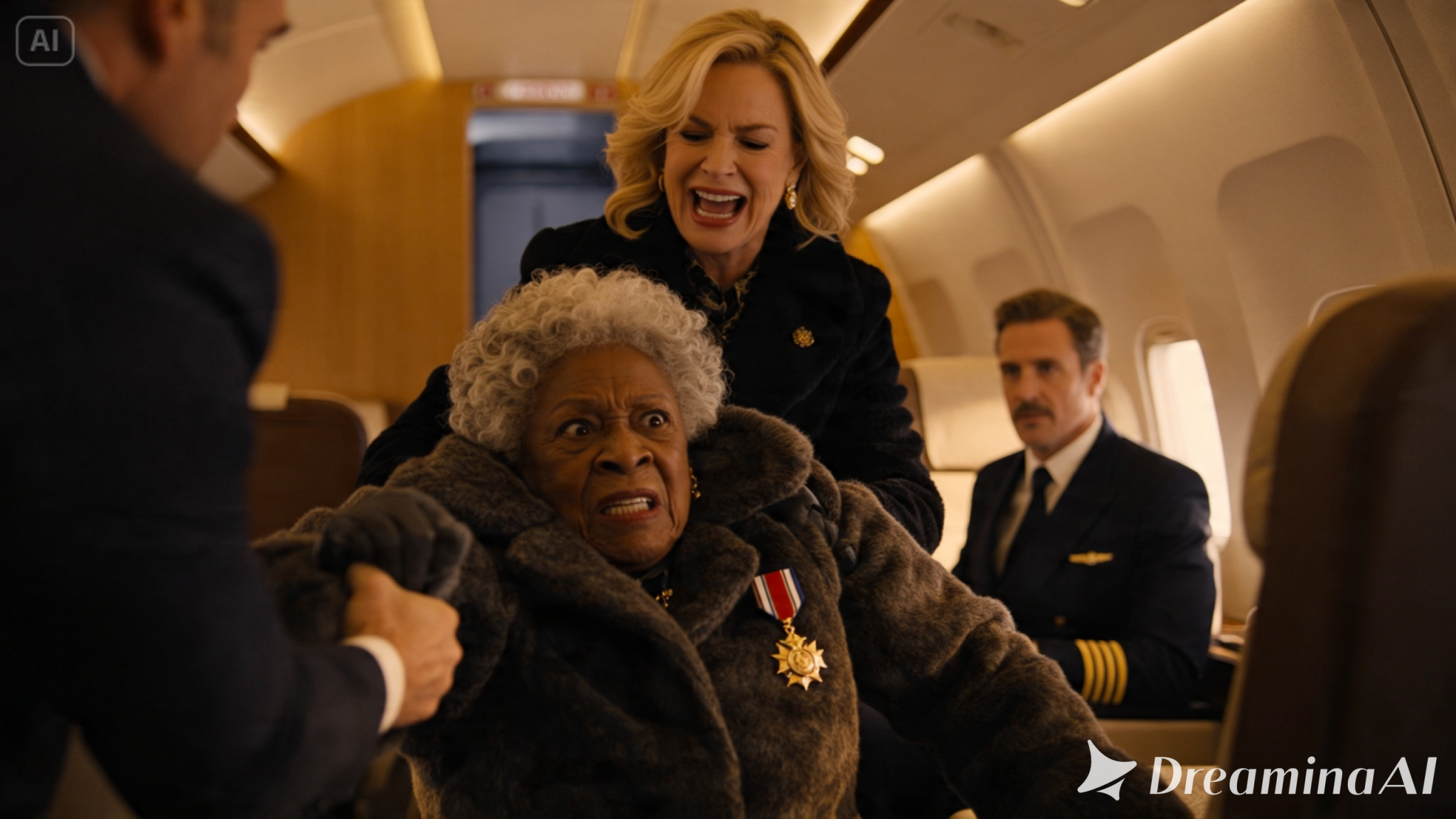
“Ma’am, I suggest you close your mouth. Right now.”
The words didn’t echo, because the First Class cabin of a Boeing 737 is designed to absorb sound, but they might as well have been a gunshot. The ambient hum of the aircraft’s auxiliary power unit suddenly felt deafening. The soft jazz playing over the overhead speakers seemed to freeze mid-note.
I have lived a long time. I have been in rooms where generals mapped out the coordinates for carpet bombings, and I have sat in church pews where grieving mothers screamed at heaven. I know what the atmosphere feels like right before the oxygen is violently sucked out of a space.
That is exactly what happened in Row 2.
Clara’s jaw actually dropped. The manufactured, pearl-white smile she had weaponized just seconds before vanished, replaced by a look of profound, uncomprehending shock. Her manicured fingers went slack, and her custom-cased iPhone slipped a fraction of an inch in her grip. I could faintly hear the tinny, confused voice of her husband—“Clara? Clara, what’s going on? Who is that?”—leaking from the earpiece.
For a woman whose entire existence was predicated on the belief that the world was a red carpet rolled out exclusively for her feet, being spoken to with such absolute, icy authority by a man in a pilot’s uniform was a systemic shock. It simply did not compute.
“Excuse me?” Clara gasped, her voice trembling—not with fear, but with the sudden, volcanic ignition of pure entitlement. The flush of an ugly, mottled red crept up her neck, clashing violently with her beige cashmere. “Did you just… did you just tell me to shut up? Are you speaking to me?”
Captain Miller didn’t flinch. He didn’t blink. He stood in the aisle, an imposing figure of quiet, restrained power, the four gold stripes on his epaulets catching the overhead reading lights.
But he wasn’t looking at her anymore.
He slowly pivoted, turning his back halfway toward Clara’s sputtering outrage, and lowered himself. Right there in the narrow aisle, the captain of a commercial airliner dropped to one knee, bringing himself down to my eye level.
The businessman in seat 1B leaned entirely out of his space to watch. Julian, the flight attendant, stood frozen at the edge of the galley curtain, his hands clasped tightly in front of him, his eyes wide.
Captain Miller looked at me. The harsh, fluorescent lighting of the terminal was gone, replaced by the warm, directional beam of my overhead light. It cast deep shadows across the lines of his face—lines earned from decades in the sky, and perhaps, from a past that understood the gravity of what he was looking at.
His eyes locked onto the torn, frayed gap of my navy-blue pea coat. He looked at the heavy wool where the brass button had been violently ripped away. And then, his gaze settled on the inner lapel. On the bronze cross and the red, white, and blue ribbon.
“Ma’am,” Captain Miller said. His voice was completely different now. The sharp, commanding bark was gone. It was replaced by a tone so gentle, so steeped in a deep, profound reverence, that it made my throat tighten. “Is that… I don’t want to presume, but is that the Distinguished Service Cross?”
I looked at him. Really looked at him. He was a white man, probably in his late fifties, maybe early sixties. He wore his uniform with the precision of someone who had spent his formative years conforming to military regulations. The military haircut, the perfectly pressed collar, the absolute stillness in his posture. Real recognizes real. He knew.
I took a slow breath, letting the stale, recycled air of the cabin fill my lungs. My knee was throbbing a vicious, syncopated rhythm against my thigh bone, but I forced my hands to remain perfectly still in my lap.
“Yes, Captain,” I said, my voice steady, though it felt heavy with the weight of ghosts. “It is.”
The Captain closed his eyes for a fraction of a second. A muscle in his jaw twitched. When he opened his eyes again, they were shining with an emotion I couldn’t quite place—a mixture of awe and a deep, empathetic sorrow.
“May I ask your name, ma’am?”
“Beatrice,” I replied quietly. “Beatrice Vance.” I had kept Arthur’s last name after he passed, but in this moment, wearing this medal, I felt the spirit of my commanding officer, Thomas Vance, standing right behind me. It was a slip of the tongue, a merging of the men who had shaped my life, but I didn’t correct it.
“Beatrice,” Captain Miller repeated, tasting the name, committing it to memory. “It is an absolute honor to have you on my aircraft. I served in the Air Force. Gulf War. But my father… my father flew medevac in Vietnam. 68th Medical Detachment.”
The numbers hit me like a physical blow. The 68th. “Dustoff.” The absolute lunatics who flew unarmed helicopters into active firefights to pull bleeding kids out of the jungle. The men who had pulled me and Thomas out of the mud.
“They were brave men,” I whispered, the memory of rotor blades chopping through the humid, smoke-filled air suddenly loud in my ears. “The bravest I ever knew.”
“Not as brave as the nurses who stayed in the back, up to their elbows in it,” the Captain said, his voice thick with emotion. He looked at the medal again. He knew the criteria. You don’t get the DSC for just doing your job. You get it for looking death in the face and refusing to blink. “To earn that… I can’t even imagine what you survived.”
“I survived because I wasn’t alone,” I said simply, touching the faded photograph of Thomas through the fabric of my purse. “I’m flying to Seattle today to bury the man who pulled me out of a burning Huey. I’m wearing this for him.”
Captain Miller swallowed hard. He nodded slowly, a silent, unbreakable pact of understanding passing between us. In that tiny, pressurized metal tube, we weren’t just a pilot and a passenger. We were two people who understood the cost of a blank check written to your country.
“Well, Beatrice,” he said softly, “Thomas would be damn proud of you today.”
“Excuse me! Hello?!”
The shrill, piercing screech of Clara’s voice shattered the moment like a hammer smashing through stained glass.
I had almost forgotten she was there. For sixty seconds, she had been entirely erased from the narrative, and for a woman like Clara, being ignored is a fate worse than death.
She had unbuckled her seatbelt and leaned aggressively over the center console, her phone still clutched in her hand, the screen glowing.
“I am sitting right here!” Clara practically spat, her face contorted into a mask of righteous, furious indignation. “I don’t know what kind of little veteran reunion you two are having, but I am a Diamond Medallion member, and I demand you address me! You told me to shut up! Do you have any idea who my husband is? He’s listening to this right now! David, tell him you’re calling the airline’s corporate office!”
Captain Miller slowly, deliberately broke his gaze away from me. He didn’t rush. He didn’t scramble to apologize. He stood up, letting his full height tower over her seat.
The warmth in his eyes vanished, replaced instantly by the cold, unforgiving steel of a commanding officer dealing with a severely insubordinate liability.
“I know exactly who you are, ma’am,” Captain Miller said, his voice dropping an octave, carrying that terrifying, quiet volume that forces everyone in the room to hold their breath. “You are the passenger who violently assaulted an elderly, disabled veteran on my jet bridge.”
The collective gasp from the First Class cabin was audible. The businessman in 1B actually dropped his tablet. Julian let out a sharp intake of breath.
Clara froze. The color drained from her face so fast she looked vaguely translucent. Her mouth opened and closed twice, like a fish pulled out of the water.
“I… I have no idea what you’re talking about,” she stammered, but the lie was so fragile, so transparent, it practically shattered in the air. Her eyes darted wildly around the cabin, looking for allies, but she found only horrified stares. “She… she tripped! She was blocking the priority lane and she stumbled over her own cheap luggage!”
The audacity of it. The sheer, unadulterated sociopathy required to physically rip someone to the ground and then seamlessly transition into playing the victim. It was a defense mechanism she had likely honed over a lifetime of stepping on people.
“She pushed me!” Clara escalated, her voice rising to a hysterical pitch, leaning into the role of the fragile, threatened woman. She pointed a manicured finger right at my face. “She’s aggressive! She threatened me when she sat down! I don’t feel safe with her sitting next to me! I want her removed from this flight immediately!”
This is the moment where, historically, people who look like me lose.
This is the moment where the tears of a wealthy white woman trump the lived reality of a Black woman. It is a script so deeply ingrained in the DNA of our society that it plays out like an automated reflex. I felt a cold, familiar dread coil in the pit of my stomach. Even with the Captain standing there, even with my medal, a part of me braced for the inevitable shift. I waited for the authorities to be called, for the “misunderstanding” to be handled quietly, for me to be asked to move to coach to “keep the peace.”
But Captain Miller did not follow the script.
He didn’t argue with her. He didn’t try to reason with her. He simply looked down at her with a disgust so profound it was almost palpable.
“Ma’am, I do not care who your husband is,” the Captain said, his tone utterly devoid of compromise. “And I do not care about your frequent flyer status. Let me make this completely clear for you, so there is zero ambiguity: I was doing my exterior walk-around. I was standing at the threshold of the aircraft door. I had a direct, unobstructed line of sight down the B14 jet bridge.”
Clara’s hand, the one holding the phone, began to tremble.
“I watched you,” Captain Miller continued, his voice echoing in the dead silence of the cabin. “I watched you approach a woman twenty years your senior. I watched you grab her by the collar of her winter coat. I watched you violently yank her backward to clear your own path. I watched her fall hard onto the metal grating, and I watched you step over her body and laugh.”
“That’s a lie!” Clara shrieked, panic finally bleeding through her anger. “David, are you hearing this?! This pilot is lying! He’s discriminating against me!”
“Julian,” Captain Miller barked, not breaking eye contact with Clara.
“Yes, Captain?” Julian stepped forward instantly, his posture rigid.
“Did you notice the state of the passenger in 2A when she boarded?”
“Yes, sir,” Julian said, his voice surprisingly firm for a young man thrown into a chaotic conflict. “Her coat was freshly torn at the shoulder. The button was missing. She was limping heavily, and her hands were shaking. And… and I heard this passenger,” he pointed vaguely at Clara, “complaining loudly about ‘the element’ they were letting into First Class and how the boarding process was a joke.”
“Thank you, Julian,” the Captain said.
I sat there, my hands resting on my folded coat, and for the first time since I hit the floor of that freezing tunnel, a tear broke free. It betrayed me, sliding hot and fast down my cheek, catching in the deep creases near my mouth.
It wasn’t a tear of sadness. It wasn’t pain.
It was the sheer, overwhelming shock of being seen. Of being validated. Of having someone look at a situation involving a Black woman and a wealthy white woman and instantly, unequivocally, stand on the side of the truth. It is a terrifyingly rare experience to have your pain acknowledged by a system that usually demands your silence.
I wiped the tear away quickly with the back of my hand, keeping my chin high.
Clara was hyperventilating now, realizing the walls were closing in. Her narrative had failed. The audience wasn’t buying her performance.
“You can’t prove anything!” she snapped, crossing her arms tightly over her chest, vibrating with a toxic mix of fear and fury. “It’s my word against hers. You’re just taking her side because she pinned some cheap piece of metal to her jacket! I paid two thousand dollars for this seat, and I am not putting up with this harassment!”
“You’re right about one thing,” Captain Miller said, his voice dropping into a deadly calm. “You are not putting up with this.”
He reached to his shoulder, unclipped the radio mic attached to his epaulet, and pressed the button.
“Flight Deck to Gate B14. I need Port Authority Police and the Lead Gate Supervisor to board the aircraft immediately. We have a Level 2 passenger disturbance and an assault in the forward cabin. We will not be pushing back until the situation is resolved.”
The static chirp of the radio confirming the request echoed loudly in the small space.
Clara stared at the radio, her eyes wide with a dawning, horrific realization. “What are you doing?” she whispered, her voice finally losing its serrated edge, replaced by genuine, panicked disbelief.
“Federal Aviation Regulations are very clear, ma’am,” Captain Miller said, looking down at her like she was a stain on the carpet. “It is a federal offense to assault, threaten, or intimidate any passenger or crew member. It is also a federal offense to interfere with the safe boarding process of a commercial aircraft.”
“I didn’t interfere!” she yelled, slamming her hands down on her tray table. “I was just trying to get to my seat!”
“You assaulted an elderly woman who is a decorated war hero, and you caused physical injury to her person on my aircraft,” the Captain said. “As the Captain of this flight, I have absolute authority over who is allowed in this cabin. You are a threat to the safety and security of my passengers. You are volatile, you are aggressive, and you are a liability.”
He leaned in, just a few inches closer to her, his voice hard as iron.
“You are no longer flying on my airplane today. Gather your things, take your bag out of the overhead bin, and exit the aircraft.”
For a moment, the world stopped turning.
The silence was absolute. Nobody breathed. Even the businessman in 1B seemed to have turned into a statue.
Clara looked at the Captain. She looked at me. She looked down at the heavy brass button that had somehow, impossibly, made it from the jet bridge into the cuff of her sleeve when she grabbed me, and was now resting glaringly obvious on the center console between us. The physical proof of her violence, sitting right there in the open.
Her face contorted into something ugly, a mask of pure, feral desperation. The entitlement that had protected her for fifty years had just met a brick wall it couldn’t shatter.
“No,” Clara said.
It was a small word, petulant and childish.
“Ma’am, this is not a negotiation,” Captain Miller warned.
“I said NO!” Clara suddenly screamed, the sound tearing through the quiet cabin, raw and hysterical. She dug her manicured fingers into the leather armrests, physically anchoring herself to the seat. “I am not leaving! I have a spa appointment in Seattle! I have a life! You can’t do this to me! I am not moving! If you want me off this plane, you are going to have to drag me off!”
Through the open cockpit door, past the galley, I saw the heavy forms of two Port Authority police officers, wearing tactical vests and stern expressions, step onto the aircraft.
Captain Miller looked at the officers, then back down at Clara, who was now clutching her Louis Vuitton bag to her chest like a shield, her eyes wild, her phone still broadcasting the entire meltdown to her husband.
The Captain didn’t look angry anymore. He just looked deeply, profoundly tired of people like her.
“Have it your way,” the Captain said quietly.
Chapter 4
“Have it your way,” Captain Miller said quietly.
He didn’t raise his voice. He didn’t gloat. He simply stepped back, folding his arms across his chest, and gave a brief, imperceptible nod to the two Port Authority police officers waiting in the galley.
The shift in the cabin’s atmosphere was absolute and terrifying. The sterile, ambient warmth of First Class suddenly felt as cold and unyielding as a concrete holding cell. The officers didn’t walk; they advanced. They moved with the heavy, practiced synchronization of people who dealt with belligerent unpredictability every single day.
“Ma’am, you need to stand up and exit the aircraft,” the lead officer said. He was a mountain of a man with a shaved head and a nameplate that read Sgt. R. Davies. His voice was deep, flat, and completely devoid of the customer-service deference Clara was desperately accustomed to.
Clara pressed herself deeper into the plush leather of seat 2B. Her knuckles were bone-white as she gripped the handles of her Louis Vuitton bag, treating it like a life preserver in a violently churning sea.
“Don’t you dare touch me!” she shrieked, her voice cracking, the polished veneer of the wealthy suburbanite entirely shattered, revealing the panicked, feral child beneath. “You can’t do this! I am a paying customer! I am a Diamond Medallion! This is a massive misunderstanding! That woman—” she thrust a shaking, manicured finger toward me “—she attacked me on the jet bridge! Check the cameras! I want the cameras checked right now!”
“There are no cameras inside the enclosed jet bridge tunnel, ma’am,” Captain Miller stated, his tone glacial. “Which I’m sure you counted on. But you have an eyewitness. Me.”
“He’s lying! David, tell them he’s lying!” Clara screamed into her phone, bringing the device back to her mouth.
But from where I sat, less than two feet away, I could hear the tinny, distorted audio leaking from her earpiece. The voice on the other end didn’t sound supportive. It sounded frantic. It sounded furious.
“Clara, shut up! Just shut your mouth!” her husband’s voice hissed through the speaker, loud enough for Sgt. Davies to hear. “You are arguing with a federal officer and a pilot! Do you want to go to federal prison? Hang up the phone, get off the damn plane, and call the lawyers! Stop making it worse!”
The blood drained from Clara’s face. The ultimate betrayal. The man whose name and bank account she used as a shield had just explicitly told her to surrender. She lowered the phone slowly, staring at the blank screen as the call disconnected. The silence from the device seemed louder than her screaming.
“Ma’am, I am not going to ask you again,” Sgt. Davies said, unclipping a pair of heavy, black plastic zip-ties from his tactical vest. The thick plastic made a harsh, ratcheting sound as he tested the loop. “You can walk off this aircraft under your own power, carrying your bags. Or we can escort you off this aircraft in restraints, and your luggage will be impounded as evidence in a federal assault investigation. You have exactly three seconds to decide how this goes. One.”
Clara’s eyes darted wildly. She looked at Julian, who stood near the galley curtain, his face a mask of polite neutrality. She looked at the businessman in 1B, who had deliberately turned his head toward the window, refusing to make eye contact.
Finally, she looked at me.
For a fraction of a second, I saw it. Stripped of her entitlement, her status, and her audience, she was nothing but a hollow, terrified shell of a human being. She looked at my dark skin, at my gray hair, at my torn coat. She had spent her entire life believing people who looked like me were beneath her, that we existed only to yield space to her comfort. The cognitive dissonance of realizing that the universe had just violently corrected that assumption was breaking her in real-time.
“Two,” Sgt. Davies counted, stepping into the aisle, closing the distance.
“Fine!” Clara spat, her voice a ragged, defeated hiss. “Fine! I’m leaving!”
She scrambled out of the seat, practically throwing her designer bag over her shoulder. She didn’t bother trying to retrieve her luggage from the overhead bin; she just wanted to escape the suffocating humiliation of the cabin.
As she squeezed past the officers, she paused at the threshold of the aircraft door. She turned back, glaring at me with a hatred so pure and venomous it could have etched glass.
“You think you’ve won,” she sneered, her voice trembling with malice. “You’re just a pathetic old woman playing dress-up with some cheap metal. You’re nothing.”
I didn’t blink. I didn’t raise my voice. I just looked at her, letting the profound, unshakeable weight of my history settle into my bones.
“I survived a war, Clara,” I said softly, using her name for the first time, watching her flinch at the familiarity. “I survived bombs, and mud, and bleeding men. I survived a country that told me I was less-than the day I was born. Your petty, fragile little insults mean absolutely nothing to me. You are dismissed.”
It was the final nail. She opened her mouth to retort, but Sgt. Davies placed a heavy, gloved hand on her shoulder and physically turned her toward the jet bridge.
“Walk,” the officer barked.
I watched her disappear down the tunnel, flanked by law enforcement, her expensive cashmere coat dragging slightly against the cold metal grating where, just twenty minutes prior, she had thrown me to the ground.
The heavy cabin door swung shut with a definitive, airtight thud.
The silence that followed was profound. It wasn’t the tense, suffocating silence of an active conflict; it was the exhausted, decompression of a battlefield after the artillery finally stops.
Captain Miller stood in the aisle for a long moment, looking at the empty seat 2B. Then, he turned back to me.
“Are you alright, Beatrice?” he asked, his voice returning to that gentle, reverent tone. “Do you need a paramedic to look at that knee before we push back? We have a medical kit on board, and I can call EMTs to the gate.”
“I’m alright, Captain,” I lied softly. The knee was screaming, a hot, rhythmic pulsing that radiated up my thigh and down to my ankle. But I had spent a lifetime pushing through pain. I wasn’t about to delay this flight any further. I had a funeral to get to. “Just a bit stiff. Nothing a few aspirin and a smooth takeoff won’t fix.”
He looked at me, his eyes crinkling at the corners. He knew I was lying, but he also recognized the dignity in the lie. He gave a sharp, respectful nod.
“Smooth takeoff it is, ma’am. Julian will make sure you are well taken care of.” He stepped back, pausing at the cockpit door. “It truly is an honor to fly you today.”
“Thank you, Captain,” I said.
As the cockpit door locked behind him, the First Class cabin slowly began to breathe again. The ambient jazz music swelled.
Suddenly, a hesitant voice broke the quiet.
“Ma’am?”
I turned my head. It was the businessman in seat 1B. He looked to be in his late thirties, wearing a sharp, custom-tailored suit, his laptop resting closed on his tray table. His face was flushed, his expression a complicated mix of guilt and profound discomfort.
“Yes?” I asked, my voice guarded.
“I… I owe you an apology,” he said, swallowing hard. He unbuckled his seatbelt and leaned awkwardly across the aisle. “I saw her push you in the tunnel. I was right behind her. I saw you fall. And… and I didn’t do anything. I just kept my head down. When she started yelling at you here in the cabin, I just sat here. I’m sorry. I should have said something. I should have helped you up.”
I looked at him. Really looked at him. He was a man who navigated the corporate world, a man who had been taught that minding his own business was the key to self-preservation. It is a common, insidious cowardice that plagues our society. We watch the vulnerable get trampled, and we convince ourselves it isn’t our place to intervene.
I could have offered him absolution. I could have smiled, told him it was okay, and eased his conscience. It is what Black women are expected to do—to act as the emotional janitors for the guilt of others.
But my knee was throbbing, my coat was ripped, and I was on my way to bury my commander. I had no patience left for coddling.
“Yes, you should have,” I said evenly. My voice wasn’t angry, but it was absolute. “Silence is a choice, young man. When you watch someone being abused and you choose to look away, you aren’t staying neutral. You are choosing the side of the abuser. You gave her permission to keep going.”
He flinched, the words landing like a physical blow. He looked down at his expensive leather shoes, the flush on his neck deepening.
“You’re right,” he whispered. “You’re absolutely right. I am so sorry.”
“Don’t apologize to me,” I said softly, turning my gaze back out the window to the tarmac. “Just promise yourself that next time, you won’t wait for a man in a uniform to tell you what the right thing to do is. Be brave enough to do it yourself.”
He nodded slowly, sitting back heavily in his seat. He didn’t speak to me again for the rest of the flight, but I noticed he didn’t open his laptop either. He just sat staring straight ahead, turning my words over in his mind. I hoped they would take root.
The airplane engines whined to life, a deep, resonant vibration that shook the floorboards. As we pushed back from the gate and began our taxi toward the runway, Julian approached my row.
He didn’t bring the standard pre-flight champagne. Instead, he brought a steaming mug of black tea, a warm, damp towel on a porcelain plate, and a small, sealed packet of ibuprofen.
“The Captain requested I bring these from his personal kit,” Julian murmured, setting the items down on my tray table with profound care. He looked at the torn shoulder of my coat, then at my face. “If you’d like, ma’am, we have a sewing kit in the back. I’m not a tailor, but I could try to stitch that tear for you before we land.”
I touched the frayed wool of the navy-blue pea coat. My thumb brushed over the empty space where the heavy brass button used to be. For a moment, I considered his offer. I wanted to look respectable at the funeral. I wanted to honor Thomas.
But then I thought about what had happened today. I thought about the assault, the humiliation, and the ultimate, triumphant vindication. This tear wasn’t just fabric. It was a scar. It was a physical manifestation of a battle fought in a brightly lit, sterile hallway.
“No, thank you, Julian,” I smiled, a genuine, tired smile. “I think I’ll leave it exactly as it is. It adds character.”
Julian smiled back, a bright, relieved expression. “Understood, ma’am. Let me know if you need anything. Anything at all.”
As the plane accelerated down the runway, pressing me back into my seat, I closed my eyes. The gravitational pull felt briefly like the violent, upward thrust of a Medevac chopper leaving the jungle canopy.
My mind drifted back, pulled by the undertow of memory, to a sterile, white room in a VA hospital in Honolulu in 1972.
I had been in that bed for two months, my leg pinned together with titanium, my spirit completely shattered. The war had taken pieces of me I didn’t know I could lose. The physical pain was a constant, blinding white noise, but the emotional isolation was worse. When I looked at the news, I saw a country tearing itself apart over the very war I had bled for. I saw civil rights leaders being assassinated. I saw a society that still looked at my dark skin and saw a second-class citizen, regardless of the uniform I wore.
I remember sitting in that hospital bed, staring at the blank wall, wondering if I had survived the jungle just to come home and die of a broken heart.
And then, the door had opened, and Major Thomas Vance had limped in.
He was leaning heavily on a cane, his arm in a sling, a jagged red scar cutting across his forehead. He looked older, tired, and deeply worn down. But when he saw me, that brilliant, indomitable smile broke across his face.
He didn’t ask how I was doing. He didn’t offer empty platitudes. He hobbled over to my bed, pulled up a hard plastic chair, and dropped a heavy, brown manila envelope onto my lap.
“What’s this, sir?” I had asked, my voice raspy from disuse.
“That, Lieutenant, is your discharge paperwork,” Thomas had said. “And inside it, there is a recommendation letter signed by me, and countersigned by the General of the 68th.”
I had frowned, opening the envelope. “Recommendation for what?”
“For the Distinguished Service Cross,” Thomas had said, his voice dropping the playful banter, becoming intensely serious.
I had frozen. I looked at him in disbelief. “Sir… they don’t give that to nurses. And they sure as hell don’t give it to Black women from Alabama.”
Thomas had leaned forward, his blue eyes locking onto mine with an intensity that burned right through my depression.
“Listen to me, Beatrice,” he had said, his voice a low, steady rumble. “I don’t give a damn about what they usually do. I don’t give a damn about the politicians in Washington, or the bigots back home. I know what happened in that mud. You kept me breathing for six hours. You fought off a VC patrol with a sidearm and a prayer while holding a tourniquet on my severed artery. You are a warrior. And you are going to wear that medal, not just for you, but for every single person who looks like you who ever got told they weren’t enough.”
He had reached out, his rough, calloused hand gripping mine.
“The world is going to try to make you invisible, Beatrice,” Thomas had whispered. “They are going to try to push you into the margins. Your job, for the rest of your life, is to refuse to let them. You take up space. You stand tall. You wear your scars, and you make them look at you.”
The memory faded as the plane leveled out at 30,000 feet, breaking through the dense, gray cloud cover of the Pacific Northwest into the blinding, crystalline sunlight above.
I reached inside my coat. My fingers brushed against the bronze metal of the cross.
You take up space. You make them look at you.
I had done that today. I hadn’t raised my voice. I hadn’t thrown a punch. But I had stood my ground, and I had forced the world to acknowledge my existence. I had refused to be erased by Clara’s entitlement.
The four-hour flight passed in a blur of quiet reflection. Julian kept my teacup full. The businessman in 1B occasionally glanced over, a look of profound respect etched into his features. I spent the time looking at the faded photograph of Thomas and Arthur, allowing the grief to finally wash over me, untainted by the anger of the boarding incident.
When the plane finally began its descent into Seattle-Tacoma International Airport, the familiar, dense gray rain of Washington State battered the windows. It was fitting weather for a funeral.
The landing was smooth, barely a bump as the tires kissed the wet tarmac.
As we taxied to the gate, the captain’s voice came over the intercom.
“Ladies and gentlemen, welcome to Seattle. The local time is 2:15 PM, and the weather is a chilly forty-eight degrees with heavy rain. We ask that you remain seated with your seatbelts fastened until the captain has turned off the fasten seatbelt sign.”
He paused. The static hummed over the speakers.
“On a personal note,” Captain Miller’s voice continued, a slightly thicker, rougher edge to his tone. “Airlines talk a lot about safety and customer service. But today, I was reminded of what true honor looks like. We had the privilege of flying a deeply decorated veteran on this aircraft today. A woman who sacrificed more for this country than most of us can possibly comprehend. We owe her, and those like her, a debt that can never be repaid. To that passenger: thank you for your service. And thank you for your grace.”
The cabin was completely silent. And then, from somewhere in the back of First Class, someone began to clap. Just a slow, steady applause. It was picked up by the businessman in 1B. Then Julian in the galley. Within seconds, the entire cabin was applauding.
I felt a hot flush rise to my cheeks. I stared out the window, refusing to look at the other passengers, but I couldn’t stop the tears from falling this time. They were quiet, cleansing tears.
When the seatbelt sign chimed off, I took my time. I waited for the rush of impatient passengers to grab their bags and crowd the aisle. I remained seated until First Class was entirely empty, carefully buttoning my coat—as best as I could with the missing button—and gripping the handle of my roller bag.
As I stepped into the aisle, Captain Miller emerged from the cockpit.
He didn’t just wave. He walked up to me, removed his pilot’s hat, and tucked it under his arm.
“Do you have family meeting you at the gate, Beatrice?” he asked.
“My grandson is picking me up at baggage claim,” I replied, leaning heavily on my good leg. The throbbing in my knee was intense now, a stark reminder of my limitations.
“Allow me,” Captain Miller said. He reached out and took the handle of my roller bag. It wasn’t a request; it was a quiet, authoritative act of service.
He escorted me off the aircraft. We walked down the jet bridge together, side by side. It was a vastly different walk than the one I had taken four hours earlier. The air felt lighter. The path was clear.
When we reached the end of the tunnel and stepped out into the bustling, brightly lit terminal, Captain Miller stopped. He turned to face me, setting my bag down.
He reached into his breast pocket and pulled out a small, heavy coin made of polished silver. It bore the insignia of the United States Air Force and the emblem of a specific fighter wing. A military challenge coin. A deeply personal token of respect.
He pressed the coin into my palm, folding my fingers over it.
“My father passed away ten years ago,” Captain Miller said softly. “But if he were here today, he would have wanted to shake your hand. You have a good trip, Beatrice. Give Major Vance a proper send-off.”
He stepped back, came to attention, and delivered a crisp, perfect military salute.
Right there in the middle of a crowded airport terminal, surrounded by thousands of rushing, oblivious travelers, a commercial airline captain stood at attention for an elderly, limping Black woman in a torn coat.
I straightened my spine, ignoring the white-hot pain in my knee. I raised my hand and returned the salute.
“Thank you, Captain,” I whispered.
Two days later, I stood on a sweeping green hill in a military cemetery just outside of Seattle. The rain had finally stopped, leaving the air smelling of wet pine and damp earth.
The funeral was small, mostly family and a few surviving veterans from the 68th Medical Detachment. I stood near the back, my grandson standing tall and protective beside me holding an umbrella.
I wore the navy-blue pea coat. I hadn’t fixed the tear. The jagged hole on my left shoulder was fully visible. But today, the coat was unbuttoned, the wind catching the fabric, proudly displaying the bronze cross pinned over my heart.
I watched as the honor guard, moving with practiced, solemn precision, folded the American flag into a tight, perfect triangle. I listened to the sharp, terrifying crack of the 21-gun salute echoing across the rolling hills, the smell of cordite instantly transporting me back to the jungle.
And then, the haunting, solitary notes of a bugle playing Taps drifted over the graves.
I closed my eyes. I didn’t think about Clara. I didn’t think about the ugly, entitled hatred that still festered in the dark corners of the world.
I thought about Thomas. I thought about Arthur. I thought about the terrified, twenty-three-year-old girl in the mud, who had fought so hard just to survive to see her twenty-fourth birthday.
I had survived. I had lived a full, messy, beautiful, heartbreaking life. I had earned my gray hair, I had earned my scars, and I had earned my place in this world.
The bugle faded into the quiet rustle of the wind through the pines.
I opened my eyes, reached up, and gently touched the jagged tear on my coat. It was broken, yes. But it was still holding together. Just like me.
The world will always try to push you down. It will look at your skin, your age, or your gender, and it will try to tell you that you do not belong in the First Class seats of life. It will demand that you make yourself small to accommodate its comfort.
But as I stood there, a decorated Black combat nurse, surrounded by the ghosts of heroes, I knew the absolute truth.
You don’t fight the darkness by shrinking. You fight it by standing exactly where you are, wearing your scars like armor, and refusing to yield a single, solitary inch.
I adjusted my collar, took my grandson’s arm, and limped slowly down the hill, my head held high, the bronze cross catching the last, defiant rays of the breaking sun.
[END OF FULL STORY]
