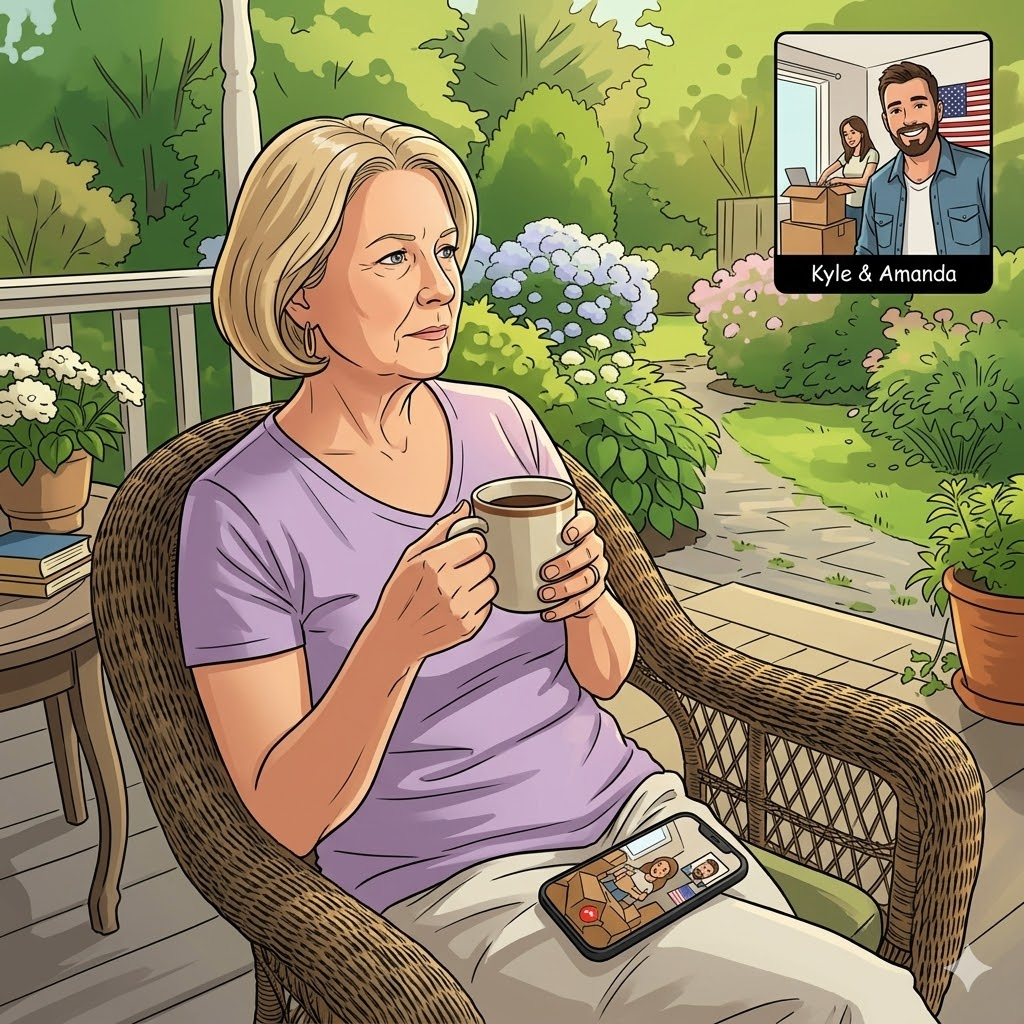
I understood the additional credit cards, the cramped apartment in the suburbs, the endless utility bills, the expensive school supplies, and the small favors that for years sustained Kyle and Amanda’s lives while they insisted on calling it independence.
I finally managed to say, “Okay, son. Have a good trip,” and I hung up the phone.
My name is Margaret Thompson, I am sixty eight years old, a widow, and for a long time I made the mistake of believing that being needed was the same as being loved.
Kyle was my only son, and when my husband, Walter, passed away, I clung to the idea that helping my child was the only way to keep our fractured family together.
I never minded waking up at dawn to drive the children to school when Amanda complained about having a rough day, nor did I mind paying the pediatrician when Kyle claimed his bank had frozen his account.
I did not mind cooking extra meals, buying new shoes, covering mounting debts, lending my SUV, signing legal papers, or opening every door for them, but what I truly minded was the discovery that they had packed up their entire lives and left without saying a single goodbye.
Behind Kyle’s voice on the phone, I heard the telltale sounds of boxes, tape, and the hollow echo of empty rooms.
I also heard Amanda say, far away but clearly audible, “Do not drag this out, Kyle, because if you let her talk, she is going to start with her usual drama.”
That was the exact moment when something inside me quietly settled into place.
I did not scream, I did not beg, and I did not ask why my grandchildren had left without giving me one last hug.
I did not remind Kyle that the apartment they had just vacated was not his property, but belonged to a family holding company that Walter and I had built over thirty years of hard work.
I did not mention that the credit cards they used to pay for groceries, gas, and uniforms were all linked to my personal account, or that every fifth of the month I deposited enough money so they could breathe without wondering who was funding their lives.
I simply hung up the phone and walked into my husband’s home office.
The room remained almost exactly as it had been when Walter was alive, with rows of heavy law books on the mahogany shelves, a green banker lamp glowing on the desk, and a framed photograph of us in Savannah, all wrapped in the dry scent of old paper.
Many associates believed Walter was the true brains of the family, and he was in part, but while he handled the litigation, I managed the accounts, properties, contracts, taxes, insurance, and complex bank transactions.
When he died, many people assumed I would hand everything over to Kyle out of sheer grief or exhaustion, but they were entirely wrong.
I sat down, opened my computer, and wrote an email to Mr. Patterson, our longtime family lawyer.
“Mr. Patterson, please immediately cancel the monthly transfer to Kyle Thompson, and I also need you to suspend the additional credit cards in the names of Kyle and Amanda. Please begin a full inspection of the apartment in the suburbs, which was vacated without any notice, and review any current authorizations where Kyle appears to have access to our family assets or documents, as I am attaching all relevant records for your immediate attention.”
I hit the send button, and the digital sound of the email leaving my inbox was louder than any scream I could have ever let out.
I barely slept that night, not out of any sense of guilt, but because guilt no longer had a place in a mind that had finally achieved such crystal clear clarity.
I lay awake thinking about dates, keys, signatures, and files, while remembering the last time Amanda had sat in my kitchen eating pot roast and insisting they would share their plans with me soon.
I thought about Leo asking if he could leave his bicycle at my house because he felt it was safer here, and I remembered Sophie asleep on my couch tucked under a yellow blanket I had knitted for her when she was a baby.
The next morning I drove to their former apartment building, where the doorman, Mr. Henderson, lowered his gaze as soon as he saw me approaching the front desk.
“Mrs. Thompson, I truly thought you knew they were moving out,” he said, looking uncomfortable.
“I did not,” I replied, seeing no need to say anything further to him.
I went up to the tenth floor with my spare key, and when I opened the door, I was greeted by a sour smell, a mixture of spoiled food, dampness, and general neglect.
The living room was completely empty, and on the walls, light rectangles remained where the family photographs had once hung.
In the kitchen, the refrigerator had been left unplugged and was now filled with rotten milk and blackened vegetables, while the floor was littered with dirty dishes, broken toys, and loose school papers.
What truly broke me inside was not the mess, but finding poor Sophie’s yellow blanket lying on the floor next to a broken cardboard box.
I picked it up carefully, noting that it was stained and wrinkled, discarded like an old rag by people who had once claimed to love my gifts.
That blanket had taken me months of work, as I had knitted it at night during the final weeks of Amanda’s pregnancy, whispering a prayer and a hope into every single stitch.
It had been my silent way of saying that I was already their grandmother, even before they had entered this world.
And yet, they had left it on the floor without a second thought.
That was when I realized they had not simply forgotten to tell me about their move, because they had systematically erased me from their lives.
My phone vibrated in my pocket, and I saw that it was Kyle calling, but I did not answer.
Then a text message arrived from him: “Mom, something is wrong with the credit card because it did not go through at the supermarket, and we are here with the kids and this is so embarrassing.”
He did not say it was cruel, he did not say he was sorry, and he did not say that the children missed me.
He only said it was embarrassing because, for the very first time in his life, he was the one feeling uncomfortable in public.
I put my phone away, went down to the lobby, and looked at the doorman, telling him, “No one enters this apartment without my direct permission, so please change the locks today.”
Mr. Henderson nodded solemnly and said, “You are the owner, Mrs. Thompson, and I will see it done.”
Yes, I was the owner, and for the first time in many years, I finally began to act like one.
In attorney Patterson’s office, the situation shifted from a private family wound to a much more serious legal matter.
He greeted me with a thick folder on his desk and an expression that told me he had discovered something truly upsetting.
He explained that Kyle and Amanda had rented an expensive, elegant beachfront condo in Miami, the kind of place people brag about to make themselves look successful.
Up to that point, their sheer irresponsibility could have remained their own problem, but then Patterson took a deep breath and said, “Mrs. Thompson, they actually listed you as the primary guarantor on the lease.”
I felt the heat of anger rush to my face as I asked, “With what authorization did they do that?”
He opened a copy of the file and pointed to an old power of attorney document I had signed years ago so Kyle could help me with some simple car registration paperwork while Walter was sick.
They had used that old, expired authority to secure a luxury rental without my consent, using my name as a stepping stone for their own shallow ambitions.
I gave the order to revoke the power of attorney, challenge the lease guarantee, repossess the company SUV, close all access points, change every password, block the cards, and protect my accounts.
Patterson looked at me cautiously and warned that if I did it all at once, they would be left without a car, an apartment, or any money.
I replied, “They are healthy adults, and if they wanted to live so far away, they should learn to pay for that life themselves.”
Two days later, the SUV was towed from the building’s parking lot in Miami right in front of the neighbors and security guards.
I was told later that Amanda had made quite a scene, and Kyle had called my phone fifteen times before leaving a message saying I was acting like a spiteful woman and suggesting someone should check my mental state.
I almost laughed at the irony, because it is always the same tired pattern: when an older woman helps, she is considered sweet, but when she sets clear boundaries, she is branded as crazy.
Later, Amanda managed to call me from a different number and shouted, “You are being incredibly cruel by leaving us out on the street with your own grandchildren.”
I replied, “My grandchildren will always have a safe place with me, but it is your decisions, not my lack of money, that have put you in this terrible situation.”
She accused me of wanting to destroy the family, and that was when I told her about finding the yellow blanket on the floor.
There was a long silence on the other end before she murmured, “It was just an old blanket.”
I replied, “No, it was love woven by hands that you chose to trample underfoot,” and I hung up the phone before she could insult me again.
That same afternoon, a notification arrived from the bank showing that someone had tried to withdraw a massive sum using an old access route, but the attempt was rejected because Patterson had already secured the accounts.
I did not need anyone to confirm who it was, because Kyle, without a car, without a credit card, and without the basic shame required to offer an apology, had still tried to reach into my pockets.
I knew they would come for me eventually, not because they wanted to apologize or speak with humility, but because they had nowhere else left to turn.
So I prepared the house, changing the gate code, checking the security cameras, organizing my legal file, and simultaneously putting fresh linens in the guest room.
One thing was ceasing to support two irresponsible adults, but another entirely was allowing Leo and Sophie to sleep in a car because of their parents’ failures.
On Sunday at noon, a dusty, rented sedan pulled up in front of my house.
Kyle got out first, looking disheveled with a wrinkled shirt and sunken eyes, while Amanda followed him with no makeup and her pride clearly beginning to fray.
The children followed behind them, looking exhausted with heavy backpacks and faces that showed they had overheard far too many adult arguments during the long drive.
Kyle tried to open the security gate with his old key, but it would not work, and Amanda snatched it from him in a fit of rage before failing just as miserably.
They began to ring the doorbell repeatedly, but I watched them from the security monitor for a few moments to ensure I kept my resolve.
I was not acting out of cruelty, but out of justice, because they had to understand that they could no longer enter my life as if they were opening their own junk drawer.
I walked out onto the porch and moved slowly to the gate as Kyle shouted, “Mom, open this gate right now, the children are hungry.”
I looked at Leo and Sophie, and my heart ached for them as it always did, but my voice remained steady and firm.
“The children can come inside, but you two are not coming in,” I said clearly.
Amanda grabbed Sophie’s wrist and snarled, “No one is coming in here unless we all go in together.”
I looked her straight in the eye and stated, “Let go of my granddaughter, because children are not bargaining chips to use when adults run out of valid arguments.”
She released the girl, and I opened the gate just enough for the children to pass through.
Sophie ran toward me first, followed by a serious looking Leo who was trying to act older than his years.
I hugged them both, feeling their fear and the lingering smell of a long, stressful trip.
“There is fresh water and cake inside the kitchen for you,” I told them, and once they were safely through the door, I closed the gate again.
I took the legal folder out of my bag and looked at my son, saying, “Now we are going to talk like adults.”
Kyle clung to the metal bars of the gate as if he could still bully me from the other side.
“You have ruined everything,” he said with a breaking voice. “They took the car, the apartment, and the credit cards, so what did you expect us to do?”
I looked at him without hatred, but also without the blind, suffocating tenderness I had mistakenly called love for so many years.
“I wanted you to tell the truth before you dared to use my name for your debts,” I said. “I wanted you to give me the courtesy of a warning before dragging my grandchildren across the country, and I wanted you to act like a man before demanding that I continue to be your ransom.”
Amanda let out a bitter laugh and accused me of enjoying their humiliation, but I ignored her and slid the documents Patterson had prepared through the bars.
The agreement was simple, requiring them to acknowledge the misuse of my power of attorney, renounce any right to use my assets without my written permission, and agree to return all stolen family property.
For six months, I would take direct financial responsibility for the children’s schooling and essential needs, but I would not give them a single cent in cash.
Kyle and Amanda would have to move into a modest apartment in their own names, find work, submit a monthly budget to me, and rebuild their lives without lies.
If they refused, Patterson was authorized to initiate legal action for breach of trust, attempted bank fraud, and property damage.
Amanda turned pale as she looked at the papers, whispering, “He is trying to take our children away from us.”
“No,” I replied calmly, “I am simply trying to prevent his children from paying the ultimate price for his arrogance.”
Kyle read each page slowly, his hands trembling as he realized the reality of his situation.
For the first time in his life, he did not look angry at me, but instead seemed genuinely afraid of the person he had become.
Amanda insisted she would not sign anything that made her feel like a kept woman, but then Kyle finally looked up and said, “Look at us, Amanda, and I mean really look at us.”
She turned toward the dirty rental car, the overstuffed suitcases, the locked gate, and the house where her children were now safe and warm.
Her pride began to crack, not with a loud sound, but with a weary exhaustion.
Kyle asked for a pen, and I tossed one through the bars to him.
He signed first, and Amanda took much longer, but when she finally heard Sophie’s laughter coming from inside the house, her resolve crumbled and she signed as well.
When they returned the papers to me, Kyle was crying, not like a pampered child or a victim, but like a man who had finally reached the edge of his own consequences.
I opened the gate just wide enough to hand them a sealed envelope.
“Here is the address of a small, furnished apartment ten blocks away,” I said. “I have paid the first month’s rent because my grandchildren will not sleep in a car, but after this, the rent is entirely up to you.”
I continued, “There are also two job contacts in this envelope, and tomorrow at nine, Kyle, you have a meeting with an administrative agency, while Amanda, you have an interview with a publisher who needs proofreading help.”
I warned them, “If you do not show up, the entire agreement is off, and the law will take its course.”
Amanda looked at me as if she had just received the most elegant slap of her life, and she asked, “Did you actually get us jobs?”
“I got you an open door,” I replied, “but walking through it is entirely up to you.”
That night, Leo and Sophie slept in my guest room, and I made them quesadillas, told them stories about their grandfather Walter, and explained in gentle words that their parents were busy taking care of important adult things.
I did not talk to them about betrayal, because children do not need to carry the heavy weight of adult names they cannot yet understand.
During the following months, Kyle learned to arrive early, obey a boss much younger than himself, and discover that the world does not organize itself around his whims.
Amanda learned exactly how much milk costs, how heavy the weight of debt can be, and how humiliating it is to fix the mistakes you previously refused to acknowledge.
They did not change overnight, as people rarely find humility simply by signing a piece of paper, but something fundamental began to shift.
One Friday, Kyle came into my kitchen and said, “Mom, I used to think that as long as you were helping us, that meant everything was okay.”
I kept chopping tomatoes and answered, “No, son, sometimes a mother helps so much that she accidentally teaches her child not to stand on their own two feet.”
He lowered his head and whispered, “I am sorry,” and I did not hug him right away because some words need to linger in the air to prove they are not just a habit.
But that night, when he left, he placed an envelope on my table containing the first small payment for his children’s school.
It was not much money, but it came from his own hard work, and that changed everything.
Sometimes justice does not arrive with a noisy punishment, but rather like a mother closing a bank card, changing a lock, and finally opening the right door, not the door to comfort, but the door to truth.
