My mother only made pot roast when somebody was about to ask me for something.
That was the first clue, though I didn’t recognize it until later, when I was standing in my own driveway with three crying children, six suitcases, and the kind of anger that makes your hands go cold.
It was a Sunday in early September, one of those Portland afternoons where the sky couldn’t decide whether to rain or shine. I drove to Mom’s house with my windshield wipers ticking every few minutes, the smell of damp leaves coming through the vents. I’d been invited for “a simple family dinner,” which should have made me suspicious by itself. My family did not do simple. My family did ambushes with gravy.
When I walked in, the house smelled like rosemary, onions, and old carpet cleaner. My sister Madison was already seated at the dining table, glowing under the chandelier like she’d been lit from inside by a spotlight. She had one hand resting on her stomach. Not casually. Not accidentally. It was the full announcement pose.
Madison was three years older than me, blonde, loud, charming, and permanently convinced that gravity itself was a personal favor. I was Jessica, the brunette younger sister who learned early that keeping quiet made life easier. Madison got the bigger bedroom, the birthday parties with ponies, the benefit of the doubt. I got “try to understand your sister.”
Her husband Derek sat beside her, scrolling his phone with the blank expression of a man waiting for instructions. Their three kids were in the living room: Emma, seven, lining up plastic horses on the coffee table; Lucas, five, making explosion noises with a toy truck; and Tyler, two, dragging a throw pillow across the floor like it had personally offended him.
“Jess,” Madison said before I’d even taken off my coat. “Guess what.”
I knew. Every woman in the room knew. Even Derek probably knew, and he looked like he found out at the same time I did.
“You’re pregnant,” I said.
Madison clapped her hands once, delighted with herself. “Number four!”
Mom made a watery sound of joy near the stove. “Isn’t it wonderful?”
I smiled because I was not a monster. “Congratulations.”
And I meant it, for about eight seconds.
Then Madison’s smile softened into something practiced. “There’s more.”
I pulled out a chair. The wood scraped against the floor louder than it should have. “More than a baby?”
“My blood pressure is elevated,” she said, lowering her voice. “The doctor says this pregnancy needs careful monitoring. There’s a chance I’ll have to go on modified bed rest once I’m further along.”
Mom turned from the stove, wearing the same expression she used when asking me to forgive Madison for stealing my graduation money because “she was going through a lot.”
I reached for the bread basket. My fingers found a roll. I didn’t eat it.
Madison continued, “So Derek and I talked it over, and we came up with the perfect plan.”
There it was. The ask. I felt it before I heard it.
“The kids will stay with you for a few months,” she said brightly. “Just until I have the baby.”
The butter knife slipped from my hand and hit my plate.
I looked at her. Then at Derek. Then at Mom. Nobody laughed.
“You’re joking,” I said.
Madison tilted her head. “Why would I joke about my health?”
“You want me to take Emma, Lucas, and Tyler into my house for months?”
“Only temporarily.” She said it the way people say “only one slice of cake” while holding a knife over half the pan. “You have three bedrooms. You work from home most days. Lincoln Elementary is only fifteen minutes from you, and there’s a daycare nearby for Tyler. Honestly, it fits together perfectly.”
Not for me, I thought. Nothing about it fit me.
I was thirty-three, single by choice, and proud of the quiet life I’d built. I had a career in software engineering that regularly swallowed sixty hours a week. I had a small house outside Portland with a home office, a guest room, and a spare room I used for storage because peace was not wasted space. I liked clean counters, uninterrupted coffee, and the low hum of my dishwasher at midnight. I did not have juice boxes or car seats or any desire to become a temporary mother because my sister didn’t like inconvenience.
“No,” I said.
Madison blinked, as if I had spoken in another language.
Mom set down the carving fork. “Jessica, honey—”
“No,” I repeated. “I’m sorry about the pregnancy complications, but I’m not taking three children for several months.”
Madison’s lips pressed together. “You haven’t even thought about it.”
“I don’t need to. I work constantly. I don’t know their routines. They barely know me.”
“They know you,” Mom said weakly.
“They see me at Christmas and the occasional birthday party.”
Madison leaned forward. “They’re easy kids.”
A crash came from the living room, followed by Lucas yelling, “It wasn’t me!”
I looked toward the noise. Madison did not.
“You can do your computer thing while they play,” she said. “Kids entertain themselves.”
That was when I almost laughed. Not because it was funny, but because it was so wildly detached from reality that laughter seemed like the only safe response.
“Hire a nanny,” I said. “Ask Derek’s mother. Look into family leave.”
Derek finally looked up. “My mom’s arthritis is bad.”
“And childcare is expensive,” Madison added.
“So your solution is free labor from me.”
Her face hardened. “Family helps family.”
“Family also listens when someone says no.”
The room went quiet except for the rain tapping the window.
Mom’s eyes filled with disappointment, and I hated how fast my body reacted to it. Tight throat. Hot face. That old little-sister panic.
“Jessica,” she said, “your sister needs you.”
“No,” I said one last time, standing. “She needs a plan that doesn’t involve taking over my life.”
Madison’s voice followed me to the door. “You’re being selfish.”
I stopped with my hand on the knob. For one second, I wanted to turn around and say everything I had spent thirty-three years swallowing. Instead, I opened the door.
Outside, the cold air hit my face. Behind me, Madison muttered something I couldn’t catch, and Mom said my name like I was breaking her heart.
I drove home gripping the steering wheel so hard my fingers hurt, thinking the worst was over because I had said no clearly.
A week later, I learned Madison had never heard no as an answer. She had heard it as a delay.
And the first sign was the pounding on my front door.
Part 2
Saturday morning should have smelled like coffee, laundry detergent, and the cinnamon candle I burned when I needed to feel like my life was under control.
Instead, it smelled like panic.
I was in my home office at 8:17 a.m., wearing gray sweatpants and my old University of Oregon T-shirt, trying to finish a presentation for the Morrison account before Monday. My desk had two monitors, three sticky notes, and a mug of coffee gone cold because I had been too focused to drink it. Outside, the neighborhood was quiet in that early weekend way: distant lawn mower, a dog barking once, tires whispering on wet pavement.
Then the doorbell rang.
I ignored it.
It rang again.
Then someone started pounding.
I yanked off my headphones, annoyed before I was worried. I went downstairs, already rehearsing a polite but firm speech for whoever thought Saturday morning was an acceptable time to sell roof repairs.
Through the front window, I saw Madison’s black SUV in my driveway.
Both back doors were open.
My stomach dropped before my brain understood why.
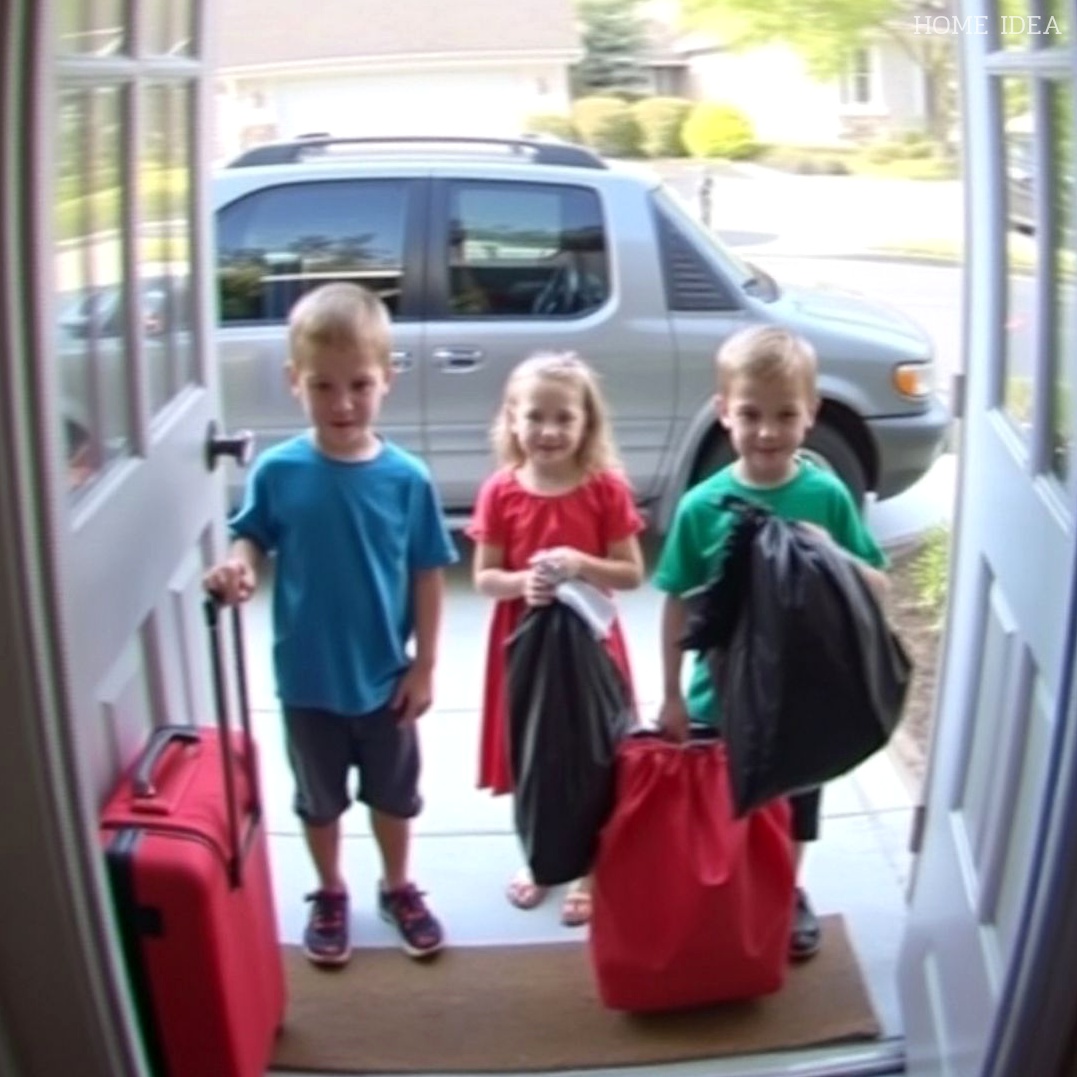
I opened the door and found Emma, Lucas, and Tyler standing on my porch surrounded by luggage. Not just backpacks. Full suitcases. Plastic grocery bags. Two black trash bags tied at the top, bulging with clothes and what looked like stuffed animals. Emma held a pink backpack against her chest. Lucas had red eyes and snot under his nose. Tyler sat on a small blue suitcase eating a Pop-Tart, crumbs stuck to his pajama shirt.
Madison was already backing out of the driveway.
“What are you doing?” I shouted, running down the steps barefoot.
She rolled down the passenger window. Her sunglasses covered half her face. “I told you I needed help.”
“No. I told you no.”
“The school papers are in Emma’s backpack,” she called. “Tyler’s daycare takes drop-ins. Derek packed most of their stuff.”
“Madison, stop the car.”
“I have an appointment.”
“You cannot leave your children here.”
Her mouth tightened. “Don’t be dramatic. It’s temporary.”
Lucas began to cry harder. Emma’s face went pale. Tyler looked up and asked, “Aunt Jess, do you have juice?”
Madison put the SUV in drive.
“If you leave, I’m calling the police,” I said.
For the first time, she looked directly at me. Through the windshield and the gray morning light, I saw something in her expression that wasn’t desperation. It was certainty. She believed I would fold because the children were watching.
Then she drove away.
I stood in the driveway, rain misting against my face, as my sister disappeared around the corner. A neighbor across the street paused with his recycling bin halfway to the curb. I could feel him staring. I could feel everyone staring, even though no one else was outside.
Emma whispered, “Mommy said you knew.”
I turned around.
Three children looked at me like I held the answer to a question I did not understand.
I called Madison immediately. Voicemail.
I called Derek. Voicemail.
I called my mother. She answered on the fourth ring.
“Mom,” I said, my voice shaking, “Madison just left the kids on my porch.”
A pause. Then, far too calm, “Oh good, she got them there.”
My skin went cold. “You knew?”
“Jessica, don’t start. She’s under medical stress. Just help for a little while.”
“She abandoned three children at my house after I refused.”
“That’s not abandonment. You’re their aunt.”
“I did not agree to this.”
“You have the room.”
That sentence did something to me. It cracked open an old sealed place in my chest. You have the room. As if empty space in my house was public property. As if my life counted only when it could be useful to Madison.
“I’m calling the police,” I said.
Mom’s voice sharpened. “Don’t you dare humiliate your sister.”
“She humiliated herself.”
I hung up.
Behind me, Tyler announced, “I need potty.”
That was how reality arrived. Not with legal clarity or moral satisfaction, but with a two-year-old doing a little hopping dance on my porch while my own hands shook too badly to unlock my phone.
I brought them inside because what else could I do? The house felt instantly smaller. Lucas dragged a suitcase wheel across my hardwood floor, making a low grinding sound. Emma stood by the entryway, still holding her backpack, eyes moving around the room like she was memorizing exits. Tyler vanished into the half-bath, then shouted that he needed help.
I helped him. I washed his sticky hands. I gave everyone water because I had no juice boxes. I found graham crackers in the pantry and sliced two apples with a knife that suddenly looked too sharp to use around children. Lucas cried because I didn’t have the kind of fruit snacks he liked. Emma apologized for him in a tiny adult voice that made my heart hurt.
Then I stepped into the kitchen and called the non-emergency police line.
“I need to report child abandonment,” I said.
The dispatcher asked for names, ages, addresses. My voice became strangely steady as I explained. Maybe shock has its own professionalism.
“Are the children safe right now?” she asked.
“Yes.”
“Are they injured?”
“No.”
“Can they overhear you?”
I glanced toward the living room. Emma was pretending to watch TV, but her body was angled toward me.
“No,” I lied, then moved farther into the pantry and shut the door halfway.
An officer arrived thirty-four minutes later. Her name was Patricia Chen. She had kind eyes, a neat ponytail, and the tired patience of a woman who had seen families do every possible terrible thing to each other.
I told her everything. The dinner. My refusal. The calls. Madison driving away.
Officer Chen wrote it down. Her pen scratched against the notepad while Tyler hummed along to cartoons in the other room.
“Your sister left them without consent,” she said.
“Yes.”
“And you made it clear beforehand that you would not take custody of them?”
“Multiple times.”
She stepped outside to make calls. I watched through the front window as she stood near the curb, one hand on her belt, speaking into her phone while the rain gathered on her shoulders.
When she came back in, her face had changed.
“What did she say?” I asked.
Officer Chen closed her notebook slowly. “Your sister claims you agreed to take the children.”
I felt the floor tilt.
“She also said you’ve been under stress, behaving erratically, and that you called police out of spite after changing your mind.”
I stared at her. “That’s a lie.”
“I understand.”
“No, you don’t understand. She planned this.”
Officer Chen’s voice softened. “I believe you. But right now, legally, the children are with a relative in a safe home. If you refuse to keep them, we can involve Child Protective Services for emergency placement, but that may mean foster care while they sort it out.”
From the couch, Emma looked over. She had heard enough. Her eyes were huge.
My anger collapsed into a sick, trapped feeling.
“So she gets away with it,” I said.
“No,” Officer Chen said. “But today may not be the day it gets fixed.”
That was worse than a threat. It was the truth.
After she left, I sat on the kitchen floor beside a cabinet full of cleaning supplies and cried silently into my hands. Then Tyler appeared in the doorway holding my TV remote.
“The screen is black,” he said.
I wiped my face, stood up, and ordered pizza.
That night, Lucas cried himself to sleep in the guest room. Emma wet the bed at 2:00 a.m. and sobbed like she had committed a crime. Tyler woke up three times asking for Mommy. I changed sheets, found blankets, whispered comfort I did not feel, and watched the hours crawl across my phone screen.
At 5:41 a.m., while the house was finally quiet, my phone buzzed.
A text from Madison.
Stop making this ugly. You’ll adjust.
I stared at those four words until they blurred.
Because that was when I understood this was not a misunderstanding.
It was a hostage situation disguised as family.
Part 3
By Sunday morning, my house looked like it had been searched by raccoons wearing tiny sneakers.
There were cracker crumbs ground into the living room rug. A blue sock floated in the downstairs bathroom sink. Someone had put a plastic dinosaur in my plant pot, half-buried like an archaeological warning. My coffee table, which usually held a ceramic bowl and one design magazine I never read, was covered in markers, stuffed animals, a half-eaten slice of cold pizza, and Tyler’s suspiciously wet pajama pants.
I had slept maybe ninety minutes.
My goal was simple: keep the children fed and safe until I found a lawyer. That was it. Survival with cereal.
The conflict was that children do not care about legal strategy.
Tyler wanted pancakes. Lucas wanted waffles. Emma said she wasn’t hungry, but her stomach growled loudly enough for both of us to hear. I made Cheerios, because it was what I had, and placed three bowls at my dining table. Tyler dumped his onto the floor within four minutes. Lucas cried because I didn’t have chocolate milk. Emma quietly picked up Tyler’s cereal pieces one by one, like she was afraid I’d be mad.
“Emma,” I said gently, “you don’t have to clean that.”
She froze. “Mom says big girls help.”
The sentence was small, but it landed hard.
“You can help by eating,” I said.
She looked down at her bowl. “Are we in trouble?”
“No.”
“Is Mommy?”
I didn’t answer fast enough.
Lucas looked up. “When are we going home?”
“Soon,” I said, hating the word because it meant nothing.
I spent the morning calling family law offices. Most were closed. A few had emergency lines that went to bored answering services. One attorney called me back, listened for three minutes, and said, “You need someone who handles custody emergencies. I’m not your person.” At least he was honest.
At 10:12, I found Jennifer Walsh.
Her voice was clipped and calm, the way I imagined a surgeon’s voice would sound right before cutting something dangerous out of you.
“Did you consent to care for the children?” she asked.
“No.”
“Do you have written proof that you refused?”
“Yes. Texts.”
“Did law enforcement respond?”
“Yes.”
“Good. Bring everything tomorrow morning at ten.”
“Tomorrow?” I asked.
“Unless you want to wait.”
“No. Tomorrow is fine.”
Her consultation fee was three hundred dollars. I gave her my card number with Tyler screaming in the background because Lucas had touched his Pop-Tart.
When I hung up, my phone rang again.
Mom.
I stared at her name until the screen went dark. Then she called again. And again.
At 4:03 p.m., she showed up.
I saw her through the window, marching up my front path with her purse tight under one arm and her mouth already set for disappointment. I opened the door before she could knock, mostly to keep the sound from waking Tyler, who had finally fallen asleep on the couch with one shoe on.
“Madison called me crying,” Mom said, pushing past me.
“Come in, apparently,” I said.
She ignored that. Her eyes swept over the living room mess and landed on Emma and Lucas, who were sitting on the floor building a crooked tower from plastic cups.
“Hi, babies,” Mom said, her voice sugary. “Are you having fun with Aunt Jessica?”
Emma looked at me before answering. That glance told me more than any accusation could have.
Lucas shrugged. “I want my cars.”
Mom turned on me. “See? They need stability. You making this into a war isn’t helping.”
I walked into the kitchen because I did not want to fight in front of the kids. Mom followed, lowering her voice only after I glared toward the living room.
“She’s pregnant and scared,” Mom said.
“She abandoned her children.”
“She knew you wouldn’t let anything happen to them.”
“That is exactly the problem.”
Mom frowned. “You’re twisting this.”
“No, I’m naming it.”
“You always do this. You make everything about boundaries and fairness. Families don’t work like that.”
I stared at her. The kitchen smelled like microwaved chicken nuggets and apple juice. My work laptop sat open on the counter behind her, my Monday presentation untouched. In the sink were three plastic cups I had bought years ago for a summer barbecue and never expected to use as everyday dishware.
“You’re right,” I said. “Our family doesn’t work like that. Madison gets what she wants. I get told to understand.”
Mom’s face tightened. “That is not fair.”
“No. It isn’t.”
“She needs help.”
“Then help her.”
“I can’t watch three children full-time.”
“Neither can I.”
“You work from home.”
“I work, Mom. From home is a location, not a vacation.”
Her eyes narrowed. “This is about you resenting her.”
I almost laughed. It came out as a hard breath.
“What exactly am I supposed to resent? Her husband who won’t answer calls about his own kids? Her pregnancy complications? Her ability to turn child abandonment into a group project?”
Mom’s hand flew to her chest. “Don’t say abandonment like that.”
“That is what the officer called it.”
“The officer doesn’t understand our family.”
“No,” I said, feeling something inside me go quiet and solid. “The officer understands consent.”
Mom stared at me like I had slapped her.
From the living room, Emma said softly, “Grandma?”
Mom’s expression shifted instantly. She walked back out and knelt in front of Emma. “Everything’s okay, sweetheart. Aunt Jessica is just upset.”
I moved before I thought, stepping between them.
“Do not put this on me in front of her.”
Mom stood slowly. “Excuse me?”
“Get out.”
Her mouth opened.
“Now.”
“Jessica.”
“You raised Madison to believe everybody else’s life belongs to her. You can keep doing that if you want, but not in my house.”
The words shocked both of us. I heard them hang in the air, bright and sharp.
Mom’s eyes filled, but they weren’t sad tears. They were angry ones.
“You’ll regret this,” she said.
“Maybe,” I said, though I knew I wouldn’t. “But I won’t regret saying no.”
She grabbed her purse and left, slamming the door hard enough to rattle the little framed print in my hallway.
Emma stood near the couch, clutching her stuffed bunny. “Is Grandma mad because of us?”
“No,” I said immediately. “This is grown-up stuff.”
Lucas sniffed. “Are grown-ups always mad?”
I didn’t know how to answer, so I made macaroni and cheese.
That night, after all three kids were asleep, I sat at my dining table with my laptop, phone, and a spiral notebook. I made a timeline. Dinner. Refusal. Drop-off. Police report. Mom’s visit. Every call. Every voicemail. Every expense, down to the pizza and emergency pull-ups.
My handwriting got neater the angrier I became.
At 11:26 p.m., an email arrived from Madison. Subject line: You’re hurting them.
The message was short.
If you drag this into court, Emma will know you didn’t want her. Is that what you want?
I read it once. Then again.
For the first time since Saturday morning, the fear in my stomach turned into something harder.
Madison wasn’t just counting on my guilt.
She was studying exactly where to press.
Part 4
Monday started with Tyler pouring orange juice into my wireless keyboard.
I had bought the juice the night before because I was learning that children consider water a personal insult. Tyler wanted to help. Helping meant gripping the carton with both hands, tipping too fast, and watching a bright river of pulp flood across my desk while my Morrison slides flickered on the screen.
“No, no, no,” I said, snatching the keyboard up.
Tyler’s lower lip trembled. “I made it shiny.”
That was the moment I knew I was close to snapping.
My goal that morning was to get through one lawyer appointment and somehow keep my job intact. The conflict was everything else: school paperwork I did not have, daycare spots that did not exist, children who needed constant care, and a sister who had vanished into silence except when she wanted to stab me with guilt.
I called Emma’s school first. The office secretary sounded polite until I explained that I was the aunt, not the parent, and did not have signed authorization.
“I’m sorry,” she said. “We can’t release or receive students without proper forms.”
“I understand. Their mother left them at my house without the forms.”
A pause.
“Oh.”
That single syllable carried an entire moral judgment, though I couldn’t tell who it was aimed at.
Lucas’s kindergarten gave me the same answer. Tyler’s daycare told me drop-ins were possible only after registration, vaccination records, emergency contacts, and a waiting period. Madison had lied about even the practical details.
I left voicemails for her. Then Derek. Then Madison again.
Nothing.
By noon, I had fed the kids peanut butter sandwiches on paper towels because every plate I owned seemed to be dirty. Tyler had peanut butter in his hair. Lucas had asked twelve times if I had toy cars. Emma sat too straight at the table, eating quietly.
“Your mom hasn’t called back yet,” I told her, because she was watching my phone like it might turn into a door.
Emma nodded.
After lunch, I called my best friend Rachel.
She answered with, “Tell me she came to her senses.”
“She did not.”
“Of course not. What do you need?”
“Can you watch them while I meet the lawyer?”
Rachel was silent for half a second. She lived downtown in a loft with white furniture, glass tables, and a cat named Mr. Whiskers who hated movement.
“Bring them,” she said.
“You don’t have to—”
“Jessica. Bring them.”
I could have cried from gratitude, but Tyler was licking peanut butter off his arm and I didn’t have time.
Getting three children into my car was like staging a military evacuation with people who had never heard of urgency. Emma buckled herself. Lucas couldn’t find one shoe. Tyler insisted on carrying a plastic mixing spoon “for safety.” By the time we reached Rachel’s building, I was sweating through my T-shirt.
Rachel met us in the lobby wearing black leggings, oversized glasses, and the determined smile of someone walking into a storm with an umbrella made of paper.
“Hi, small humans,” she said.
Lucas stared at her. “Do you have cars?”
“I have coasters.”
“Are they fast?”
“We’ll find out.”
I hugged her longer than planned.
Jennifer Walsh’s office was on the twelfth floor of a downtown building that smelled like polished stone and expensive coffee. Her receptionist offered me sparkling water. I chose still because bubbles felt too festive.
Jennifer was in her fifties, with steel-gray hair cut sharply at her chin and eyes that missed nothing. She shook my hand, gestured to a chair, and said, “Start at the beginning.”
So I did.
I told her about the pot roast, the pregnancy announcement, the demand wrapped as a favor. I showed her the texts where I refused. I described the porch, the luggage, Madison driving away. I handed over the officer’s card and the notes I’d made. Jennifer read everything without interrupting.
When she finished, she clicked her pen once.
“This is not complicated,” she said. “Your sister attempted to create a custodial arrangement without consent. We can file for an emergency hearing ordering the parents to retrieve their children and prohibiting further drop-offs or harassment.”
“How fast?”
“I’ll file today. The court may hear it within the week.”
My breath left me so suddenly I leaned back in the chair.
“There’s more,” she said. “You need to document every expense, every missed work obligation, every message from family. Do not respond emotionally. Do not threaten. Save everything.”
“She told me Emma would think I didn’t want her if I went to court.”
Jennifer’s expression hardened. “Forward that to me.”
I did.
She read it, and for the first time her professional calm cracked into disgust. “She’s using the children’s feelings as leverage.”
“Yes.”
“That will not play well in front of a judge.”
The word judge made my stomach twist. “Do the kids have to be there?”
“Possibly. I know that feels awful, but the court needs to understand the reality of what she did.”
I thought of Emma’s face in the guest room, Lucas asking for his cars, Tyler curled on my floor at night with his thumb in his mouth.
“They didn’t ask for this,” I said.
“No,” Jennifer replied. “And protecting them does not mean surrendering your life.”
That sentence stayed with me.
When I got back to Rachel’s, Mr. Whiskers was hiding on top of the refrigerator, Lucas had made a racetrack out of Rachel’s yoga mats, and Tyler had somehow removed one of his socks and dropped it into a decorative vase.
Rachel looked at me with wild eyes. “Children are fast.”
“Did he break anything?”
“Only my belief that I could ever be a mother.”
I laughed for the first time in three days. It came out cracked, but real.
Then Rachel handed me her phone. “Also, your mom called me.”
My smile died.
“What?”
“She said I shouldn’t enable your selfishness.”
I closed my eyes.
“I told her she had the wrong number,” Rachel said. “Then I hung up.”
On the drive home, Emma sat in the back seat holding her bunny. The late afternoon sun flashed between buildings, striping her face with gold and shadow.
“Aunt Jessica?” she said.
“Yeah?”
“Do you not want us?”
The question struck so cleanly it hurt more than anger.
I pulled into a grocery store parking lot because I could not keep driving.
I turned around. “Emma, listen to me. This is not about not wanting you. You and your brothers did nothing wrong. What happened was wrong because grown-ups made choices without asking, and now other grown-ups have to fix it.”
“Mommy said you said yes.”
“I didn’t.”
She looked down at her bunny. “She said people forget what they promise.”
There it was. Another clue. Madison had prepared them. She had fed them a version of events before they even reached my porch.
I felt sick.
That night, after chicken nuggets, baths, two bedtime stories, one tantrum, and Tyler crying until he hiccupped, I opened my email.
Jennifer had sent confirmation. Emergency hearing set for Thursday morning.
Below it was a new message from Derek.
Subject: Please don’t do this.
I opened it with my heart pounding, expecting an apology.
What I found was worse.
Part 5
Derek’s email read like it had been written by a man standing behind a locked door while the house burned down.
Jessica,
I know things got out of hand, but Madison is fragile right now. Court will make everything worse. She truly believed you would help. We both did. You don’t understand how hard it is with kids because you don’t have any. Please keep them until after the baby comes. I’ll try to help on weekends when I can.
Derek
I stared at “when I can” for a long time.
His children were sleeping in my house. His five-year-old had cried into my couch pillows because he missed his room. His seven-year-old thought she had been unwanted so badly she folded herself into silence. His toddler still smelled faintly of peanut butter after two baths. And Derek, their father, would “try” to help on weekends.
I forwarded the email to Jennifer.
Then I typed one reply.
No.
I didn’t explain. I didn’t defend myself. I didn’t soften it with “sorry.” I just sent the word and set my phone face down like it might bite.
The next two days were a blur of small disasters.
Tyler woke up before dawn and screamed because the blue cup was dirty. Lucas developed a cough that sent me into a 2 a.m. panic spiral on a nurse hotline. Emma wet the bed again and begged me not to tell anyone. I told her accidents happen, ran the sheets through the wash, and sat on the laundry room floor while the machine thumped like a tired heart.
Work became a battlefield I was losing.
I called my manager, Karen, and told her I had a family emergency.
“What kind of emergency?” she asked gently.
“The kind with lawyers,” I said, because I had no better sentence.
Karen paused. “Do you need time?”
“Yes.”
“How much?”
I looked toward the living room, where Tyler was trying to put a marker cap in his ear.
“I don’t know.”
The worst part was the shame. I had built my career on being dependable. People came to me when projects were on fire because I didn’t panic, didn’t miss deadlines, didn’t bring chaos into the room. Now chaos was drawing purple circles on my hardwood floor.
“I’ll move the Morrison presentation to Friday,” Karen said. “David can prep backup.”
David. Of course.
He was competent. Friendly. Also the kind of man who said “circle back” without irony and treated every delayed deliverable like an opportunity to gain territory. If he took Morrison, I might not get it back.
“Friday is fine,” I said, though nothing was fine.
On Wednesday afternoon, Emma asked if she could call her mom.
She didn’t ask dramatically. She stood beside my desk while I was trying to write speaker notes, holding her bunny by one ear.
“I just want to hear her voice,” she said.
I could not refuse that. Whatever Madison had done, Emma was still a child missing her mother.
I unblocked Madison’s number and called.
Voicemail.
I tried Derek.
Voicemail.
Emma watched my face. Children are better detectives than adults give them credit for.
“They’re probably busy,” I said.
She nodded, but her eyes filled.
I tried again before dinner. Nothing. Again after baths. Nothing.
That night, Emma stopped asking.
At 9:30, with all three finally asleep, I stood in my kitchen under the harsh ceiling light and ate cold macaroni directly from the pot. My whole body ached. The house smelled like baby shampoo, detergent, and the sour edge of stress. I looked around at the backpacks by the door, the tiny shoes scattered under my bench, the court papers stacked beside my laptop.
I could see exactly how Madison expected this to work.
First, I would be angry.
Then overwhelmed.
Then guilty.
Then used to it.
Then everyone would praise me for “stepping up,” and Madison would tell the story for years as if I had volunteered.
That thought brought me back to myself.
Thursday morning, I dressed carefully. Navy pants. White blouse. Low heels. Armor, but washable.
Emma wore a yellow dress I found in one of the trash bags. Lucas wore khakis and a dinosaur shirt. Tyler wore overalls and one red sock, one blue sock, because I no longer had the strength to fight socks.
Rachel met us outside the courthouse with coffee and a tote bag full of snacks. “You look like you’re walking into war,” she said.
“I am.”
The courthouse smelled like metal detectors, floor wax, and old paper. Every sound seemed too loud: shoes clicking, doors opening, someone coughing down the hall. Emma clung to my hand until she saw Madison.
My sister stood near the courtroom doors in a loose green dress, one hand on her stomach. She looked pale and fragile in a way that might have moved me if she had looked at her children.
She didn’t.
Emma whispered, “Mommy.”
Madison’s eyes flicked toward us for half a second. Then she turned to her lawyer.
That half-second broke something in me.
Derek looked worse than Madison. His tie was crooked, and he kept rubbing his jaw. When Lucas saw him, he ran forward. Derek bent to hug him, but his eyes went to Madison first, as if checking whether he had permission.
The hearing began at 9:14.
Madison’s lawyer spoke first. He painted a picture so false I almost admired the construction. Madison was a frightened pregnant mother. I was the unmarried sister with a large house who had offered support, then cruelly withdrawn it. The children were “caught in the middle” because I had escalated a private family matter.
Jennifer’s face stayed calm. Mine did not.
Then Madison testified.
“My sister and I have always been close,” she said, dabbing her eyes with tissue.
My body went still.
“We talked after dinner. She understood I needed help. She said the kids could stay because she works from home and has plenty of space.”
I leaned toward Jennifer. “That never happened.”
“I know,” Jennifer whispered. “Let her finish.”
Madison sniffed. “Then something changed. She became angry. She called the police. I think the stress from her job—”
“Objection,” Jennifer said.
“Sustained,” the judge replied. “Mrs. Henderson, do not speculate about your sister’s mental health.”
Mental health. There it was again. The same seed she’d planted with the officer. A red herring dressed as concern.
Jennifer stood when it was our turn.
She did not raise her voice. She didn’t have to.
She displayed the text messages on the courtroom screen. My no. Madison’s accusation that I was selfish. My second no. The message warning her not to bring the children. Then the photos Officer Chen had taken: suitcases on my porch, Emma’s small face turned toward the door, Lucas crying into his sleeve, Tyler sitting on the suitcase with the Pop-Tart.
The courtroom air changed.
Jennifer read from Officer Chen’s statement. Then she showed Derek’s email. When “Please keep them until after the baby comes” appeared on the screen, the judge looked over her glasses at Derek, and he sank lower in his chair.
Jennifer’s final exhibit was a spreadsheet. She had calculated professional childcare, food, transportation, supplies, emergency time off, and lost work hours.
Total estimated value for sixteen weeks: $47,040.
Madison stared at the number as if it had personally betrayed her.
Jennifer turned to her. “Mrs. Henderson, when was the last time your children spent an entire day with their aunt before you left them at her house?”
Madison hesitated. “I don’t remember.”
“Had they ever spent the night?”
“No.”
“So you left three children with a relative they barely knew, after she refused, for what you hoped would be months?”
Madison began crying harder. “I was desperate.”
The judge leaned forward. “Desperation does not create consent.”
Those five words echoed through me.
Then the judge asked one question.
“Mrs. Henderson, did your sister ever explicitly agree to take your children?”
Madison opened her mouth.
Closed it.
The silence answered for her.
And for one bright, terrifying moment, I realized the truth was finally bigger than Madison’s performance.
Part 6
The judge was a stern woman with silver hair, narrow glasses, and the kind of voice that made everyone sit up straighter.
She looked at Madison for a long moment after that silence. The courtroom was so quiet I could hear Tyler whispering to Rachel about a toy car in the back row.
“Mrs. Henderson,” the judge said, “you left three minor children at your sister’s home without her consent.”
Madison’s lawyer stood. “Your Honor, my client was under significant medical—”
“I did not ask you.”
He sat.
Madison pressed the tissue under her nose. “I needed help.”
The judge’s expression did not move. “Many people need help. They do not leave children on porches.”
A sharp breath went through the room. It might have been mine.
The judge continued, “Miss Torres has no legal duty to provide childcare, housing, transportation, or supervision for your children. She declined clearly and repeatedly. You ignored that refusal. You then attempted to characterize her reaction as instability. That concerns me.”
Madison looked down at her hands.
For a second, I expected to feel triumph. Instead, I felt tired down to the bone.
The judge ordered Madison and Derek to take the children back immediately. She issued a temporary restraining order prohibiting Madison from contacting me, coming to my home, leaving property there, or attempting any further childcare arrangements without my written consent. Then she said the words that made Madison finally look up.
“I am also referring this matter to Child Protective Services for review.”
Madison gasped. “Your Honor, please.”
The judge’s voice sharpened. “You used your children to force compliance from another adult. CPS can decide whether further action is appropriate.”
The gavel came down.
Just like that, it was over.
Except it wasn’t.
In the hallway, Emma ran to Madison and wrapped both arms around her waist. Madison held her, but stiffly, like someone aware of being watched. Lucas clung to Derek’s leg. Tyler reached for the snack bag Rachel was holding and said, “More crackers?”
Madison’s eyes met mine for the first time since the hearing started.
They were not sorry.
They were furious.
“I will never forgive you for this,” she hissed as she passed me.
My voice came out quiet. “Good. That saves us both time.”
Derek stopped like he wanted to say something. His mouth opened, then closed. He gathered Tyler into his arms instead.
Emma looked back at me over Madison’s shoulder. Her eyes were wet and confused.
That was the only part that hurt.
Outside, the afternoon sun was too bright. The courthouse steps glittered with rainwater from an earlier shower. People walked past carrying coffee, briefcases, flowers, ordinary proof that life could continue while yours split open.
Jennifer walked me to my car.
“You did well,” she said.
“I don’t feel like I did well.”
“You protected yourself.”
“What about them?”
She followed my gaze to Madison’s SUV, where Derek was buckling Tyler into a car seat with visible confusion.
“They’re back with their parents,” Jennifer said. “That is the legal goal today.”
“Is it the right one?”
Her eyes softened. “Sometimes the right thing still feels terrible.”
I drove home through traffic without turning on music. My car smelled like spilled apple juice and crayons. In the back seat, Lucas’s toy dinosaur had fallen between the cushions. I left it there because touching it felt like touching a bruise.
At home, the silence was enormous.
No cartoons. No crying. No little feet thudding across the floor. Just the refrigerator humming and rain tapping the kitchen window.
I walked through the house slowly. The guest room beds were stripped. Emma’s stuffed bunny was gone, but a hair tie with a plastic butterfly lay on the dresser. Lucas had left three toy cars lined up under the window. Tyler’s blanket nest still covered one side of my bedroom floor.
The house was mine again.
It did not feel peaceful.
It felt haunted.
I sat on the couch and finally turned on my phone.
Thirty-seven missed calls. Sixty-two text messages. More arriving by the minute.
Mom: You destroyed your sister today.
Aunt Helen: Madison is having contractions because of you. Hope you’re proud.
Cousin Patricia: Family helps family. You should be ashamed.
Uncle Bob: Your father would be disgusted.
That one made me laugh once, sharply. My father had died when I was twelve. Uncle Bob had visited twice in fourteen years. But apparently the dead were convenient character witnesses.
I scrolled without replying.
Then I found a message from Grandma Louise, my mother’s mother, eighty-three years old and still sharper than most of us.
Jessica, honey, I don’t know every detail, but I know you. You are not cruel. Take care of yourself.
I screenshotted it.
Then I screenshotted everything else for Jennifer.
That night, I slept nine hours and woke up feeling like I had been pulled from deep water.
Friday morning, my mother was sitting on my porch.
She wore her beige raincoat and held her purse on her lap. She looked older than she had the week before. For a moment, guilt pricked me. Then she stood.
“Madison lost the baby,” she said.
The world narrowed.
“What?”
“She started bleeding after court. The stress was too much. Are you satisfied?”
The words hit me like ice water. My stomach dropped. My hands went numb.
Then something small and alert in my mind lifted its head.
If Madison had lost the baby, Mom would not be on my porch alone. She would be at the hospital. She would be calling relatives. She would be grief-stricken, not theatrically calm and waiting for my reaction.
I looked at her carefully.
“She didn’t lose the baby,” I said.
Mom’s face flickered.
There it was. The new information. The tell.
“She had contractions,” Mom snapped. “She could have lost her.”
“But she didn’t.”
“That is not the point.”
“It is exactly the point.”
Mom’s eyes filled with angry tears. “You have become so cold.”
“No,” I said. “I have become harder to manipulate.”
She flinched as if I’d thrown something.
“Pregnancy is serious,” I continued. “I hope she and the baby are healthy. But I did not cause this. I did not abandon her children. I did not force her into court. She made choices.”
“You were jealous of her life,” Mom said suddenly.
That stopped me.
“Jealous?”
“Her husband. Her children. Her family. You sit alone in that house and pretend it’s independence, but it’s loneliness.”
The words were designed with old maps. She knew where every weak place used to be.
But something had shifted.
“I would rather be alone in a quiet house,” I said, “than surrounded by people who think love means obedience.”
Mom stared at me.
Then she turned and walked to her car.
I watched her reverse down my driveway, my heart hammering. The rain had started again, fine and silver.
Inside, my phone buzzed with a new email.
Not from Madison. Not from Mom.
From HR at work.
Subject: Meeting request regarding outside concern.
For the first time all week, I felt real fear.
Because Madison had found a new porch.
Part 7
I had survived my sister leaving children on my doorstep, a police visit, a courtroom, and my mother inventing a miscarriage to punish me.
Somehow, the HR email scared me more.
Work was the one place I had built from scratch. No golden child. No family history. No mother sighing that Madison “just needed more understanding.” At work, I was Jessica Torres, senior software engineer, the woman who could rescue ugly code, calm angry clients, and turn vague problems into working systems. I had earned every inch of that identity.
The meeting was scheduled for 9:00 a.m. Monday.
I spent the weekend preparing like I was going back to court. I printed the judge’s order. I saved the text messages in a folder labeled Madison Documentation. I made a timeline. I also finished the Morrison presentation with a level of focus that felt almost violent. Every slide was clean. Every chart checked twice. Every speaking note polished.
If Madison wanted me to look unstable, I would become a spreadsheet with a pulse.
Monday morning, I joined the video call from my home office. I wore a blazer over jeans. My coffee sat untouched beside my keyboard. Through the window, I could see wet maple leaves stuck to my deck.
Sandra from HR appeared first. Then Karen, my manager.
Both looked serious.
Sandra folded her hands. “Jessica, thank you for meeting with us. We received a phone call Friday from someone identifying herself as your sister.”
My mouth went dry.
Karen’s jaw tightened. She already knew this was bad.
Sandra continued, “She stated that you were experiencing a mental health crisis and suggested the company should reconsider putting you on critical projects.”
For a second, there was no sound except my own pulse.
“She called my job,” I said.
“Yes.”
“And said I was mentally unstable.”
“In different words, but yes.”
The room blurred at the edges. Not from tears. From rage.
I inhaled slowly. “I need to explain what’s been happening.”
I told them. Not everything, not every humiliating detail, but enough. The forced childcare attempt. The police report. The emergency hearing. The restraining order. I shared the court order on screen. Then the texts. Then Derek’s email.
Sandra’s expression shifted from caution to disbelief.
Karen leaned toward her camera. “Jessica, why didn’t you tell me this was the emergency?”
“Because it’s embarrassing,” I said. “Because I didn’t want my family dysfunction to become my professional identity.”
Karen’s face softened. “Your sister tried to sabotage your employment. That is not your embarrassment.”
I almost looked away.
Sandra made notes. “For the record, this call from your sister will not negatively affect your standing here. We do not make employment decisions based on unverified claims from relatives. If she contacts us again, we’ll route it to legal.”
“Thank you,” I said.
Karen added, “And the Morrison deck is excellent. David’s backup is no longer needed.”
That should have felt like victory. It did, a little. But beneath it was a bitter knowledge: Madison had crossed another line because the first line had held.
After the meeting, I forwarded everything to Jennifer.
Her reply came quickly.
This strengthens a harassment pattern. Save all evidence. Do not respond directly.
So I didn’t.
For two weeks, the restraining order held. Madison didn’t call. Mom sent long messages I didn’t read. Relatives posted vague quotes about forgiveness on Facebook. I muted everyone.
The house slowly became mine again. I washed the guest room bedding and folded it into the closet. I found a tiny sock behind the downstairs toilet. I discovered Tyler had hidden a graham cracker in a decorative bowl. I put Lucas’s toy cars and Emma’s butterfly hair tie into a padded envelope and mailed them to Derek’s office with no note.
Then CPS called.
The caseworker’s name was Marisol. She had a soft voice and direct questions.
“Did you ever agree to take physical custody of the children?”
“No.”
“Had the children stayed overnight with you before?”
“No.”
“Did the parents provide medical records, school authorization, or emergency information?”
“No.”
“Did they check on the children while they were in your care?”
I swallowed. “No. Emma asked to call her mother. Madison and Derek didn’t answer.”
Marisol was quiet for a moment. I heard typing.
Then she said, “Thank you. We may need a follow-up.”
The call ended. I stood in my kitchen staring at the wall, remembering Emma’s small voice: Do you not want us?
That was the hardest thing to untangle. Madison had hurt me, yes. But she had also hurt them. And still, my family treated the children’s pain as a weapon to swing at me, not a wound Madison had caused.
Three days later, Derek emailed again.
This time the subject line was: I’m sorry.
I waited an hour before opening it.
Jessica,
I know I should have handled things differently. Madison was scared and I didn’t know what to do. I’m sorry you felt attacked. Maybe after things calm down, we can all talk.
Derek
I read it twice.
Sorry you felt attacked.
Not sorry we abandoned our children.
Not sorry I ignored your calls.
Not sorry we tried to ruin your reputation at work.
I forwarded it to Jennifer and archived it.
That evening, Rachel came over with Thai food and a bottle of wine. We sat on my living room floor because my couch still carried memories I wasn’t ready to sit in.
Rachel opened containers of pad see ew and green curry. “So,” she said, handing me chopsticks, “how’s life after the hostage exchange?”
“Quieter.”
“That’s not an answer.”
I looked around. The house was clean again. My laptop was closed. Rain streaked the windows, catching streetlight in thin lines.
“I feel guilty,” I admitted.
Rachel nodded. “Because you’re human.”
“I keep thinking about Emma.”
“Of course you do.”
“She thanked me for lunch. For peanut butter sandwiches.”
Rachel’s expression softened. “That kid knew something was wrong before anyone said it.”
I stared into my noodles. “What if they think I rejected them?”
“Then one day, if they’re lucky, they’ll get old enough to understand who put them there.”
That thought stayed with me through October.
CPS closed the review with no removal, but their report noted Madison’s “concerning judgment” and recommended family counseling. Madison, naturally, blamed me for that too. I learned this through Cousin Patricia, who sent me a message saying I had “invited government strangers into a mother’s private pain.”
I blocked her.
More relatives followed. I blocked them too.
The first time I blocked my mother, my finger hovered over the button for almost a full minute. Then I remembered her standing on my porch saying Your niece is dead because of you, and the hesitation vanished.
Block.
The silence afterward was not empty.
It was clean.
In November, work sent me to Seattle for a client meeting. I checked into a hotel with white sheets, bad art, and a view of traffic shining in the rain. I ordered room service, ate fries in bed, and realized I hadn’t once worried about a phone call from home.
For the first time since September, I slept without dreaming of the doorbell.
Then, in late March, as cherry blossoms opened pink along my street, Rachel texted me a screenshot.
Madison had posted a birth announcement.
A baby girl. Sophia Grace Henderson. Seven pounds, six ounces. Pink hat. Perfect cheeks. Madison smiling from a hospital bed.
Under the photo, my mother had commented, Our family is complete.
I looked at that sentence for a long time.
Then I noticed something in the corner of the hospital photo: Emma standing beside the bed, not smiling, holding Sophia carefully while Madison looked at the camera.
Emma’s eyes were aimed at someone outside the frame.
And I wondered who had taught her to look for exits.
Part 8
I did not send a gift when Sophia was born.
No blanket. No card. No tiny embroidered onesie. Nothing wrapped in pastel tissue paper to prove I could be the bigger person. I had spent my whole life being the bigger person, and all it had done was make me easier to climb on.
Madison did not send an announcement to me directly. I found out through Rachel, then through the slow leak of relatives who forgot I had blocked them on one platform but not another. For two days, my phone collected messages like burrs.
Aunt Helen: A new baby is a chance for healing.
Uncle Bob: Your father would want you to meet your niece.
Cousin Patricia: Don’t punish an innocent baby.
I deleted them all.
The baby was innocent. So were Emma, Lucas, and Tyler. Innocence had never stopped Madison from using them.
Spring came soft and bright that year. My neighborhood smelled of cut grass and wet bark. Kids rode scooters on the sidewalk. Every Saturday, someone nearby used a smoker, and the air filled with hickory and meat. My house felt quiet again, but not in the same way as before. The silence had weight now. It was not the silence of someone waiting to be useful. It was the silence of someone who had locked the door.
I started therapy in April.
Not because Madison had been right about my mental health. That still made me want to throw something. I started because anger is heavy when you carry it alone, and I was tired of waking up with my jaw clenched.
My therapist, Nina, had plants in every corner of her office and a little ceramic fox on her bookshelf. During our third session, she asked, “What would forgiveness mean to you?”
I stared at the fox.
“In my family? It means pretending it didn’t happen so the person who hurt you doesn’t feel uncomfortable.”
“And what does it mean to you?”
I thought about Madison’s face in court. Derek’s email. Mom’s porch lie. Emma’s small voice asking if she was unwanted.
“It means nothing useful right now,” I said.
Nina smiled slightly. “That’s an honest place to start.”
People love telling you forgiveness is freedom. They say it like a coupon code for peace. But nobody tells you that sometimes refusing forgiveness is the first honest thing you do after years of swallowing poison politely.
I did not forgive Madison.
I did not forgive Mom.
I did, slowly, forgive myself for not seeing the trap sooner.
In May, I heard from Derek again.
This time, he used a new email address.
Jessica,
I know you don’t want contact, and I’ll respect that after this. Madison is struggling with four kids. I wanted to ask if you’d consider meeting for coffee, just you and me, to clear the air. I think there are things you don’t know.
Derek
There are things you don’t know.
That line was bait, and he had chosen it well. A secret-shaped hook.
I sat with it for twenty minutes. Then I forwarded it to Jennifer.
Her response: Do not meet. If he has relevant information, he can send it in writing through counsel.
So I replied with exactly that.
Derek never answered.
A week later, Rachel and I ran into him at a grocery store.
It was one of those ridiculous suburban coincidences that feels scripted by a cruel intern. I was comparing pasta sauces in aisle six when Rachel grabbed my elbow.
“Don’t turn around dramatically,” she whispered, which naturally made me turn around dramatically.
Derek stood near the cereal, holding Sophia in a car seat carrier and looking like a man who had aged five years in eight months. There were dark circles under his eyes. His shirt had a spit-up stain on one shoulder. Lucas sat in the cart, kicking the metal bars. Tyler was trying to climb out. Emma stood beside them, holding a grocery list.
For one second, Emma saw me.
Her face changed.
Not joy. Not fear. Recognition, then something guarded.
“Hi, Emma,” I said softly.
Derek turned.
Everything froze.
Rachel moved closer to me. Loyal, silent, ready.
Derek looked from me to Rachel, then down at Sophia. “Jessica.”
“Derek.”
Lucas shouted, “Dad, Tyler’s standing!”
Derek grabbed Tyler’s shirt one-handed. The baby began crying. Emma put a box of Cheerios into the cart and whispered something to Lucas.
The scene was ordinary and miserable.
Derek’s voice dropped. “I’m sorry.”
I said nothing.
“I mean it,” he added. “I should have stopped her.”
“Yes,” I said. “You should have.”
He looked toward Emma, then back at me. “Things have been hard.”
“That tends to happen when people have four children.”
He flinched.
Part of me wanted to keep going. Part of me wanted to list every call he ignored, every hour of sleep I lost, every way he had failed his own children. But Emma was standing three feet away, listening with the stillness of a child trained to catch adult weather.
So I said only, “Take care of them.”
Derek nodded.
As Rachel and I walked away, Emma whispered, “Bye, Aunt Jessica.”
I turned back. “Bye, sweetheart.”
Her small smile disappeared almost immediately, but I saw it.
In the parking lot, I sat in my car and cried while Rachel held my hand over the gearshift.
“Do you want to talk about it?” she asked.
“No.”
She nodded and turned on the radio low.
That encounter became a bruise I pressed in private. I wondered whether Emma remembered my house as a place of fear or safety. I wondered whether Lucas got his elephant back. I wondered whether Tyler had forgotten the whole thing, as toddlers do. I wondered whether Sophia would grow up as another tool in Madison’s hands or whether one of those children would someday name the pattern before it swallowed them.
But wondering is not responsibility.
That was the sentence I practiced.
Wondering is not responsibility.
In June, Madison tried again.
Not directly. She sent a message through my grandmother, because she knew Grandma was the only person I still answered.
Grandma called me one warm evening while I was watering basil on my back deck. The sun was low, turning the fence honey-colored. My hands smelled like tomato leaves.
“Your sister asked me to pass something along,” Grandma said.
My stomach tightened. “You don’t have to.”
“I know. I told her I would decide after hearing it.”
That was why I loved Grandma.
“What did she say?”
Grandma sighed. “She says she hopes you can move past everything. She thinks the family should let bygones be bygones for unity.”
I laughed once. The basil leaves shook under the water stream.
“Did she apologize?”
“No.”
“Did she admit what she did?”
“No.”
“Then she doesn’t want peace. She wants silence.”
Grandma was quiet for a moment. “That’s what I thought.”
The emotional turn came not from Madison’s message, but from Grandma’s answer. For once, someone in my family had seen the shape of the thing without me having to draw it in blood.
“I’m proud of you,” Grandma said.
I closed my eyes.
Nobody had said that to me about this. Not in those words.
“Thank you,” I whispered.
After we hung up, I stood on the deck until the sky went purple. Somewhere down the street, children laughed under a sprinkler. My basil smelled sharp and green. My house glowed behind me, every window lit by my own choosing.
Madison wanted bygones.
But some bridges are supposed to burn.
And in the ashes, I had begun to see a road.
Part 9
By late summer, the story had settled into family legend.
Not the true story, of course. Families like mine do not preserve truth. They preserve whatever version keeps the loudest person comfortable.
In their version, I had “refused to help my pregnant sister.” I had “called the police on children.” I had “dragged a mother to court.” The porch became a misunderstanding. The texts became “out of context.” The HR call became “concern.” My mother’s fake miscarriage announcement disappeared completely, the way inconvenient facts vanish when nobody wants to host them.
For a while, I wanted to correct every lie.
I drafted messages. Long ones. Elegant ones. Messages with screenshots attached and timelines so clean a judge would applaud. I imagined sending them to every aunt, cousin, and family friend who had called me selfish.
Then I pictured what would happen.
They would skim. They would pick one sentence to twist. They would call my documentation “cold.” They would say, “Why are you keeping score?” as if Madison hadn’t tried to charge my life without permission.
So I kept the evidence and stopped auditioning for fairness.
My goal became simple: build a life so solid their opinions couldn’t knock on the walls.
I took on a new project at work, a messy infrastructure migration nobody wanted. It had unclear requirements, angry stakeholders, and old code written by people who clearly believed comments were a government conspiracy. In other words, perfect.
For twelve weeks, I poured myself into it. I woke early, ran two miles before coffee, sat at my desk while dawn turned the windows pale, and solved problems that did not cry, lie, or show up on my porch with luggage. Karen noticed.
During my annual review in October, she smiled over the conference room table and said, “You’ve had a difficult year, and your work has still been exceptional.”
I waited for the “but.”
There wasn’t one.
“We’re promoting you to principal engineer,” she said. “Effective next month.”
For a second, I couldn’t speak.
The conference room smelled like dry erase markers and burnt coffee. Rain blurred the glass wall behind Karen. Somewhere outside, someone laughed near the elevators.
I thought of Madison calling HR.
Then I thought of myself, sitting on the kitchen floor in September, crying beside a cabinet of cleaning supplies.
“What’s the compensation change?” I asked, because growth does not mean forgetting to negotiate.
Karen grinned. “Substantial.”
That night, Rachel took me out for champagne at a little restaurant downtown with candlelit tables and brick walls. She raised her glass.
“To being unstable and unreliable,” she said.
I nearly choked laughing.
“To boundaries,” I said.
“To expensive lawyers worth every penny.”
“To quiet houses.”
“And to never babysitting unless you want to.”
We clinked glasses.
The champagne tasted like apples and victory.
A week later, I used part of my raise to make the house more mine. I converted the spare room, the one Madison had eyed as “extra space,” into a reading room. I painted the walls deep blue. I bought a soft chair, a brass floor lamp, and shelves that made the room smell faintly of fresh wood. I placed a small lock on the inside of the front gate, not because I expected Madison, but because symbols matter.
The guest room stayed a guest room, but I changed the bedding from the lavender set Emma had slept in to crisp white cotton with green stripes. Not erasing. Reclaiming.
In November, I met someone.
Not in a dramatic way. No airport collision. No bookstore reach for the same novel. His name was Miles, and he was a product manager from a partner company who joined a video call wearing a flannel shirt and holding a mug that said Ask Me About My Dog. He had kind eyes, a dry sense of humor, and a habit of pausing before answering, like he considered words furniture and didn’t want to clutter the room.
We worked together for a month before he asked if I wanted to get coffee after a client workshop.
I almost said no automatically.
Then I asked myself why.
Fear said dating would complicate my peace. But curiosity, quieter and braver, said peace was not the same thing as a locked room.
So I said yes.
Coffee became dinner. Dinner became a walk along the waterfront under bare winter trees. Miles told me about his rescue dog, Pepper, who feared umbrellas but loved garbage trucks. I told him carefully edited stories about my family, then less edited ones when he proved capable of listening without grabbing for easy advice.
When I told him about Madison, I braced for the usual response. But she was pregnant. But family. But couldn’t you have—
Miles only said, “That must have been terrifying.”
I looked at him across the table.
It was such a simple sentence. No correction. No moral lecture. No request that I shrink the harm so the room could stay comfortable.
“Yes,” I said. “It was.”
He nodded. “I’m glad you had a lawyer.”
That was the moment I liked him.
I did not fall in love quickly. I had no interest in late-arriving love that expected applause for showing up after the fire. Miles did not rescue me. He did not fix me. He simply arrived after I had already chosen myself, and he respected the locked doors instead of asking for keys.
By December, he had been to my house three times. He complimented the blue reading room. He brought Pepper, who sniffed every corner and then fell asleep on my rug. He never once called the space “extra.”
On Christmas Eve, Grandma invited me to her apartment for tea. She had moved into a senior community years earlier and kept it cozy with crocheted blankets, framed photos, and a candy dish full of butterscotch. I expected a quiet visit.
When I arrived, she handed me an envelope.
“What’s this?” I asked.
“Something your grandfather wrote before he died,” she said. “I found copies while cleaning.”
Inside was a letter in my grandfather’s blocky handwriting. He had written one for each grandchild when we were small. Mine said I had “a spine like a steel beam hidden inside a quiet house.”
I cried right there at her kitchen table.
Grandma patted my hand. “He saw you.”
The emotional turn was sharp and warm. All those years I thought quiet meant invisible. Maybe someone had seen me all along.
As I left, Grandma said, “Your mother asked if you were coming to Christmas dinner.”
I paused at the door.
“What did you tell her?”
“That I didn’t know.”
I looked down the hallway. Someone had hung silver garland along the rail. A television played holiday music behind a nearby door.
“No,” I said.
Grandma nodded once. “Good.”
Outside, cold air filled my lungs. My phone buzzed.
A message from an unknown number.
It’s Madison. Please don’t ignore this. It’s about Emma.
The old fear rose immediately.
Because even after everything, Madison knew one name could still make me turn around.
Part 10
I stood outside Grandma’s building in the December cold, reading Madison’s message until my fingers went numb.
It’s about Emma.
Four words. No details. No apology. No context. Just a hook shaped like a child.
Snow had started to fall, soft and uncertain, melting as soon as it touched the sidewalk. My car waited under a streetlamp, windshield glittering. Somewhere inside the building, a choir recording played faintly through the lobby speakers.
I did not reply.
I screenshotted the message and sent it to Jennifer with one question: What do I do?
Her answer came fifteen minutes later.
Do not engage directly. Ask Derek, in writing, to confirm whether there is an emergency involving Emma. Keep it factual.
So I emailed Derek.
Madison contacted me from an unknown number claiming this is about Emma. Is there an actual emergency involving your child? If yes, provide necessary information in writing. If no, do not contact me again.
Then I sat in my car with the heater blasting and waited.
Derek replied after twenty-three minutes.
No emergency. Emma is fine. Madison wanted you to come to Christmas because Mom is upset. I’m sorry.
For a moment, I saw red.
Not dramatic red. Not movie anger. A real, physical heat that flashed behind my eyes and made my hands shake against the steering wheel.
Madison had used Emma’s name to bypass a boundary. Again.
But this time, the trap did not close.
I forwarded everything to Jennifer and blocked the new number.
That should have been the end of it. Of course, it wasn’t.
On Christmas morning, my mother left a voicemail from a blocked caller ID. I knew it was her before she finished saying my name.
“Jessica, I hope you’re proud of yourself. Your absence is hurting everyone. Emma asked why you hate us. Madison cried all morning. I don’t know what happened to the daughter I raised.”
I deleted it.
Then I made cinnamon rolls from a tube, burned the bottoms slightly, and ate two while standing at the counter in my pajamas.
Miles came over around noon with Pepper and a bag of groceries. We made soup. We watched an old movie. Pepper barked at a plastic reindeer decoration on my neighbor’s lawn for eleven straight minutes. It was, by any reasonable measure, a good Christmas.
That evening, as Miles washed dishes and I dried, he said, “Are you okay?”
I looked toward the living room, where Pepper slept upside down near the tree.
“Yes,” I said, and realized it was mostly true.
“Mostly?” he asked, because apparently my face had footnotes.
“My mom left a voicemail.”
“Ah.”
“I deleted it.”
He handed me a bowl. “Proud of you.”
Those words still startled me.
January arrived clear and cold. I renewed the restraining order on Jennifer’s advice, limited to no harassment and no third-party contact. Madison’s lawyer objected, but the judge reviewed the Christmas message about Emma and extended protections. Madison cried in court again. This time, I did not feel guilty. I felt bored.
Boredom, I learned, is a sign of healing. The same performance that once gutted me now looked like bad community theater.
In February, I received a letter from Emma.
It came in a pale blue envelope addressed in careful second-grade handwriting. My name was spelled Aunt Jesica, one s missing. There was no return address, but I knew.
I called Jennifer before opening it.
“Can I read it?” I asked.
“Yes,” she said. “A child writing to you is not harassment by itself. Just don’t respond through Madison. If you choose to reply, we can discuss how.”
I opened the envelope with a butter knife.
Inside was a drawing of a house. My house, I realized, from the blue door and the maple tree in front. There were four stick figures: me, Emma, Lucas, and Tyler. No Madison. No Derek. Above us, Emma had written:
Thank you for being nice when we were scared.
I sat down on the floor.
The emotional turn was so sudden it stole my breath. All that time I had feared she remembered rejection. Maybe she remembered safety too.
There was a short note.
Dear Aunt Jessica,
Mom said not to talk about that time but I remember you made mac and cheese and washed Bunny when I cried. I am sorry I wet the bed. I hope you are not mad.
Love,
Emma
I cried so hard Pepper came over and put her chin on my knee.
I did not reply immediately. Not because I didn’t want to, but because I refused to let Madison twist a child’s letter into a new battlefield. Jennifer helped me send a simple card through Derek’s office address.
Dear Emma,
You never have to be sorry for being scared. I was glad I could help you feel safe. I hope Bunny is doing well.
Love,
Aunt Jessica
No family commentary. No adult poison. Just truth a child could hold.
Derek emailed two days later.
She got it. She smiled. Thank you.
I didn’t answer.
In March, almost a year after Sophia’s birth, a mutual friend named Leah invited me to lunch. She had known both Madison and me in high school but had somehow remained neutral, possibly because she had the survival instincts of a fox.
We met at a café with yellow chairs and excellent tomato soup.
Halfway through lunch, Leah said, “I heard something and debated telling you.”
I put down my spoon. “That sentence has never led anywhere peaceful.”
She winced. “Madison tried to hire a nanny.”
I almost laughed. “That’s sensible.”
“She had a meltdown when agencies quoted rates. Apparently, she thought twenty dollars an hour was generous for four kids.”
I closed my eyes.
Leah continued, “The agency quoted closer to thirty-five plus benefits.”
The number hit me with dark humor. Jennifer’s estimate had not been exaggeration. Madison had tried to extract nearly fifty thousand dollars of labor from me and call it family.
“Did she hire anyone?” I asked.
“No. Your mom is helping.”
Of course she was.
For one brief second, I felt something like pity for my mother. Not enough to open the door. Just enough to see the cage she kept decorating and calling love.
Leah stirred her tea. “For what it’s worth, people are starting to understand.”
I looked at her. “Are they?”
“Some. Derek talks when he’s tired. And he’s always tired.”
That was new information, but it did not change my life. I did not need a public acquittal anymore.
“Good for them,” I said.
Leah smiled. “You really are done.”
I looked out the café window. Rain slid down the glass. Across the street, a woman in a red coat held an umbrella over herself and a laughing little boy.
“Yes,” I said. “I am.”
That night, I sat in my blue reading room with Emma’s drawing framed on the shelf. Not displayed in the living room for guests. Not hidden in a drawer like shame. Just there, in a room that belonged to me.
Miles sat in the chair opposite me, reading. Pepper snored at our feet.
My phone was silent.
My house was warm.
And for the first time in a long time, the quiet did not feel haunted.
It felt earned.
Part 11
The final message from Madison came six months after Emma’s letter.
It arrived through email because she had run out of numbers I hadn’t blocked. The subject line was Family Unity, which told me everything before I opened it.
Jessica,
I hope enough time has passed for us to move forward. What happened last year was painful for everyone. I think it’s time to let bygones be bygones, especially for the sake of the kids and Mom. We don’t have to rehash the past. We should all be mature and come together as a family again.
Madison
No apology.
No “I should not have left my children on your porch.”
No “I lied to police.”
No “I called your workplace.”
No “I used Emma’s name to manipulate you.”
Just bygones, floating there like a cheap paper napkin over a crime scene.
I read it once. Then I closed my laptop.
A year earlier, that email would have consumed me. I would have paced the kitchen, called Rachel, drafted replies, deleted them, cried, defended myself to an imaginary jury. I would have felt the old machinery grinding to life: explain, prove, plead to be understood.
This time, I made tea.
The kettle clicked softly on the stove. Steam curled against the window. Outside, my maple tree had turned gold again, almost the same shade it had been the week before Madison came to my porch with her SUV and her entitlement packed in trash bags.
I carried my mug to the reading room and sat under the brass lamp. Emma’s drawing rested on the shelf beside a stack of novels. Pepper, who had become a regular visitor and unofficial household inspector, slept near the doorway while Miles made dinner downstairs.
I thought about the word family.
For years, it had meant obligation. A rope. A debt I never remembered taking on but was always expected to pay. Family meant Madison’s needs were urgent and mine were optional. It meant Mom’s comfort mattered more than my consent. It meant peace was my job, even when other people brought the war.
But over the past year, the word had changed shape.
Family was Rachel opening her pristine loft to three sticky children because I was drowning.
Family was Jennifer saying, “Protecting them does not mean surrendering your life.”
Family was Grandma listening to Madison’s message and recognizing silence disguised as peace.
Family was Miles standing in my kitchen on Christmas, washing bowls and being proud that I deleted a voicemail.
Family was even Emma, in her small careful handwriting, telling the truth everyone else had tried to bury.
Blood had not saved me. Honesty had.
I did not respond to Madison.
Instead, I forwarded the email to Jennifer for the file, then moved it into a folder labeled Closed Doors.
A month later, Mom tried once more. A handwritten card appeared in my mailbox. No return address, but I knew her looping cursive.
Inside, she had written:
I miss my daughter. I wish you would stop punishing this family.
I stood at the mailbox with the card in one hand and the afternoon sun on my face.
There was a time when those words would have split me open. I would have heard loneliness, guilt, duty. I would have imagined Mom sitting alone, suffering because I was cruel.
But now I noticed what was missing.
No curiosity about my pain. No accountability. No question. Just the old demand in softer clothes.
I put the card in the recycling bin.
That was not cruelty. That was clarity.
My happy ending did not look the way people in my family wanted it to look. There was no tearful reunion around a holiday table. No montage of Madison apologizing while I hugged her and everyone learned a lesson. No scene where Mom admitted she had favored one daughter and failed the other. No late apology that magically repaired what repeated disrespect had destroyed.
Some bridges should stay burned because they light the way out.
My ending looked like this:
A quiet house with a blue reading room.
A promotion I earned after someone tried to shake my career.
A best friend who knew when to bring wine and when to bring silence.
A grandmother who saw my spine before I did.
A man who never asked me to shrink my boundaries so he could feel important.
A little girl’s drawing framed not as a wound, but as proof that kindness can exist without surrender.
Sometimes I still think about Emma, Lucas, Tyler, and Sophia. I hope they grow up safe. I hope Emma keeps noticing the truth. I hope Lucas gets all the toy cars he wants. I hope Tyler forgets the porch entirely. I hope Sophia is loved for who she is, not for what she can be used to get.
But their parents are their parents. Their lives are not mine to rescue at the cost of my own.
That was the lesson I had paid for in legal fees, sleepless nights, and a shattered family story.
No is a complete sentence.
A house with empty rooms is not an invitation.
Love without respect is only control wearing perfume.
And being called selfish by people who benefit from your self-abandonment is not an insult. It is a weather report. It tells you the storm is angry because you finally closed the door.
On the anniversary of the porch incident, I took the day off work. Not because I was sad, but because I wanted to mark it honestly. I drove to the coast alone in the morning, with coffee in the cup holder and rain tapping the windshield. By noon, the sky cleared. I walked along the beach with my shoes in one hand, cold water rushing over my feet, wind tangling my hair.
The ocean smelled like salt, kelp, and clean distance.
I stood there for a long time, watching waves erase every footprint.
Then I took out my phone and deleted the last unread messages from the relatives I had muted but not fully blocked. Aunt Helen. Patricia. Uncle Bob. People who had loved the version of me that could be guilted into service and resented the version that could not.
One by one, I let them go.
When I got home, Miles was on my porch with Pepper and takeout. He raised the paper bag.
“Thai?” he asked.
“Perfect,” I said.
He stepped aside as I unlocked my front door myself.
Inside, my house smelled like lemon cleaner, books, and the faint vanilla candle I liked in the evenings. No suitcases. No trash bags. No demands disguised as emergencies.
Just my life.
Mine.
I slept well that night.
And when the doorbell rang the next morning, I looked through the window before opening the door.